
Introduction
Learning becomes more interesting when students can participate instead of simply reading a textbook or listening to a lecture. This is one reason educational gaming platforms have become popular in classrooms. Blooket combines question-based learning with interactive games, giving students an opportunity to review information while enjoying a competitive experience. Whether someone is discovering the platform for the first time or already plays regularly, understanding its main features makes every session more meaningful.
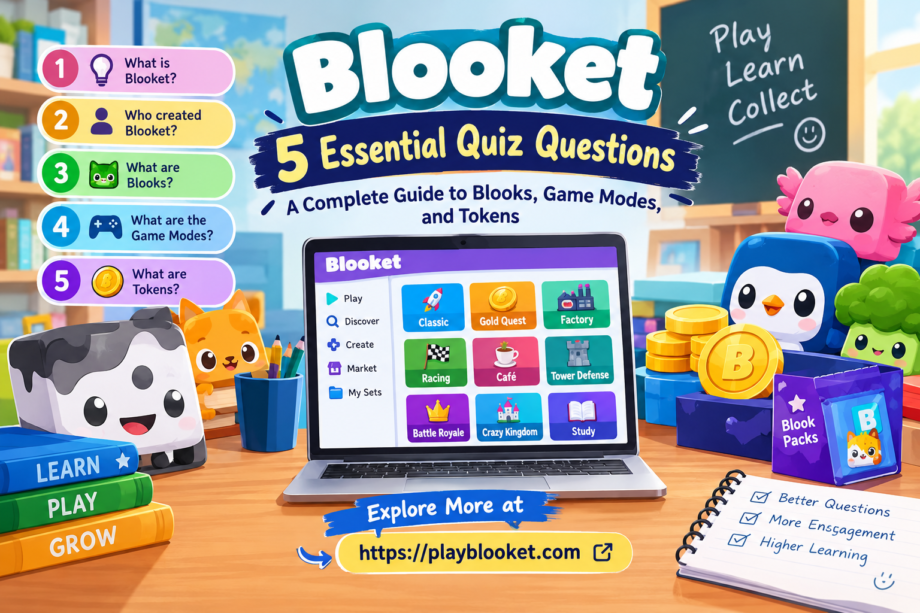
The best way to get started is to explore a few essential quiz questions about the platform itself. These questions cover its purpose, creator, collectible characters, available game modes, and virtual currency. Each topic explains an important part of the experience and helps new players understand how the different features work together.
Blooket is more than a collection of online activities. Teachers can use it to review lessons, students can practise important concepts, and groups can compete while answering educational prompts. Instead of separating studying from entertainment, the platform connects both through different gameplay experiences.
This guide answers five important questions in detail. By the end, readers will understand what Blooket offers, how Blooks fit into the experience, why game modes matter, and how tokens help players build their collections.
These quiz questions help beginners understand Blooket’s main features before joining their first game.
1. What Is Blooket?
Blooket is an online educational gaming platform that combines learning questions with interactive gameplay. Teachers can create their own question sets or select existing sets from the platform’s library. They can then choose a compatible game mode and invite students to participate in a live session or complete an activity independently.
The main idea is straightforward: students answer questions while playing a game. Their responses help them progress through the activity, earn rewards, or compete with other participants, depending on the selected mode.
For example, a teacher reviewing a science chapter might prepare questions about planets, gravity, and the solar system. Students can answer these questions during a classroom game rather than completing an ordinary worksheet. A mathematics teacher could use the same approach for multiplication, fractions, or basic algebra.
This flexibility makes Blooket useful across several subjects. Language teachers can prepare vocabulary activities, history teachers can review important events, and science teachers can test students’ understanding of key terms.
How Does Blooket Work?
The experience generally begins with a question set. Teachers can find an existing set or create one that matches their lesson objectives. Once the questions are ready, they select an available game mode and configure the session.
Students can join a hosted game using the information provided by the teacher. Depending on the activity, they may use a game ID, QR code, or joining link. An account is not required for students to participate in every hosted game, although an account provides additional features, including personal progress tracking and collecting Blooks.
The gameplay changes according to the chosen mode. Some activities focus on speed and accuracy, while others introduce strategy, resource management, or competition. The educational questions remain an important part of the process.
Teachers can also review performance information after supported activities. These reports may help identify questions that students found difficult and topics that need further explanation.
Teachers can create quiz questions that match their lesson objectives and help students practise important concepts.
Why Are Quiz Questions Important in Blooket?
Well-prepared quiz questions make the learning experience more effective because they connect the game to a clear educational goal. A visually exciting activity may attract attention, but meaningful questions help students remember concepts and identify gaps in their knowledge.
For instance, a question asking students to identify the correct definition of evaporation can reinforce a science lesson. A question requiring them to solve a multiplication problem encourages active practice rather than passive reading.
Teachers should aim for questions that are clear, accurate, and appropriate for the students’ age and ability. Very easy questions may fail to challenge learners, while unnecessarily complicated wording can create confusion.
A balanced set can include basic recall, short calculations, practical examples, and questions requiring students to apply what they have learned. This variety makes a session more engaging without losing its educational purpose.
Blooket is also useful for informal revision. Students can revisit topics before a test, practise with classmates, or work through assignments when a teacher makes them available. The game format can make repetition feel less monotonous.
However, winning should not be the only measure of success. A student who answers carefully and learns from mistakes may gain more educational value than someone who simply responds quickly.
2. Who Created Blooket?
Blooket was created by Tom Stewart, who developed the platform to make learning more engaging through games. Its development reflects an idea that many educators appreciate: reviewing information does not always have to involve traditional worksheets, flashcards, or repetitive exercises.
The platform grew around the connection between educational content and playful competition. Instead of building a separate activity for every subject, Blooket allows users to create or discover question sets and connect them with different gameplay experiences.
This approach makes the platform adaptable. A question set about geography can support a classroom review, while another set covering vocabulary can help students practise language skills. The content changes, but the basic system remains familiar.
What Makes the Idea Behind Blooket Useful?
The concept behind Blooket addresses a common classroom challenge: keeping students interested while ensuring they actually learn the material.
Some students enjoy competition, while others prefer independent practice. Different game modes offer alternatives that may appeal to different learners. Teachers can also adjust their question sets to match the material currently being taught.
For example, a class preparing for a history examination might use a set containing questions about historical figures, dates, and major events. Students answer these prompts while the game provides a more interactive structure for revision.
This does not mean every learner will prefer games or that every game automatically improves academic performance. The value depends on the quality of the questions, the way the teacher uses the platform, and whether students receive opportunities to understand their mistakes.
How Teachers and Students Benefit
Teachers can use the platform to introduce a topic, check understanding, or revisit difficult material. Creating a question set around specific lesson objectives helps keep the activity relevant.
Students benefit from active participation. Rather than only reading an answer, they must recall information and select or enter a response. Repeated practice can help them recognise concepts they understand well and identify areas requiring more attention.
Teachers can also use the results to guide follow-up instruction. If a large portion of the class struggles with a particular question, the teacher can explain that concept again before moving to a new lesson.
The strongest approach is to treat Blooket as a supporting educational tool rather than a replacement for teaching. Discussions, explanations, reading, and independent practice remain valuable parts of learning.
When educators combine these methods, classroom games can become a useful addition to an effective lesson plan.
3. What Are Blooks?
Blooks are the collectible characters used throughout Blooket. They add a visual and collection-based element to the platform, giving players something to unlock and collect while participating in educational activities.
Their appearance and rarity can vary. Some Blooks are easier to obtain, while others are harder to find through particular packs or special releases. Collecting them can become an enjoyable side activity for students who like discovering new characters.
Blooks are not the same thing as question sets. A question set contains the educational material that players answer, whereas Blooks are part of the platform’s collectible character system.
This distinction is important for new users. Players do not need a large collection to benefit from the educational activities. The central learning experience still depends on answering questions and engaging with the material.
Well-designed quiz questions allow students to focus on learning while enjoying the platform’s collectible features.
How Can Players Collect Blooks?
Players can use the Blooket Market to explore available packs and other collectible items. Tokens earned through gameplay can be spent on eligible items, including packs that provide opportunities to unlock new Blooks.
The general process is simple:
- Open the Market from the relevant area of your Blooket account.
- Browse the available Blook Packs.
- Check the pack’s cost and the Blooks it may contain.
- Choose a pack you want to open.
- Spend the required tokens and reveal the items.
- Collect any newly unlocked Blooks and review your collection.
The exact items available may change as the platform updates its Market or introduces seasonal content. Checking the displayed information before spending tokens helps players understand what a particular pack offers.
Opening a pack does not guarantee that every player will receive the same character. Some items are rarer than others, which makes collecting partly dependent on chance.
Why Do Students Enjoy Collecting Blooks?
Collecting adds a personal goal to the learning experience. A student might want to discover a particular character, complete a collection, or compare available Blooks with friends.
For some players, this creates another reason to participate in activities. They may become more interested in earning rewards after completing a session or improving their performance.
Nevertheless, collection goals should remain secondary to learning. Students do not need rare characters, expensive accounts, or a complete collection to enjoy the platform’s educational features.
When preparing quiz questions for younger learners, teachers can focus on educational outcomes rather than the rarity of a player’s characters. This keeps classroom activities inclusive and helps students understand that learning matters more than virtual possessions.
Do Blooks Affect Learning?
Blooks mainly add a collectible and visual dimension to the experience. Their appeal may encourage some students to participate, but the characters themselves do not replace the educational content.
A student studying fractions still needs to understand numerators, denominators, and equivalent values. A student learning geography must still recognise locations and understand relevant facts.
The best results come when teachers connect rewards with meaningful participation. Completing an activity, reviewing mistakes, and improving understanding are more valuable goals than collecting every available character.
4. What Are the Different Blooket Game Modes?
Choosing suitable quiz questions makes every Blooket game mode more useful for classroom revision.
Game modes determine how a Blooket activity works. They influence the rules, objectives, pace, and interactions players experience while answering questions.
The platform offers a range of options, including competitive games, strategy-based activities, and modes intended for solo practice or homework. Availability can differ according to the type of session and account plan, so users should check the current options when setting up a game.
Classic
Classic is a straightforward competitive mode. Players answer questions and try to earn points by responding correctly. Its simple structure makes it a useful starting point for students who are unfamiliar with Blooket.
Teachers can use Classic for short reviews, vocabulary checks, and classroom revision. Because the format is easy to understand, students can focus on the subject matter instead of learning complicated game rules.
Gold Quest
Gold Quest combines answering questions with collecting virtual gold. Players encounter rewards and game events that can change their totals, adding an element of unpredictability.
This mode can create excitement during group revision. However, the final standings may reflect game events as well as academic performance, so teachers should not use the leaderboard alone to evaluate what students know.
Factory
Factory introduces a strategy element. Players answer questions and use the results to develop and upgrade their virtual factory.
The mode can appeal to students who enjoy planning and making decisions. Each correct response contributes to progress within the game, while upgrades add another objective beyond answering questions.
Factory is a useful example of how educational gameplay can combine recall with resource management.
Racing
Racing focuses on progressing through a race by answering questions. Correct responses help players move toward the finish line, creating a clear connection between answering and advancement.
Because the objective is easy to understand, Racing can work well for quick review sessions. Teachers should still make sure students prioritise accuracy rather than rushing through every question.
Café
Café asks players to manage a virtual food-serving environment. Students answer questions as part of the process of serving customers, restocking supplies, and improving their café.
The additional tasks make the experience different from a simple question-and-answer game. Students who enjoy management-style activities may find this format particularly appealing.
Tower Defense
Tower Defense combines answering questions with building and upgrading defensive structures. Players work toward protecting their area against incoming waves of enemies.
This mode requires more planning than a basic quiz game. Students need to respond to questions while also making decisions about how to develop their defence.
Battle Royale
Battle Royale centres on direct competition between players or teams. Participants answer questions and try to outperform their opponents according to the mode’s rules.
It can create an energetic atmosphere during classroom activities. Teachers should consider the group and the subject when deciding whether a highly competitive format is appropriate.
Crazy Kingdom and Study
Crazy Kingdom focuses on managing a kingdom and responding to different requests. It encourages players to consider choices and manage resources while progressing through the activity.
Study, by contrast, concentrates on answering questions without the usual game mechanics. This makes it suitable for learners who want a more direct practice experience.
The availability of individual modes may change, and some are restricted to particular session types or subscriptions. The official Blooket game-mode guide provides the latest details.
How Should You Choose a Game Mode?
Choosing a mode should depend on the learning objective rather than popularity alone.
- For a quick classroom review, try a straightforward mode such as Classic.
- For a more unpredictable group activity, consider Gold Quest.
- For students who enjoy planning, explore Factory or Tower Defense.
- For a direct practice session, consider Study where available.
- For a competitive activity, choose a suitable mode and establish clear classroom expectations.
Teachers should also consider the amount of time available, students’ ages, and the complexity of the subject. A short vocabulary review may need a different structure from a longer science revision session.
Well-designed quiz questions remain essential in every mode. If the questions are inaccurate, confusing, or unrelated to the lesson, changing the game mechanics will not solve the underlying problem.
A good question set supports the lesson, while the game mode determines how students interact with it.
Teachers should select quiz questions that match the difficulty level, subject, and learning goals of their students.
5. What Are Tokens in Blooket?
Tokens are a form of virtual currency in Blooket. Players earn them through eligible gameplay and can use them to obtain collectible items through the Market.
One of their main purposes is opening Blook Packs. These packs give players opportunities to discover new characters and expand their collections. Depending on the current Market, tokens may also be used for other available items.
Tokens therefore provide a link between participation and collecting. Students can play educational activities, earn rewards, and decide which eligible packs or items they would like to obtain.
After earning tokens, students can continue practising with quiz questions and explore more educational activities.
How Do Players Earn Tokens?
According to Blooket’s help documentation, tokens are awarded after games, alongside experience points. The amount earned can depend on the applicable game and reward rules.
The platform also describes a daily opportunity to earn additional tokens through its Daily Wheel. Account plans and current reward limits can affect the details, so players should consult the official help centre for up-to-date information.
The general approach is to participate in eligible games and check the account after the session. Tokens earned through gameplay can then be used in the Market.
Players should be cautious about websites or videos claiming to offer unlimited tokens through unofficial generators. These claims may be misleading and can put account information at risk. Using the official platform is the safer option.
How Are Tokens Used to Open Boxes?
Opening packs is one of the most recognisable parts of collecting Blooks. A player selects an available pack, checks its price, and spends the required number of tokens.
The pack then reveals the available rewards. Depending on its contents and rarity system, a player might receive a familiar character or discover something less common.
Before opening packs, it is useful to review their details. Different packs can contain different Blooks, and a higher price does not necessarily mean that a particular character is guaranteed.
Players who want to build a collection can decide which packs interest them most and save their tokens accordingly.
Are Tokens the Same as Experience Points?
No. Tokens and experience points serve different purposes.
Tokens function as virtual currency for eligible purchases in the Market. Experience points, often called XP, contribute to account progression and related platform features.
Although both can be earned through gameplay, they should not be confused with one another. Having more XP does not automatically mean that a player has the same amount of spending currency.
Understanding this difference helps beginners manage their rewards and make informed choices about collecting.
Can Tokens Improve Educational Performance?
Tokens are rewards, not a direct measurement of academic understanding. A player may earn tokens through participation, but the currency alone does not prove that the player has mastered a topic.
For teachers, educational progress is better evaluated through students’ responses, their ability to explain concepts, and their improvement over time.
Students can enjoy collecting while still treating the main activity seriously. The most useful approach is to view tokens as an optional extra rather than the primary reason for learning.
Tips for Creating Better Blooket Learning Activities
Understanding the platform is only the first step. The quality of the learning experience also depends on how the activities are prepared and used.
Keep Questions Clear and Accurate
Each question should communicate one main idea. Avoid unnecessary wording, confusing answer choices, and information that students have not yet studied.
Before sharing a set, check the facts and confirm that the intended answer is correct. This is especially important when creating activities for science, mathematics, history, or other subjects where small errors can cause misunderstandings.
Match Difficulty to the Learners
A useful question set includes an appropriate level of challenge. Begin with straightforward material when introducing a topic, then gradually include questions that require deeper understanding.
Students who are new to a subject may need simple definitions and examples. More experienced learners can benefit from application-based questions and problems that require several steps.
Use Different Question Styles
Repeating the same type of question throughout an entire activity can make the experience predictable. Consider combining definitions, factual recall, calculations, and real-world examples where appropriate.
These different quiz questions can help teachers see whether students remember information and whether they can apply it in a new situation.
Review Results After Playing
A completed game can provide useful information about student understanding. Look for topics where several learners struggled and use those results to guide follow-up teaching.
If students repeatedly miss a question, check whether the concept needs further explanation or the wording needs improvement. A mistake can be an opportunity to learn rather than simply a reason to lose points.
Keep Competition Friendly
Competition can increase excitement, but not every student responds to it in the same way. Teachers should create an environment where students feel comfortable participating and making mistakes.
Recognising improvement, effort, and thoughtful answers can make activities more welcoming. Students should understand that learning and progress matter more than finishing first.
Frequently Asked Questions About Blooket
1. Can students play Blooket without creating an account?
Yes. According to Blooket’s help centre, students can join a hosted game using the provided game ID, QR code, or link without logging in. Creating an account provides additional features, including collecting Blooks and tracking personal statistics.
2. Are all Blooket game modes available to everyone?
Not necessarily. Availability can depend on whether an activity is hosted live, assigned as homework, played solo, or accessed through a particular account plan. The current mode list should be checked before organising an activity.
3. Do players need tokens to answer questions?
No. Tokens are a reward currency used for eligible Market items. Players can participate in educational activities without needing to spend tokens to answer questions.
4. What is the difference between a Blook and a question set?
A Blook is a collectible character, while a question set contains the educational prompts used during gameplay. Both are part of the Blooket experience, but they serve different purposes.
5. How can teachers make activities more useful?
Teachers should choose questions that match their learning objectives, select an appropriate game mode, and review the results afterward. Explaining incorrect answers can be just as valuable as celebrating correct ones.
Conclusion
Blooket brings together educational content, interactive games, collectible characters, and virtual rewards in one platform. Understanding its basic features helps students participate more confidently and allows teachers to plan activities that support classroom learning.
The five topics explored in this guide explain the platform’s main components: what Blooket does, who created it, how Blooks work, which game modes are available, and why tokens matter. Each feature contributes to the overall experience, but meaningful learning still depends on accurate content and thoughtful participation.
When preparing quiz questions, educators should focus on clarity, relevance, and the skills they want students to practise. Game modes can make revision more enjoyable, Blooks can add a collection goal, and tokens can provide optional rewards. None of these features replaces understanding the subject itself.
Regular practice with quiz questions can help learners review lessons, recognise mistakes, and build confidence over time.
The best way to use Blooket is to combine its interactive features with purposeful teaching and regular review. With a well-prepared question set and a suitable game mode, students can practise important concepts, learn from mistakes, and make revision feel more engaging.
