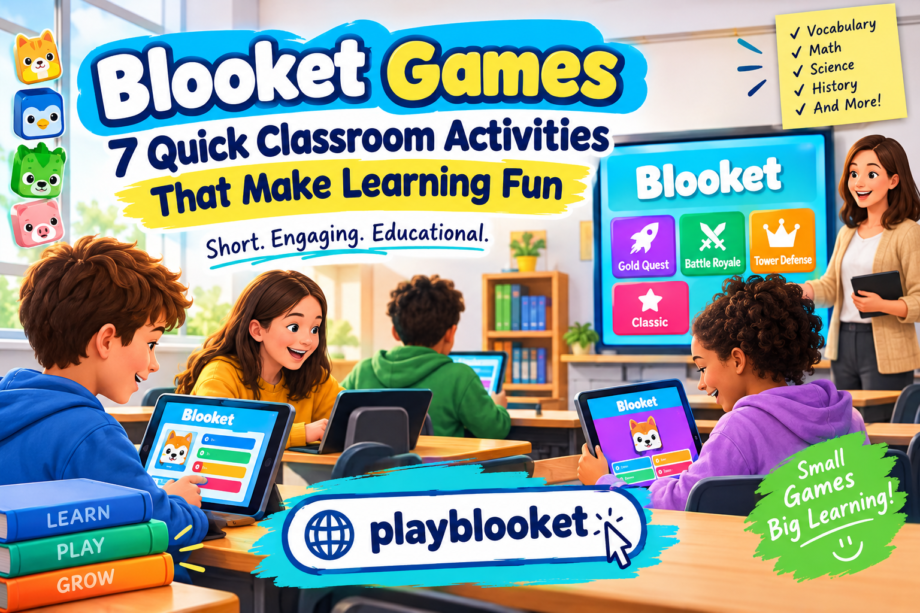
A classroom does not need a complicated lesson plan to make learning enjoyable. Sometimes, a short activity between lessons is all it takes to refresh students’ attention and bring energy back into the room. Blooket games are a useful option for these moments because they combine educational questions with interactive challenges that students can join without a lengthy introduction.
Teachers often need activities for the final minutes of a lesson, a short break between subjects, or a day when the usual schedule changes unexpectedly. Instead of asking students to sit quietly while waiting for the next task, educators can use a quick review game to keep their minds active. With the right question set, even a five-minute session can reinforce important concepts.
The best part is that these activities can be adapted to different subjects and age groups. A teacher might review multiplication facts with younger learners, revisit vocabulary with language students, or ask history questions before an upcoming test. The format provides variety while keeping the educational goal clear.
This guide explores seven quick activity ideas, practical classroom tips, and ways to make short learning sessions productive without turning every spare minute into another formal lesson.
Why Blooket Games Work Well as Filler Activities
Filler activities are short tasks that fit into small gaps in a schedule. They are especially helpful when students finish their work early, a lesson ends sooner than expected, or a teacher needs a simple transition between two topics.
Traditional filler tasks can sometimes feel like extra homework. An interactive quiz offers a different experience because students respond to questions while participating in a game. They have a reason to pay attention, recall information, and keep trying when they make a mistake.
Another advantage is flexibility. Teachers can choose questions related to a recent lesson rather than introducing an entirely new topic. This helps students revisit information they have already encountered and gives educators another opportunity to notice which concepts need clarification.
Blooket games can also support different classroom routines. A teacher might run a short activity with the whole class, use it during a review session, or offer it to students who complete their assignments ahead of schedule. The activity does not have to replace instruction; it can complement the main lesson.
However, a game is most useful when its length and difficulty match the situation. A quick activity should have a clear beginning and ending, straightforward instructions, and questions that students can reasonably answer with the knowledge they have learned.
1. Start With a Five-Minute Knowledge Challenge
A five-minute knowledge challenge is one of the easiest activities to prepare. Select a question set covering a topic students recently studied, explain the rules briefly, and let the class answer as many questions as the available time allows.
For example, a science teacher might use questions about the water cycle, plant structures, or the states of matter. An English teacher could focus on punctuation, spelling, or word meanings. Mathematics lessons might use basic calculations or mental arithmetic.
The purpose is not to test every detail. Instead, the activity gives students a quick opportunity to retrieve information from memory. Recalling a fact can help reinforce learning, especially when the teacher reviews confusing answers afterward.
Keep the questions focused on one topic whenever possible. A short session becomes less effective when students have to switch between unrelated subjects without enough time to think.
When using Blooket games as a five-minute challenge, prepare the activity before students begin. Check that the questions are appropriate, the instructions are easy to understand, and the chosen format fits the time available.
2. Use Vocabulary Races for Language Practice
Vocabulary practice is another excellent way to fill a short gap in the school day. Students frequently need repeated exposure to unfamiliar words before they can recognize and use them confidently.
Create a question set that includes definitions, synonyms, antonyms, spelling, or example sentences. For a foreign-language lesson, questions could ask learners to match words with meanings or identify the correct translation.
Teachers can make this activity more useful by selecting words from the current reading assignment. Students then revisit the vocabulary in a different format instead of simply copying definitions into a notebook.
After the game, ask learners to choose two or three words they found difficult. They can write original sentences, explain the meanings to a partner, or identify the words in a passage they have already read.
This final step connects the game to practical language use. Without it, students may remember an answer temporarily without understanding how to apply the word in context.
Blooket games can make vocabulary revision feel less repetitive, but students still benefit from reading, writing, speaking, and listening activities alongside digital quizzes.
3. Turn Mathematics Revision Into a Mental Workout
Mathematics is well suited to short practice sessions because many skills improve through regular repetition. A few carefully selected questions can help learners strengthen their recall of number facts, fractions, decimals, percentages, or simple equations.
Start with questions that match the class’s current level. Younger learners may benefit from addition and multiplication facts, while older students could review algebraic expressions or geometric terminology.
Try organizing questions into three levels:
- Warm-up: Simple calculations that help everyone get started.
- Practice: Questions that require an extra step or a little more thought.
- Challenge: A few harder problems for students who are ready to extend their understanding.
This progression makes the activity more approachable than presenting difficult problems immediately. It also gives the teacher a chance to notice whether the class is ready to move forward or needs additional practice.
Remember that speed is not the same as understanding. Some students calculate accurately but need more time, and others may answer quickly without checking their reasoning. Discussing one or two challenging problems after the session helps keep accuracy at the center of the activity.
When choosing Blooket games for mathematics, check that the question format allows students to understand what is being asked. For multi-step problems, you may need to explain the solution outside the game.
4. Make Early-Finisher Time More Meaningful
Teachers often face a familiar classroom situation: some students finish an assignment while others are still working. The early finishers need something worthwhile to do, but the next major lesson may not be ready to begin.
A short educational game can provide a useful option. It gives early finishers a structured activity without requiring the teacher to prepare a separate worksheet for every student.
The key is to establish expectations in advance. Explain when students may begin the activity, whether they should use headphones, how loudly they may communicate, and what they should do when the session ends.
You can also create a small collection of question sets for different subjects. Students might choose from approved mathematics, reading, science, or general knowledge activities, depending on what they have already studied.
Avoid using the game as a reward that is always available only to the fastest students. Learners who need additional time deserve the opportunity to finish their work without feeling rushed. The activity should support classroom organization rather than encourage students to sacrifice careful work for speed.
With clear routines, Blooket games can help teachers manage spare time while keeping early finishers engaged in an educational task.
5. Add a Quick Science or History Review
Some subjects involve many details that students must remember over time. Science terminology, historical dates, geographical features, and important people can all benefit from regular revision.
A short quiz offers a convenient way to revisit these details between larger lessons. A history teacher could prepare questions about a historical period, while a geography teacher might review countries, capitals, landforms, or map terminology.
For science, the questions could focus on vocabulary and basic concepts from a recent experiment. Students might identify the purpose of a laboratory tool, recognize a stage of a process, or distinguish between two related terms.
Try including questions that ask students to apply their knowledge rather than simply memorize isolated facts. For instance, instead of asking only for the definition of evaporation, ask learners to identify an everyday example of evaporation.
Teachers should also be mindful of accuracy. Check the question set before using it, especially when it comes from a public collection. An incorrect answer or confusing explanation can reinforce a misconception if it goes uncorrected.
These short activities are most effective when they connect directly to classroom learning. A few minutes of review can prepare students for the next lesson and reveal topics that deserve another explanation.
6. Try a Team-Based Challenge
Competition can add excitement, but not every classroom activity needs to focus on individual scores. A team-based challenge offers another way to encourage participation and cooperation.
Divide the class into small groups when the selected activity and classroom setup allow it. Students can discuss possible answers, explain their reasoning, and help one another remember previously taught material.
To make the activity inclusive, rotate responsibilities. One learner might read the question, another might explain the reasoning, and a third could help the group check its final choice.
Teachers should set a few simple rules before starting. Encourage respectful communication, discourage teasing about incorrect answers, and remind students that the purpose is learning rather than proving who is the smartest.
You can also award recognition for different achievements. A class might celebrate careful reasoning, steady improvement, helpful teamwork, or thoughtful explanations instead of focusing exclusively on the highest score.
When planning Blooket games for group participation, consider whether the chosen mode supports your intended team arrangement. Available features and rules can vary by game mode, so review the setup rather than assuming every format works identically.
7. End the Lesson With an Exit Review
A short exit review is useful when a lesson finishes a few minutes before the next class begins. Rather than ending abruptly, teachers can use the remaining time to check what students remember from the day’s instruction.
Choose five to ten questions that cover the main learning objectives. Keep them short enough to fit the remaining time and avoid introducing unfamiliar material at the last moment.
Afterward, ask students to identify one idea they understand well and one topic they would like to review. Their responses can help the teacher plan the next lesson.
An exit review also works as an informal check for understanding. If many learners struggle with the same question, the teacher has a clear signal that the concept may need another explanation.
The results should not automatically be treated as a formal assessment. A quick game provides only a snapshot of performance, and factors such as reading speed, device access, and familiarity with the activity can affect the outcome.
Used thoughtfully, Blooket games can turn the final few minutes of class into a purposeful review instead of unstructured waiting time.
How to Choose the Right Activity for Your Classroom
Not every game is appropriate for every moment. A useful filler activity should match the time available, the students’ learning needs, and the classroom environment.
Before starting, consider these questions:
How much time do you have? If only three to five minutes remain, choose a short question set and avoid a complicated setup. A longer review session can accommodate more questions and discussion.
What should students practise? Decide whether the goal is vocabulary recall, mathematical fluency, factual knowledge, or a general review. A clear purpose makes it easier to select suitable content.
Can everyone participate? Check device availability, internet access, school rules, and any accessibility needs. Have a non-digital alternative ready when students cannot participate online.
Is the content accurate? Review questions and answers before presenting them. Publicly available question sets may vary in quality, so they should not be treated as automatically reliable.
What happens after the game? A brief discussion, written reflection, or explanation of a difficult question can help turn an entertaining activity into a meaningful learning experience.
These checks do not need to take long. Once a teacher has established a routine and prepared a few reliable question sets, selecting a suitable activity becomes much easier.
How to Join and Play Blooket Games
The joining process depends on whether a teacher is hosting a live session or assigning work for students to complete independently.
For a live session, the teacher typically selects a question set, chooses an available game mode, configures the activity, and starts the game. Students then follow the host’s instructions to access the session using the joining information provided.
A typical student workflow looks like this:
- Open the official Blooket website using a supported browser.
- Ask the teacher for the current game code or joining instructions.
- Enter the code on the appropriate joining page.
- Follow the prompts displayed on the screen.
- Read each question carefully and select the answer that best fits.
- Follow the teacher’s directions when the activity finishes.
Exact screens and requirements may change as the platform updates. Some activities may require different steps, and account requirements can depend on how the session is organized. Students should use the official website and avoid sharing personal information on unfamiliar pages.
For homework assignments, the teacher may provide a link and instructions instead of asking students to join a live session. Students should follow the assigned instructions, check any deadline, and complete the activity according to classroom expectations.
Tips for Keeping Short Games Educational
The most successful filler activities are easy to start, but they still need a little planning. A few simple habits can make the difference between a distracting break and a useful review session.
First, establish a time limit. Students should know when the activity starts, how long it will last, and what they need to do afterward.
Second, keep the content connected to learning objectives. A question set based on a recent lesson is usually more valuable than an unrelated collection of trivia when the goal is academic revision.
Third, provide opportunities to learn from mistakes. When time permits, discuss an incorrect answer and explain the correct reasoning. This helps students understand the material instead of concentrating only on scores.
Fourth, balance competition with encouragement. Public rankings may motivate some learners but make others uncomfortable. Choose activities and classroom rules that suit the group, and avoid embarrassing anyone for a low score.
Finally, do not use every spare minute for a screen-based task. Students sometimes need a quiet break, a conversation, movement, or time to organize their materials. Digital activities are one option among many, not a replacement for every other classroom routine.
Common Mistakes Teachers Should Avoid
Even a simple classroom game can become frustrating if the setup does not match students’ needs.
One common mistake is choosing a question set that is too difficult. Students may disengage when they cannot answer enough questions to understand the activity. Begin with familiar material and introduce harder questions gradually.
Another problem is allowing the game to run longer than intended. Filler activities should fit around the lesson rather than interrupt the next scheduled task. Set a clear stopping point and stick to it.
Teachers should also avoid assuming that a high score proves complete understanding. Students may guess correctly, recognize familiar wording, or perform well because they have played a similar activity before. Use other classroom evidence when evaluating learning.
Technical preparation matters, too. Check the connection, confirm the correct session, and explain how students should respond if a device stops working. A backup question or short paper activity can prevent a minor technical issue from wasting the remaining time.
Finally, do not overlook privacy and school policies. Use appropriate classroom settings, follow the platform’s current terms, and ensure students understand which information should remain private.
Frequently Asked Questions
Are Blooket games suitable for short classroom breaks?
Yes. Teachers can select a small question set and use an available mode for a brief review. The activity should fit the remaining time and have a clear educational purpose.
Can teachers use these activities for different subjects?
Yes. Question sets can cover mathematics, science, vocabulary, history, geography, and other topics. Teachers should review the content to ensure it matches the class’s level and learning objectives.
Do students always need an account to join?
Requirements can depend on the activity and the platform’s current rules. In many hosted sessions, students can join using a game code and the host’s instructions, but teachers should check the current official guidance.
Are quick quiz activities a replacement for regular lessons?
No. They are best used to reinforce learning, revisit important information, or fill short gaps in the schedule. They do not replace detailed instruction, independent practice, or meaningful classroom discussion.
How can teachers make the activity fair?
Choose suitable questions, establish respectful behavior, and consider different participation needs. Offer alternatives when students lack a compatible device or reliable internet access, and avoid making speed the only measure of success.
Final Thoughts
Small classroom moments can still support meaningful learning. A short review can help students revisit a difficult concept, practise useful vocabulary, or remember information from a previous lesson without requiring another full-length assignment.
The most effective activities are the ones that fit naturally into the school day. Teachers should select suitable questions, explain the rules, respect students’ different needs, and leave enough time to discuss important answers.
With thoughtful planning, blooket games can provide a convenient way to make spare classroom minutes more engaging. Whether the goal is a quick mathematics challenge, a vocabulary race, or an end-of-lesson review, the activity should always support the learning taking place beyond the screen.
