
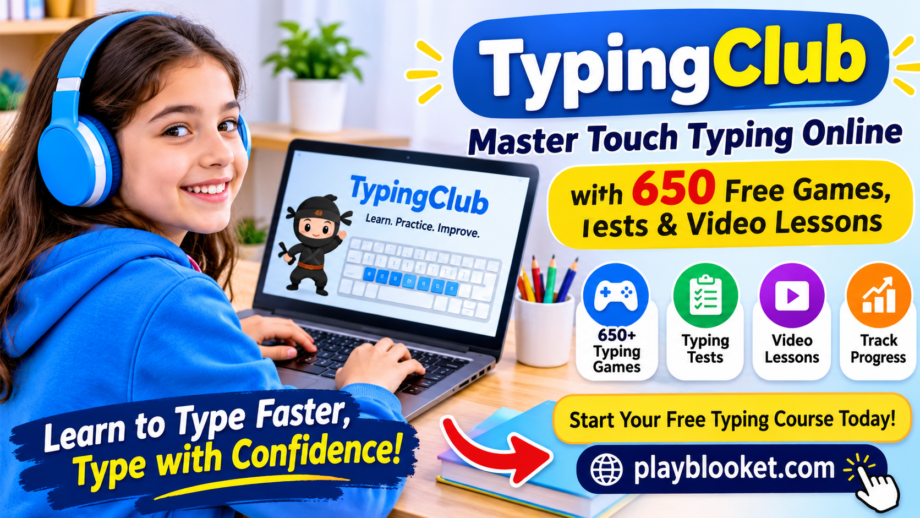
Learning to type quickly and accurately is an important skill in today’s digital world. Whether someone is preparing school assignments, completing office tasks, writing emails, or working on online projects, good typing skills can save valuable time. However, developing speed without sacrificing accuracy requires regular practice and the right learning environment. This is where typing club becomes a useful resource for beginners, students, teachers, and anyone interested in improving their keyboard skills.
Instead of learning through complicated instructions or memorizing keyboard layouts, learners can follow structured lessons that introduce each key gradually. The platform combines interactive exercises, typing games, progress tracking, tests, and instructional videos to make the learning process more enjoyable. Its free typing courses provide an accessible way to understand touch typing without needing expensive software or specialized equipment.
With hundreds of interactive activities, including approximately 650 typing games, learners have different opportunities to practice and develop their abilities. The combination of structured lessons and entertaining challenges makes the experience suitable for different ages and skill levels.
What Is TypingClub and How Does It Work?
Typing club is an online typing education platform designed to help people learn touch typing through guided lessons and practical exercises. Touch typing means using your fingers to type without constantly looking down at the keyboard. Rather than searching for individual letters, learners gradually develop muscle memory and become familiar with the position of every key.
“Typing club provides a beginner-friendly learning experience for anyone who wants to develop reliable keyboard skills.”
The platform introduces keyboard skills through a step-by-step learning system. Beginners usually start with basic finger placement before moving toward more complicated exercises. As they become comfortable with individual letters, they can practice complete words, sentences, numbers, and punctuation.
One useful feature is its structured approach. Instead of presenting every keyboard key at once, lessons introduce new skills progressively. This helps learners understand which fingers should control particular keys and how to maintain a comfortable typing position.
Another advantage is accessibility. Since lessons are available online, learners can practice from a compatible computer or laptop without installing complicated desktop programs. This makes it convenient for students working at home and teachers organizing classroom activities.
Why Learning Touch Typing Matters
Typing is no longer limited to professional writers or office employees. Students use keyboards for research, assignments, presentations, communication, and online learning. Professionals depend on typing for reports, customer communication, documentation, and everyday administrative responsibilities.
Developing touch typing skills can make these activities easier.
Here are several reasons why learning to type correctly is worthwhile:
1. Better productivity: People who type comfortably can complete written tasks more efficiently. Instead of searching for keys, they can concentrate on the information they want to communicate.
2. Improved accuracy: Proper finger placement reduces unnecessary mistakes. With consistent practice, learners become more familiar with keyboard positions and develop better control.
3. Greater confidence: Beginners sometimes feel uncomfortable when typing in front of others or completing timed assignments. Regular exercises help remove this hesitation.
4. Useful for education: Students frequently prepare homework, research documents, and online assessments. Strong typing skills can make these activities less time-consuming.
5. Valuable for professional development: Many modern careers involve computers. Faster and more accurate typing can support administrative work, content creation, data entry, and communication.
Using typing club as part of a regular learning routine can help beginners develop these abilities gradually rather than expecting immediate results.
“Regular typing club practice can help learners become more comfortable with everyday computer activities.”
Explore Free Typing Courses for Different Skill Levels
One of the most helpful aspects of the platform is its organized course structure. People do not need to understand the entire keyboard before starting. Lessons introduce essential skills in manageable sections, allowing learners to build confidence over time.
Beginner Lessons: Understanding the Keyboard
Beginners should start by learning the home row. These are the middle-row keys where the fingers normally rest when using the standard QWERTY keyboard.
The left-hand fingers are positioned over A, S, D, and F, while the right-hand fingers rest over J, K, L, and the semicolon key. The thumbs are generally used for the spacebar.
At first, remembering the correct finger positions may feel uncomfortable. This is completely normal. New learners should focus on accuracy instead of trying to achieve impressive typing speeds immediately.
Early lessons provide opportunities to repeat individual letters and simple combinations. Repetition helps the brain recognize keyboard positions and gradually builds muscle memory.
“Typing club makes these beginner exercises easier to follow through its organized learning structure.”
Intermediate Lessons: Building Speed and Accuracy
Once learners understand the home row, they can move toward exercises involving additional letters and complete words.
These activities encourage students to use the correct fingers while maintaining a consistent rhythm. They may also include longer sentences that require attention to spacing, capitalization, and punctuation.
Intermediate learners should avoid looking down at their hands whenever possible. Although this habit can be difficult to break, practicing without constantly watching the keyboard is an important part of developing touch typing.
“Students can use typing club exercises to improve their typing rhythm and reduce common keyboard mistakes.”
Advanced Lessons: Typing with Confidence
Advanced exercises are designed for learners who already understand the keyboard layout and want to improve their performance.
These lessons can involve longer passages, more complicated vocabulary, numbers, symbols, and punctuation. They help users develop better control when typing different types of content.
For people who already have basic keyboard experience, typing club offers a structured environment for strengthening existing skills and identifying areas that need additional attention.
“Typing club also gives experienced learners an opportunity to strengthen their existing typing habits.”
Discover 650 Typing Games for More Enjoyable Practice
Traditional typing exercises can become repetitive, especially for younger learners. Games provide another way to practice keyboard skills while keeping the experience interesting.
The platform includes approximately 650 typing games, offering a wide range of activities for users who enjoy learning through interactive challenges.
“Typing club games introduce entertaining ways to practice keyboard recognition and improve typing confidence.”
Rather than repeatedly entering the same letters, players can participate in activities that connect typing accuracy with game objectives. These challenges encourage learners to recognize letters, type words, and respond to on-screen instructions.
Some activities are particularly suitable for children because they introduce keyboard practice through colorful visuals and simple objectives. Other challenges may appeal to older students who want to improve their speed.
Games can also encourage healthy competition. Learners may try to improve their previous results or complete challenges more accurately than before.
However, entertainment should not become the only learning objective. Players should remember that correct finger placement and accuracy are more important than simply completing a game as quickly as possible.
Using games alongside structured lessons creates a balanced learning routine. Students can practice essential skills and then enjoy interactive activities that reinforce what they have learned.
Improve Your Performance with Online Typing Tests
Typing tests are useful because they help learners understand their current performance. Without measuring results, it can be difficult to determine whether regular practice is producing meaningful improvements.
A typical typing test measures two important factors: words per minute (WPM) and accuracy.
Understanding Words Per Minute
Words per minute measures how many standardized words a person can type in one minute. It provides a general indication of typing speed.
For example, someone who types 30 WPM can generally enter more text within a minute than someone who types 15 WPM.
However, speed alone does not tell the complete story. A learner who types quickly but makes frequent mistakes may need additional practice.
Why Accuracy Is Important
Accuracy measures how much of the entered text matches the original material. A high accuracy percentage indicates better control and fewer typing errors.
Beginners should concentrate on reaching a consistent accuracy level before trying to increase their speed.
How Often Should You Take a Typing Test?
Taking a test after several practice sessions can help learners evaluate their progress. Daily testing is not always necessary, especially for beginners who are still learning finger positions.
A practical approach is to complete a short test once or twice a week and compare the results.
Through typing club, learners can combine lessons with testing activities to understand their strengths and weaknesses more clearly.
“With typing club, learners can make typing practice a regular part of their personal development routine.”
Learn Through Instructional Typing Videos
Not everyone learns effectively by reading instructions. Some people understand new techniques more easily when they can watch someone demonstrate them.
Instructional videos provide another learning method by showing keyboard techniques, finger placement, and typing practices.
For beginners, visual demonstrations can make it easier to understand how the hands should move between different keys. They can also explain common mistakes, such as using the wrong fingers or maintaining an uncomfortable wrist position.
Videos are particularly helpful when learners are unsure about posture and keyboard positioning.
A comfortable typing setup should include:
- A keyboard positioned at a natural height.
- Relaxed shoulders and arms.
- Straight wrists without excessive bending.
- Fingers placed comfortably over the home row.
- A screen positioned at a suitable viewing angle.
Learners should also take short breaks during longer practice sessions. Continuous typing without rest can cause discomfort and reduce concentration.
Combining instructional videos with practical exercises gives students different ways to understand and develop their skills.
“Typing club videos and practical exercises offer different ways to understand touch typing techniques.”
How Students Can Use TypingClub for Schoolwork
Schools increasingly use digital technology for teaching, communication, and assessment. Students may need to prepare assignments, complete online quizzes, write essays, and submit documents through educational platforms.
“Typing club can support students who want to become more independent and confident computer users.”
Typing practice can make these responsibilities easier.
Teachers can introduce typing club as a supplementary classroom activity. Students can complete lessons according to their ability and gradually improve their keyboard familiarity.
For younger children, short exercises can be more effective than lengthy practice sessions. Teachers can introduce a small group of keys, allow students to practice them, and then move forward when they demonstrate sufficient understanding.
Older students may benefit from longer exercises involving paragraphs and punctuation.
Typing lessons can also support students who are learning independently. They can practice after school, repeat difficult exercises, and work toward personal improvement goals.
The most important point is consistency. A student who practices for a short period regularly may develop better habits than someone who completes one lengthy session and then stops practicing.
Benefits for Teachers and Educational Institutions
Typing education is not only useful for individual students. Teachers and educational institutions can also benefit from providing organized keyboard practice.
A structured online platform gives educators an opportunity to introduce typing skills without creating every exercise themselves.
Teachers can use lessons as part of computer classes, technology programs, or independent learning activities.
Some useful classroom applications include:
Digital literacy lessons: Introduce keyboard familiarity as a basic computer skill.
Independent practice: Allow students to complete exercises at their own learning pace.
Progress evaluation: Use typing tests and available performance information to understand student development.
Classroom engagement: Include interactive games to make keyboard practice more enjoyable.
Skill development: Encourage students to improve accuracy, speed, and correct finger placement.
Educational institutions can also make typing practice part of a broader digital literacy program. Students who understand keyboard fundamentals may find it easier to use different applications and complete computer-based assignments.
“Teachers can introduce typing club activities to make digital literacy lessons more engaging.”
A Simple Daily Routine to Improve Typing Skills
Learning touch typing requires patience. Instead of practicing randomly, beginners can follow a simple schedule that provides enough repetition without making the process exhausting.
Here is an example of a 20-minute daily routine.
| Practice Activity | Time |
|---|---|
| Home row exercises | 5 minutes |
| New letter combinations | 5 minutes |
| Complete words and sentences | 4 minutes |
| Interactive typing games | 3 minutes |
| Typing test and review | 3 minutes |
This routine gives learners opportunities to practice different skills in a single session.
During the first few days, concentration should remain on finger placement. Once the keyboard layout becomes more familiar, learners can gradually increase their speed.
It is also useful to keep a simple progress record. Write down weekly typing speed and accuracy results to identify improvements.
The purpose of using typing club regularly is not to achieve a particular number immediately. It is to develop reliable habits that make typing feel natural.
Common Typing Mistakes Beginners Should Avoid
New learners often develop habits that make typing more difficult. Recognizing these problems early can help prevent them from becoming permanent.
Looking at the Keyboard Too Frequently
Looking down at every key slows the learning process. Beginners should gradually practice recognizing key positions without relying on their eyes.
Using Only Two Fingers
Some people type by using only their index fingers. Although this method may work for short messages, it can limit speed and efficiency.
Learning to use the correct fingers gives each hand responsibility for specific keyboard areas.
Prioritizing Speed Over Accuracy
Trying to type quickly before understanding the keyboard can create unnecessary mistakes. Accuracy should always come first.
Skipping Difficult Lessons
It is tempting to move forward whenever an exercise becomes challenging. However, repeating difficult lessons can help strengthen weak areas.
Practicing Without Taking Breaks
Long sessions can cause tiredness and reduce concentration. Short, consistent practice sessions are generally easier to maintain.
By avoiding these mistakes, learners can make better use of their online lessons and develop more comfortable typing habits.
“Consistent typing club practice can gradually improve both keyboard familiarity and typing accuracy.”
Is TypingClub Suitable for Children and Adults?
A useful typing education platform should accommodate different learning needs. Children, teenagers, university students, and working professionals may all have different reasons for improving their keyboard skills.
For children, interactive activities can make learning less intimidating. Simple lessons and colorful games may encourage them to practice regularly.
Teenagers can use typing exercises to prepare for school assignments, research projects, and computer-based assessments.
University students may benefit from developing faster typing habits when preparing reports, essays, and academic documents.
Adults can also improve their skills, particularly if their work involves regular computer use. Office employees, freelancers, content writers, and administrative professionals may find touch typing particularly valuable.
The structured approach offered by typing club makes it possible for people with different experience levels to work toward their own learning goals.
Tips for Getting Better Results from Online Typing Courses
Having access to hundreds of exercises is useful, but the way learners approach those activities also matters.
Consider these practical suggestions:
Start with realistic goals: Beginners should focus on learning the keyboard rather than comparing their performance with experienced typists.
Practice consistently: A short daily session can help reinforce keyboard familiarity.
Use proper finger placement: Correct technique is more valuable than developing temporary speed through incorrect habits.
Repeat challenging exercises: Repetition can improve confidence and help learners remember difficult key combinations.
Measure progress: Compare typing speed and accuracy results over several weeks instead of judging improvement after one session.
Maintain good posture: A comfortable position helps learners practice without unnecessary physical strain.
Enjoy the learning process: Games and interactive challenges can provide variety when traditional exercises become repetitive.
These habits can make online typing courses more productive and easier to follow over time.
Why Free Online Typing Education Is Valuable
Not everyone has access to paid computer training programs. Students and families may prefer learning resources that do not require expensive subscriptions.
Free online typing courses help reduce this barrier by providing opportunities to practice essential digital skills through an internet-connected device.
This accessibility is especially valuable for students who want to improve outside school hours. They can revisit lessons, practice difficult keys, and develop their abilities without depending entirely on classroom instruction.
Another advantage is flexibility. Learners can choose when to practice and spend additional time on the exercises they find challenging.
The combination of free lessons, typing games, instructional videos, and testing activities gives typing club a practical role in independent learning.
Nevertheless, learners should remember that access to an online course does not automatically produce better typing skills. Improvement depends on regular practice, patience, and attention to technique.
“Typing club remains a practical learning option for people who want to build stronger keyboard skills online.”
Final Thoughts
Touch typing is a practical skill that can support education, professional development, and everyday computer use. Learning the keyboard correctly can help people complete digital tasks more comfortably while improving their typing accuracy and speed.
TypingClub makes this learning process approachable by combining structured lessons with approximately 650 typing games, tests, and instructional videos. Beginners can start with basic finger placement, while more experienced learners can continue developing their speed and accuracy through advanced exercises.
Whether someone is a school student, teacher, university learner, or working professional, typing club provides an accessible starting point for building stronger keyboard skills.
The best results come from consistent effort rather than rushing through lessons. By practicing regularly, correcting mistakes, and tracking improvements, learners can gradually turn touch typing into a natural everyday ability.
