
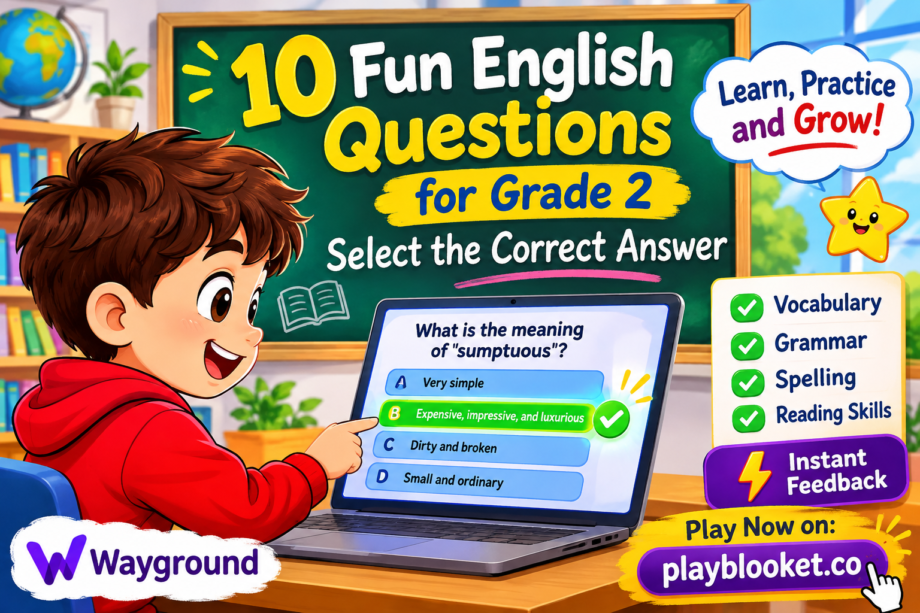
Learning English becomes easier when children get opportunities to read, think, and answer questions. For Grade 2 students, short activities with clear choices can make lessons more interesting and help build confidence. Instead of memorizing every rule, young learners can improve their language skills by practicing vocabulary, grammar, spelling, and reading comprehension.
One useful classroom activity is multiple-choice practice. Children read a question, look at several possible answers, and decide which option makes the most sense. When students select the correct answer, they practice understanding the question rather than simply guessing. This approach also gives teachers and parents an opportunity to identify which topics need more attention.
English practice does not have to feel like a difficult school assignment. A few enjoyable questions each day can help children recognize familiar words, understand simple sentences, and communicate more clearly. With instant feedback on learning platforms such as Wayground, students can discover their mistakes and try again.
This guide introduces ten English questions suitable for Grade 2 learners. Each question includes four possible choices, an explanation, and a learning tip. There is also a slightly more challenging vocabulary question featuring the word “sumptuous.”
Why Multiple-Choice English Practice Is Helpful for Grade 2
Children in Grade 2 are developing important reading and communication skills. They are learning how words work together, how sentences are formed, and how to understand information in short passages.
Multiple-choice exercises provide a simple way to practice these abilities. Students do not need to write long answers every time. Instead, they can concentrate on understanding the question and comparing the available options.
When children select the correct answer, they develop several useful learning habits:
-
Better reading: They learn to read questions carefully before responding.
-
Vocabulary development: They become familiar with new words and their meanings.
-
Grammar awareness: They recognize how nouns, verbs, and adjectives work.
-
Independent thinking: They compare different choices before making a decision.
-
Confidence: Correct responses encourage them to continue learning.
-
Mistake recognition: Explanations help them understand why an option was incorrect.
These benefits are particularly useful for younger students because they are still developing their attention and problem-solving abilities.
10 English Questions for Grade 2 Students
The following questions cover basic English topics that children commonly study in primary school. Each activity includes four options, followed by the correct response and a short explanation.
Children should try answering independently before reading the explanation. Parents and teachers can also turn the questions into a friendly classroom competition.
Question 1: Choose the Correct Naming Word
Which word is the name of an animal?
A. Table
B. Rabbit
C. Pencil
D. Window
Correct Answer: B. Rabbit
Explanation:
A rabbit is an animal with long ears and soft fur. It can move by hopping and is often kept as a pet. Table, pencil, and window are names of objects rather than animals.
Learning Tip: Naming words are called nouns. People, animals, places, and things all have names. Ask children to identify five nouns around their classroom.
Question 2: Identify the Correct Action Word
Which word shows an action?
A. Beautiful
B. Happy
C. Jump
D. Yellow
Correct Answer: C. Jump
Explanation:
The word jump describes an action. It tells us what someone can do. Beautiful and happy describe qualities or feelings, while yellow describes a color.
Learning Tip: Action words are called verbs. Examples include run, walk, read, write, sing, and dance. Children can practice by acting out different verbs.
Question 3: Complete the Sentence
Sara _____ a beautiful picture.
A. Draw
B. Drawing
C. Draws
D. Drawed
Correct Answer: C. Draws
Explanation:
The sentence talks about Sara, one person. In the simple present tense, we usually add an “s” to the verb when talking about he, she, or it.
The complete sentence is: “Sara draws a beautiful picture.”
Learning Tip: Encourage children to make simple sentences about their daily activities. For example, “My brother plays football” or “My mother cooks dinner.”
Question 4: Choose the Correct Opposite
What is the opposite of the word “hot”?
A. Warm
B. Cold
C. Bright
D. Soft
Correct Answer: B. Cold
Explanation:
Hot and cold have opposite meanings. Something hot has a high temperature, while something cold has a low temperature.
Warm is similar to hot, but usually means a comfortable temperature. Bright and soft describe different qualities.
Learning Tip: Opposite words are also called antonyms. Practice pairs such as big and small, happy and sad, fast and slow, and day and night.
Question 5: Select the Correct Article
Choose the correct word to complete this sentence:
“I saw _____ elephant at the zoo.”
A. A
B. An
C. The
D. Am
Correct Answer: B. An
Explanation:
We use “an” before a word that begins with a vowel sound. Elephant starts with a vowel sound, so the correct sentence is:
“I saw an elephant at the zoo.”
Learning Tip: Teach children the articles “a,” “an,” and “the” through everyday examples. For instance, a ball, an apple, and the sun.
Question 6: Find the Correct Plural Word
What is the plural form of “box”?
A. Boxs
B. Boxies
C. Boxes
D. Boxen
Correct Answer: C. Boxes
Explanation:
The plural form of box is boxes. Many English words ending in “x” form their plurals by adding “es.”
One box becomes two boxes.
Learning Tip: Ask children to practice other examples, including bus and buses, dish and dishes, and class and classes.
Question 7: Choose the Correct Pronoun
Which pronoun can replace the name “Ali”?
A. She
B. It
C. He
D. They
Correct Answer: C. He
Explanation:
“He” is commonly used instead of a boy’s name when talking about him. For example, instead of saying “Ali is playing. Ali is happy,” we can say “Ali is playing. He is happy.”
Learning Tip: Pronouns help us avoid repeating names. Common pronouns include I, you, he, she, it, we, and they.
Question 8: Understand the Meaning of a Word
What does the word “enormous” mean?
A. Very small
B. Very large
C. Very quiet
D. Very slow
Correct Answer: B. Very large
Explanation:
Enormous describes something that is extremely big. For example, an enormous elephant is much bigger than a small kitten.
Learning descriptive words helps children express their thoughts more clearly.
Learning Tip: Introduce children to new vocabulary by comparing familiar objects. A large building, a tiny insect, and a huge mountain are simple examples.
Question 9: Choose the Correct Sentence
Which sentence is written correctly?
A. she is my friend.
B. She is my friend.
C. She is my friend
D. she Is My friend.
Correct Answer: B. She is my friend.
Explanation:
A correct sentence begins with a capital letter and ends with suitable punctuation. The word “She” starts with a capital letter, and the sentence ends with a full stop.
Learning Tip: Teach children to check three things when writing: capital letters, spaces between words, and punctuation at the end.
Question 10: Understand the Meaning of “Sumptuous”
What is the meaning of “sumptuous”?
A. Very simple
B. Expensive, impressive, and luxurious
C. Dirty and broken
D. Small and ordinary
Correct Answer: B. Expensive, impressive, and luxurious
Explanation:
The word “sumptuous” describes something very impressive, beautiful, rich, or luxurious. For example, a sumptuous dinner might include many delicious dishes served in an elegant setting.
This word is more advanced than the everyday vocabulary usually taught in Grade 2. However, introducing interesting words can help curious learners expand their English knowledge.
Learning Tip: Explain difficult words using familiar situations. Children might understand “sumptuous” more easily when they imagine a beautifully decorated room or a special celebration with lots of delicious food.
How to Practice English Questions Effectively
Answering questions is useful, but the way children practice also matters. A good learning routine should include reading, understanding, answering, and reviewing.
Here are some simple methods that parents and teachers can use.
1. Read Every Question Carefully
Children sometimes choose an option without reading the complete question. This can lead to unnecessary mistakes.
Encourage students to read each question slowly. They should identify the important words and understand what information is being requested.
For example, if a question asks for an opposite word, children should look for a word with a different meaning rather than one that sounds similar.
2. Understand Every Available Option
Before making a choice, students should look at all the options. Sometimes the first option may seem correct, but another answer might be more suitable.
When learners select the correct answer, they should be able to explain why their choice makes sense.
This habit develops understanding and reduces random guessing.
3. Learn From Incorrect Responses
Mistakes are a normal part of learning. A child who chooses the wrong answer should not feel embarrassed.
Instead, parents and teachers can explain the correct response using a simple example.
For instance, if a student confuses “jump” with “happy,” explain that jump is something a person does, while happy describes a feeling.
This type of feedback helps children remember the difference.
4. Practice a Little Every Day
Long study sessions can become tiring for young learners. Short activities are often easier to manage.
A daily practice routine might include:
-
Five minutes of reading.
-
Five minutes of vocabulary practice.
-
Five minutes of grammar questions.
-
Five minutes of reviewing mistakes.
Regular practice allows children to build knowledge gradually without feeling overwhelmed.
5. Encourage Children to Explain Their Choices
Do not focus only on whether an answer is right or wrong. Ask students to explain their thinking.
For example, if a child chooses “rabbit” as an animal, ask what makes a rabbit different from a table or a pencil.
When students explain their decisions, teachers can better understand their progress.
How Wayground Makes English Practice More Interactive
Traditional worksheets are useful, but digital learning activities can offer another enjoyable way to practice English.
Wayground provides an interactive learning environment where students can participate in educational quizzes and activities. Teachers can use digital questions to check understanding, while students can practice different subjects in an engaging format.
One helpful feature of digital question activities is instant feedback. Instead of waiting until the teacher checks every answer, students may receive information about their responses during an activity, depending on the quiz settings.
This makes it easier to recognize mistakes and understand which topics need additional practice.
Benefits of Instant Feedback
Instant feedback can make learning more effective in several ways.
Quick understanding: Students can discover whether their responses are correct during the activity.
Improved concentration: Interactive questions encourage children to remain involved.
Learning at their own pace: Depending on the activity settings, students may have opportunities to review questions and improve their understanding.
Teacher support: Educators can use student responses to identify topics that require more explanation.
When children select the correct answer and receive helpful feedback, they can connect the question with the information they have learned.
Using Digital Quizzes at Home
Parents can also introduce educational quizzes as part of a home learning routine.
A simple approach is to choose a short English activity and allow children to complete it independently. Afterward, parents can review difficult questions with them.
For example, a vocabulary quiz might include common words such as beautiful, enormous, cheerful, and friendly.
Children can read each word, think about its meaning, and choose the matching explanation.
Digital activities should support learning rather than replace reading books, handwriting practice, or conversations with adults. A balanced routine provides children with different ways to develop their language abilities.
Common Mistakes Students Make in Multiple-Choice Questions
Even confident students sometimes make mistakes when answering English questions. Understanding these common problems can help children improve.
Reading Too Quickly
Some students look at only one or two words before choosing an option. They may miss important instructions such as opposite, plural, or complete the sentence.
The solution is simple: read the complete question before answering.
Confusing Similar Words
English contains many words with similar meanings or spellings. Young learners may confuse words such as their and there or hear and here.
Teachers should introduce these words through short sentences and practical examples.
Ignoring Grammar Rules
A sentence may contain familiar words but still be grammatically incorrect.
For example:
“She play football.”
The correct sentence is:
“She plays football.”
Regular grammar practice helps students recognize these patterns.
Guessing Without Thinking
Guessing occasionally is natural, but relying on guesses does not develop strong language skills.
Encourage students to compare the options and eliminate answers that do not make sense. This makes it easier to select the correct answer through reasoning.
Not Reviewing Mistakes
Finishing a quiz is not the end of the learning process. Reviewing incorrect responses is equally important.
Children should understand the reason behind each mistake before moving to the next activity.
How Parents and Teachers Can Make English Learning Enjoyable
Children learn better when they feel comfortable asking questions and exploring new ideas. Parents and teachers can create a positive environment by using simple activities outside regular lessons.
Here are a few practical ideas.
Word games: Choose a familiar word and ask children to find its opposite, similar meaning, or use it in a sentence.
Picture activities: Show pictures of animals, objects, and places. Ask children to describe what they see.
Reading time: Spend a few minutes reading short stories together. Ask simple questions about the characters and events.
Sentence building: Give children three words and ask them to create a meaningful sentence.
Friendly quizzes: Prepare five or ten questions and let children answer them without pressure.
Teachers can also divide students into small groups and allow them to discuss their choices. This encourages communication and teamwork.
Most importantly, children should receive encouragement for making an effort, even when their answers are not always correct.
Tips for Building a Strong English Vocabulary
Vocabulary is one of the most important parts of learning a language. Children who understand more words can read stories more comfortably and express their ideas with greater confidence.
A few simple habits can make vocabulary learning easier.
Introduce New Words Gradually
There is no need to introduce dozens of difficult words in one lesson. Start with a few words and explain their meanings through examples.
Words such as cheerful, enormous, gentle, curious, and delicious can be introduced during everyday conversations.
Use New Words in Sentences
Understanding a word becomes easier when children see how it works in a sentence.
For example:
-
The cheerful girl smiled.
-
An enormous whale lives in the ocean.
-
The gentle puppy slept peacefully.
-
The delicious cake was on the table.
Review Previously Learned Words
Revisiting old vocabulary helps students remember meanings over time.
Parents can ask children to explain a word they learned yesterday or use it in a new sentence.
Explore More Challenging Vocabulary
Once children become comfortable with basic words, teachers can introduce more advanced vocabulary.
The word “sumptuous” is a good example of a challenging descriptive word. Although it may not be essential for every Grade 2 lesson, discussing it can introduce children to richer English expressions.
The goal is not to memorize difficult words quickly. It is to develop curiosity and a willingness to learn.
A Simple Daily English Learning Routine
A consistent routine can help students improve without making study time stressful.
| Activity | Suggested time |
|---|---|
| Reading a short story | 5 minutes |
| Learning new vocabulary | 5 minutes |
| Grammar practice | 5 minutes |
| Multiple-choice questions | 5 minutes |
| Reviewing mistakes | 5 minutes |
This 25-minute routine combines different language activities and gives children opportunities to practice several skills.
Parents can adjust the schedule depending on the child’s attention span and school workload.
During question practice, students should take their time. They should understand the meaning of each question, compare the options, and select the correct answer based on what they have learned.
Frequently Asked Questions
1. What are multiple-choice English questions?
Multiple-choice English questions provide a question with several possible answers. Students choose the option that correctly answers the question.
These activities can cover grammar, spelling, vocabulary, punctuation, and reading comprehension.
2. Are these questions suitable for Grade 2 students?
Yes. Most questions in this guide cover basic English concepts suitable for Grade 2 learners. The word “sumptuous” is an additional vocabulary challenge that may require adult explanation.
3. How many English questions should a child practice daily?
A child can begin with five to ten questions each day. The number can increase gradually as the child becomes more confident.
Understanding the answers is more important than completing a large number of questions.
4. Why is instant feedback useful?
Instant feedback helps children identify mistakes while the question is still fresh in their minds. It can also help teachers identify areas where additional instruction is needed.
5. How can children improve their English vocabulary?
Reading short stories, learning new words, making sentences, playing word games, and reviewing vocabulary regularly can help children improve their language skills.
6. What is the best way to answer multiple-choice questions?
Read the complete question, understand what it asks, review every option, and eliminate choices that do not make sense. Then select the correct answer. and review the explanation.
Conclusion
English learning becomes more enjoyable when children have opportunities to practice through simple and interesting activities. The ten questions in this guide introduce Grade 2 students to important language concepts, including nouns, verbs, articles, pronouns, opposites, plurals, sentence structure, and vocabulary.
Parents and teachers can use these exercises during classroom lessons or short home study sessions. They can also introduce interactive platforms such as Wayground to give children additional opportunities to practice and receive feedback.
The most important thing is to make learning a positive experience. Encourage children to read carefully, think independently, ask questions, and learn from mistakes. With regular practice and helpful guidance, young learners can gradually develop stronger English skills and become more confident readers and writers.
