
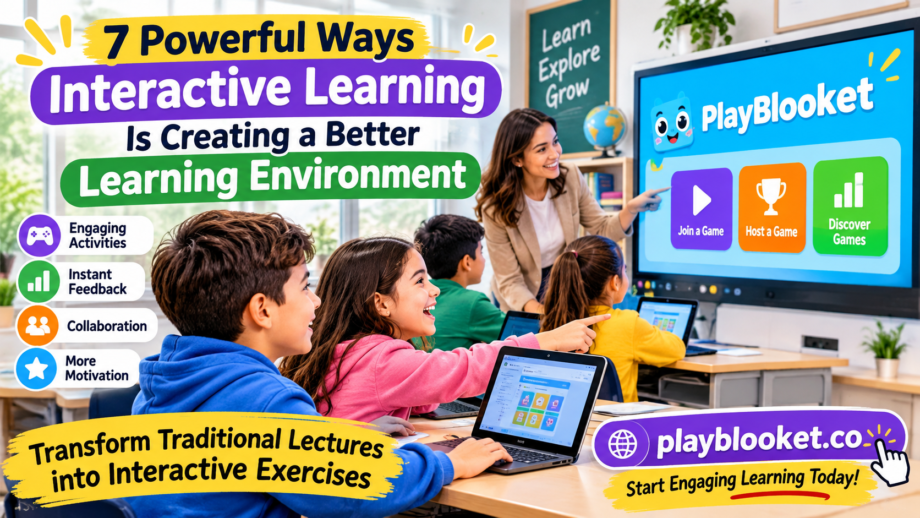
Education is changing as technology introduces new ways to share information, encourage participation, and help students understand complicated subjects. Traditional classroom lectures have played an important role for generations, but the expectations of modern learners are different. Students increasingly want opportunities to participate, experiment, ask questions, and apply what they learn instead of simply listening to an explanation.
One important development is the use of innovative educational platforms that transform traditional lectures into interactive exercises. Rather than presenting information as a one-way conversation, these platforms encourage students to respond, solve problems, complete activities, and receive feedback. This approach can make lessons more memorable while creating a more engaging learning environment for different types of learners.
The goal is not to eliminate teachers or replace every traditional teaching method. Instead, interactive technology gives educators additional ways to communicate ideas and understand how students are progressing. When thoughtfully introduced, it can make classrooms more collaborative, accessible, and responsive to individual needs.
1. Moving Beyond Traditional Classroom Lectures
For many years, classroom instruction followed a familiar pattern. Teachers explained a subject, students listened, and learning was evaluated through homework, assignments, or examinations. Although this approach remains useful for introducing important concepts, it does not always provide enough opportunities for students to participate during lessons.
Some students understand information quickly through listening, while others need examples, visual explanations, or practical activities. A lecture that works well for one student may leave another struggling to follow the discussion.
Interactive educational platforms address this limitation by turning information into activities. A teacher explaining mathematics, for example, can introduce a short exercise immediately after discussing a formula. Students can attempt the question, compare possible answers, and identify where they need additional explanation.
This creates a more active learning environment because students become participants rather than passive observers. They are encouraged to think about the material while the lesson is taking place.
Another advantage is that interactive activities can break lengthy lessons into manageable sections. Instead of expecting students to concentrate on a continuous presentation, teachers can introduce short exercises between explanations. These small changes can help maintain attention and make complex subjects easier to approach.
2. Making Student Participation a Priority
Student participation is one of the most important elements of successful education. When learners have opportunities to contribute, they become more involved in the subject and develop confidence in their abilities.
Interactive platforms can support participation through quizzes, polls, matching activities, short-answer questions, and collaborative challenges. These features give students different ways to demonstrate what they understand.
For example, a science teacher discussing the water cycle might present an explanation followed by a short activity. Students could arrange the stages of evaporation, condensation, and precipitation in the correct order. This simple exercise encourages them to recall information and apply it immediately.
A supportive learning environment should allow students to participate without feeling embarrassed about making mistakes. Digital exercises can help teachers create opportunities for low-pressure practice, especially when students are still developing their understanding.
Participation also makes classroom discussions more meaningful. When students answer questions and explain their reasoning, teachers can identify misconceptions that might otherwise remain unnoticed.
Rather than measuring progress only through final examinations, educators can observe how students respond throughout a lesson. This gives them more opportunities to provide useful guidance before small misunderstandings become larger problems.
3. Turning Complex Information Into Interactive Exercises
Some academic subjects contain ideas that are difficult to understand through written explanations alone. Science, mathematics, geography, and technology often require students to understand relationships between different concepts.
Interactive exercises can make these subjects easier to explore.
In mathematics, learners might use step-by-step problems to understand how a calculation works. In science, they could explore a sequence of events through visual activities. Language students might complete vocabulary exercises, sentence-building tasks, or reading comprehension challenges.
The value of these activities comes from the opportunity to practice. Students do not simply receive information; they use it to complete a task.
A well-designed learning environment combines explanations with opportunities to apply knowledge. Teachers can introduce a concept, demonstrate how it works, and then provide an activity that allows students to test their understanding.
This process is especially useful when lessons involve multiple stages. Students can work through one part at a time rather than trying to understand an entire subject immediately.
Interactive exercises can also encourage independent thinking. Instead of showing the correct answer straight away, some activities allow students to make an attempt and review feedback afterward. This gives them an opportunity to reconsider their approach and understand why a particular answer works.
4. Providing Immediate Feedback and Better Progress Tracking
Feedback plays a major role in the learning process. Students need to know whether they understand a topic and which areas require further attention.
In a traditional classroom, teachers may not have enough time to review every student’s understanding after each explanation. As a result, some students continue with incorrect assumptions until an assignment or examination reveals the problem.
Interactive platforms can make feedback more immediate. A student completing a digital quiz may receive an indication of whether an answer is correct. Depending on the platform, the activity may also provide an explanation or recommend another attempt.
This feature can make a learning environment more responsive because students receive information about their progress while the lesson is still taking place.
Teachers can benefit from this information as well. If a large number of students answer the same question incorrectly, the teacher may decide to explain that topic again. If most students understand it, the class can move forward to a more challenging activity.
Progress tracking can also reveal patterns over time. Educators may notice that particular students need additional support with specific skills, while others are ready for more advanced material.
However, digital scores should not become the only measure of academic ability. Teachers should consider classroom participation, individual circumstances, written work, and practical understanding when evaluating student progress.
5. Supporting Different Learning Preferences
Every student approaches education differently. Some learners prefer reading detailed explanations, while others understand ideas more easily through diagrams, demonstrations, or hands-on activities.
A single teaching method may not meet every student’s needs. This is why variety is important when designing lessons.
Interactive educational platforms can offer multiple ways to explore the same subject. A lesson might combine written instructions, illustrations, short videos, quizzes, and practical exercises. Students can engage with the material through different activities instead of relying on one presentation style.
This flexibility can contribute to a more inclusive learning environment.
For example, a history lesson could begin with a written overview before introducing a timeline activity. Students might then answer questions about important events or organize historical developments in chronological order.
Similarly, language learners could read a short passage, listen to an audio explanation, and complete a vocabulary exercise. Each activity reinforces the same subject from a slightly different perspective.
Teachers should still consider accessibility when selecting educational technology. Clear instructions, readable text, keyboard-friendly navigation, captions, and compatibility with assistive tools can make digital activities easier for more students to use.
The objective is not to label learners according to fixed learning styles. Instead, educators should provide varied teaching experiences that give everyone a reasonable opportunity to understand the material.
6. Encouraging Collaboration and Classroom Communication
Education is not only about individual achievement. Students also develop important skills by communicating with classmates, exchanging ideas, and working toward shared goals.
Interactive exercises can create opportunities for collaboration. Teachers might divide a class into small groups and ask students to solve a problem together. Each group could submit an answer, explain its reasoning, or compare its approach with other teams.
These activities help students practice communication, listening, decision-making, and cooperation.
A collaborative learning environment also allows students to learn from one another. A student who understands a difficult concept may explain it in simpler language to a classmate. At the same time, explaining an idea can strengthen the original student’s understanding.
Group activities can be especially useful for subjects that involve discussion and problem-solving. For example, students studying environmental science might work together to develop practical ideas for reducing waste at school.
Digital platforms can support this process through shared activities, discussion features, and group assignments. However, technology should complement real classroom communication rather than replace it.
Teachers should also ensure that group work is balanced. Every student should have an opportunity to contribute, and activities should be designed so that responsibilities are shared fairly.
7. Increasing Motivation Through Gamified Activities
Maintaining student interest throughout a lesson can be difficult, particularly when a topic requires concentration or repeated practice.
Gamification introduces selected elements of games into educational activities. These may include points, progress indicators, challenges, achievement badges, or friendly classroom competitions.
When used carefully, these features can make practice more enjoyable.
For example, a teacher might create a short vocabulary challenge in which students earn points for correct answers. Another activity could involve solving mathematics questions within a reasonable time limit. Students can review their results and try again to improve their understanding.
A positive learning environment should use gamification to encourage progress rather than create unnecessary pressure.
Competition can motivate some students, but it may discourage others if activities focus too heavily on rankings. Teachers can avoid this problem by including individual improvement goals, cooperative challenges, and opportunities for students to learn at their own pace.
The educational purpose must always come first. A game should reinforce the lesson rather than distract students from it.
When activities are connected to clear learning objectives, gamification can help students approach difficult subjects with greater curiosity and enthusiasm.
8. Helping Teachers Make More Informed Decisions
Educational technology is often discussed from the student’s perspective, but teachers can benefit from interactive platforms just as much.
Classroom instruction requires educators to make constant decisions. They must determine whether students understand a topic, whether a lesson is moving too quickly, and which concepts need further explanation.
Interactive exercises provide additional information that can support these decisions.
For instance, a teacher may notice that students perform well on basic questions but struggle when asked to apply the same concept to a new situation. This suggests that the class may need more practical examples before moving to the next topic.
A digital activity can help identify this gap earlier than a major examination.
In this way, technology supports a more informed learning environment by giving educators another source of feedback.
Teachers can also use assessment information to adjust their lesson plans. Students who need additional practice may receive simpler exercises, while advanced learners can work on more challenging tasks.
It is important, however, to interpret educational data carefully. A low score does not automatically mean that a student lacks ability. Technical problems, unclear instructions, language difficulties, and other circumstances can influence results.
Professional judgment remains essential. Technology can provide useful information, but teachers understand the classroom context and individual needs of their students.
9. Making Education More Flexible and Accessible
Modern education increasingly takes place across different settings. Students may attend traditional classrooms, participate in online lessons, or combine digital resources with face-to-face instruction.
Interactive platforms can support this flexibility by making educational activities available beyond a single classroom session.
Depending on the platform, students may be able to review previous lessons, complete additional exercises, or practice important skills outside regular teaching hours.
This can strengthen a learning environment by giving students more opportunities to revisit difficult subjects.
For example, a student who needs extra time to understand a mathematics lesson might repeat an exercise at home. Another student could review vocabulary before an upcoming language assessment.
Flexible access can also support blended learning, where teachers combine classroom explanations with online assignments and interactive activities.
Nevertheless, accessibility should not be taken for granted. Not every student has reliable internet access, a suitable device, or a quiet place to study.
Schools should consider these limitations before making digital platforms essential to everyday instruction. Providing alternative activities and access to school resources can help prevent technology from creating additional barriers.
A successful digital strategy should expand educational opportunities rather than make participation dependent on expensive equipment or constant connectivity.
10. Addressing Challenges When Introducing Educational Technology
Although interactive platforms offer many advantages, introducing them into education requires planning.
One common challenge is the learning curve. Teachers and students may need time to understand how a platform works. If the interface is confusing or activities require too many steps, technology can interrupt lessons instead of improving them.
Training and preparation are therefore important. Educators should become familiar with essential features before introducing them to an entire class.
Another concern is digital distraction. Students may lose focus if a platform contains unnecessary animations, advertisements, or features unrelated to the lesson. Educational activities should be simple, purposeful, and appropriate for the students’ age group.
Privacy is another important consideration. Schools should review how platforms collect, store, and use student information. They should also understand account permissions, data protection policies, and parental consent requirements where applicable.
A balanced learning environment needs clear rules for responsible technology use. Students should understand when devices are being used for educational activities and when they should be put away.
Educators must also avoid assuming that every lesson needs a digital tool. Classroom discussion, textbooks, experiments, writing exercises, and direct teacher guidance remain valuable.
The most effective approach is to select technology according to the educational objective rather than using it simply because it is available.
11. Combining Interactive Platforms With Effective Teaching Methods
Technology produces better results when it supports a well-planned lesson.
A teacher can begin with a short introduction, explain the main concept, and then use an interactive exercise to check understanding. After reviewing student responses, the teacher can lead a discussion or provide additional examples.
This creates a natural connection between traditional teaching and modern educational tools.
For example, a geography lesson might begin with an explanation of climate zones. Students could then complete a digital activity matching different regions with their climate characteristics. The teacher could review the answers and ask students to explain their choices.
This combination supports a balanced learning environment because it includes instruction, participation, feedback, and discussion.
Teachers should also consider the length and difficulty of each activity. Short exercises may work well for checking basic understanding, while longer projects can help students develop research and problem-solving skills.
The important factor is alignment. Every digital exercise should connect with the lesson’s learning objectives.
When students understand why they are completing an activity, they are more likely to treat it as a meaningful part of their education rather than an unrelated classroom game.
12. What the Future of Interactive Education May Look Like
Educational technology continues to develop, creating new opportunities for teachers and students.
Artificial intelligence, adaptive learning systems, virtual simulations, and advanced assessment tools may provide more ways to personalize educational experiences.
For example, adaptive platforms can adjust the difficulty of exercises based on a student’s responses. Some systems can recommend additional practice when a learner struggles with a particular concept.
Virtual simulations may also help students explore subjects that are difficult to demonstrate in an ordinary classroom. Science students could investigate simulated environments, while technical learners might practice procedures in a controlled digital setting.
These developments could contribute to a more flexible learning environment, but their success will depend on responsible implementation.
Schools must consider affordability, accessibility, accuracy, privacy, and the quality of educational content. New technology should be evaluated according to whether it genuinely improves learning outcomes.
The role of teachers will remain important. Students need guidance, encouragement, explanations, and human interaction. Even advanced platforms cannot fully replace the understanding and support that an experienced educator provides.
The future is therefore more likely to involve cooperation between teachers and technology than a complete replacement of traditional classroom instruction.
Conclusion: Creating More Engaging Educational Experiences
Education becomes more effective when students have meaningful opportunities to participate, practice, and understand what they are studying. Interactive platforms offer a practical way to transform traditional lectures into exercises that encourage active involvement.
From immediate feedback and collaborative activities to flexible access and gamified learning, these tools can support several important aspects of modern education.
However, successful implementation requires more than simply introducing digital software. Teachers need suitable training, students need accessible resources, and schools must establish responsible guidelines for technology use.
A strong learning environment combines effective teaching, student participation, appropriate digital tools, and opportunities for independent thinking. When these elements work together, lessons can become more engaging without losing the personal connection that makes education meaningful.
The real value of interactive learning is not that it makes every lesson look different. It is that it gives students more opportunities to think, respond, experiment, and improve. By using technology with a clear educational purpose, schools can create classroom experiences that prepare learners for the challenges and opportunities of an increasingly digital world.
