
Introduction
Modern classrooms need learning activities that help students understand information, practice new skills, and stay interested in their lessons. Reading textbooks and listening to explanations are important, but students also benefit from interactive exercises that allow them to test their knowledge. This is where educational games and well-organized question sets can make a difference.
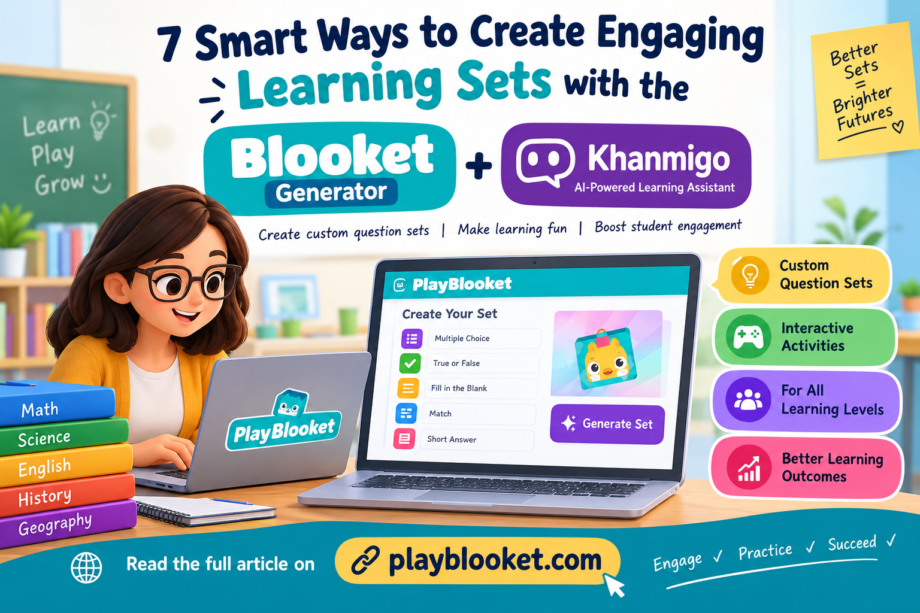
The Blooket Generator concept offers an interesting way to think about creating custom educational activities. Teachers can organize questions around specific subjects, prepare revision exercises, and develop activities that match their students’ learning goals. AI-assisted tools may also help educators brainstorm question ideas and arrange content into a more manageable structure.
When teachers create useful sets, they can turn a broad lesson into smaller learning activities. For example, a science topic can be divided into definitions, processes, examples, and practical applications. Students can work through these sets gradually, building confidence as they understand each concept.
The idea of combining educational content with interactive practice is especially valuable when teachers need to prepare materials for different learning levels. Instead of giving every student the same type of exercise, educators can develop beginner, intermediate, and advanced activities.
This guide explores seven practical ways to create effective sets, improve classroom participation, use AI assistance responsibly, and make educational games more useful for everyday learning.
1. Understanding the Blooket Generator Concept
The first step toward creating effective learning material is understanding what a question generator is intended to accomplish. Rather than preparing every question manually, educators can use structured prompts and available educational tools to develop initial ideas for classroom activities.
The Blooket Generator concept focuses on creating question-based resources that can support interactive learning. Depending on the tools and features actually available, educators may be able to organize questions around subjects, learning objectives, and classroom activities.
Khanmigo is an AI-powered learning assistant associated with Khan Academy. AI-assisted educational workflows can help teachers brainstorm examples, adjust explanations, and develop practice questions. However, teachers should verify the official documentation before assuming that a specific Blooket Generator has a direct Khanmigo integration.
The broader educational idea remains useful: teachers can combine their subject knowledge with carefully reviewed question material to prepare engaging activities.
For example, an educator teaching multiplication might create separate sets for basic multiplication facts, word problems, and more challenging calculations. Each activity would focus on a particular skill rather than presenting unrelated questions.
This structure gives students a clearer learning path. It also helps teachers recognize which topics require additional explanation.
Effective sets should always have a purpose. Before preparing questions, teachers need to decide what students should learn and how the activity will help them practice that knowledge.
2. Choose a Clear Learning Objective
A successful educational activity begins with a specific goal. If a teacher starts with a broad subject and generates random questions, the final material may lack direction. Choosing a clear objective helps keep the activity focused.
Suppose the lesson covers the water cycle. The teacher could focus on evaporation, condensation, precipitation, and collection. Instead of mixing every science topic into one activity, the educator can create sets that introduce each process separately.
The first group could cover basic definitions. The second could ask students to identify each stage in a diagram. The final activity might ask learners to explain how the stages work together.
This progression supports understanding because students begin with simple information before moving toward more complex ideas.
Teachers can follow a similar method in other subjects:
- Mathematics: Practice fractions, multiplication, division, or geometry.
- English: Review grammar, vocabulary, punctuation, and sentence structure.
- Science: Explore ecosystems, energy, matter, or the human body.
- History: Study important events, causes, dates, and consequences.
- Geography: Learn about countries, capitals, climates, and landforms.
Each subject can benefit from focused sets that support a particular classroom objective.
Clear objectives also make assessment easier. After students finish an activity, teachers can determine whether the questions tested the intended skill or whether additional practice is necessary.
3. Organize Questions From Easy to Difficult
Students usually benefit when new concepts are introduced gradually. Starting with difficult questions may discourage beginners, while presenting only simple questions may not challenge advanced learners.
Organizing sets by difficulty creates a more balanced learning experience. Teachers can begin with introductory questions, move toward standard practice, and finish with questions that require reasoning.
Consider a mathematics lesson about fractions.
The introductory activity might ask students to identify one-half, one-third, and one-quarter. The next group could compare fractions with different denominators. A final activity might involve a word problem requiring students to calculate how much of a pizza remains after several slices are eaten.
This sequence helps students connect basic knowledge with practical applications.
Teachers can use the same approach when preparing reading activities. The first set might test word meanings, the second could focus on understanding sentences, and the third might ask students to identify the main idea of a short passage.
Difficulty should not be measured only by the length of a question. A short question can require complex reasoning, while a longer question may test a straightforward fact.
Well-designed sets introduce challenges at a suitable pace. They give students opportunities to make progress while allowing teachers to identify areas where additional support is needed.
4. Use AI Assistance to Generate Better Questions
AI-assisted tools can support lesson preparation by suggesting questions, producing alternative examples, and organizing information into a consistent format. Their usefulness often depends on the clarity of the instructions teachers provide.
A vague request such as “make questions about science” may produce content that is too broad or unsuitable for a particular class. A more detailed request can specify the grade level, topic, number of questions, answer format, and desired difficulty.
For example, a teacher could request fifteen multiple-choice questions about the water cycle for middle-school students. The teacher might ask for five introductory questions, five intermediate questions, and five application-based questions.
The resulting draft can then be reviewed and adapted before being used in class.
AI can also help educators create different versions of similar sets. A teacher preparing an English lesson might request simpler vocabulary for beginners and more challenging sentence examples for advanced students.
However, generated content should never be accepted without review. AI systems can make factual mistakes, create ambiguous answers, or provide examples that do not match the lesson.
Teachers should check every answer and ensure that the questions follow the curriculum. If a tool claims to offer a particular integration or feature, educators should confirm it through the official product documentation.
AI should be treated as a preparation assistant rather than a replacement for teaching expertise. Human review is what turns a rough collection of questions into dependable educational material.
5. Make Learning Sets More Interactive
Interactive learning works best when students have clear instructions and meaningful opportunities to participate. A question activity should encourage learners to think about the subject rather than simply click answers as quickly as possible.
Teachers can create varied sets by mixing definitions, short scenarios, calculations, matching exercises, and questions about real-life situations.
For example, a lesson about healthy plants could begin with questions about roots and leaves. A second activity might ask students to identify the resources plants need. A final group could present everyday situations and ask students to predict what might happen if a plant receives insufficient sunlight or water.
This approach gives students several ways to explore the same subject.
Teachers can also connect questions with familiar experiences. Shopping examples can make mathematics more practical, while questions about weather can help students understand science and geography.
The wording should remain clear. If students must read a long paragraph before answering a simple question, the activity may become frustrating. Short, direct questions often work better for timed games.
Visual material can provide additional support when it is relevant. Maps, diagrams, number lines, and labeled illustrations can help learners understand information that would be difficult to communicate through words alone.
Interactive sets should still prioritize accuracy. Every question needs a clear answer, and the incorrect options should not mislead students through confusing wording.
6. Create Sets for Different Learning Levels
Every classroom contains students with different strengths, interests, and levels of understanding. A single activity may not provide the right amount of support or challenge for everyone.
Creating different difficulty levels can help teachers respond to these differences while maintaining the same overall learning objective.
Beginner sets can introduce essential terms and basic facts. Intermediate versions can include examples that require students to apply what they have learned. Advanced activities can challenge students to solve unfamiliar problems or explain their reasoning.
For an English grammar lesson, beginners might identify nouns in simple sentences. Intermediate learners could distinguish proper nouns from common nouns. Advanced students might identify different noun types within a longer passage.
In science, beginners could learn the names of the planets, while intermediate learners explore their order and characteristics. Advanced activities might ask students to compare planetary environments or explain why certain conditions affect the possibility of life.
Teachers can also prepare additional sets for students who need revision. Repeated practice with new examples may help reinforce a concept without making every exercise identical.
The goal is not to separate students permanently according to ability. It is to provide suitable opportunities for improvement.
Educators should review student progress regularly and adjust the difficulty as understanding develops. This keeps learning challenging without making it unnecessarily stressful.
7. Develop Subject-Specific Question Sets
Different subjects require different question formats. Matching the structure to the lesson helps students practice the skills that matter most.
Mathematics Sets
Mathematics activities should include calculations, conceptual questions, and real-world problems. Students need to understand both the procedure and the reasoning behind an answer.
A fractions activity could cover equivalent values, comparisons, addition, and subtraction. Teachers should verify every calculation and ensure that answer options are mathematically accurate.
Science Sets
Science activities can test definitions, processes, relationships, and observations. A lesson about ecosystems might cover producers, consumers, decomposers, food chains, and environmental changes.
Questions can also ask students to predict what happens when one part of an ecosystem changes. This encourages them to apply knowledge rather than memorize isolated facts.
English Sets
English activities may focus on grammar, vocabulary, spelling, punctuation, and reading comprehension. Separate sets allow students to practice one skill at a time before working with longer passages.
Teachers should ensure that grammar questions follow the rules being taught and that any exceptions are handled appropriately.
History Sets
History activities can help students remember important events and understand their causes and consequences. Rather than asking only for dates, teachers can include questions about why an event occurred and how it influenced later developments.
Geography Sets
Geography questions can cover countries, capitals, landforms, climate, natural resources, and population. Maps and diagrams are especially helpful when students need to connect locations with their names.
Subject-specific sets make educational activities more relevant because their questions reflect the learning objectives of each discipline.
8. Check Accuracy Before Using Generated Material
Accuracy is one of the most important parts of preparing classroom activities. Even an attractive game can teach the wrong information if its questions contain mistakes.
Teachers should check each question, confirm the correct answer, and review the incorrect options. The wording should be clear enough that students understand what is being asked.
Mathematics questions require careful calculation. Science questions should be checked against reliable educational resources, while historical facts should be verified using trustworthy references.
Teachers should also check for duplicate questions. Some repetition helps students practice, but unnecessary duplication can reduce the value of an activity.
Another consideration is the reading level. Younger learners may struggle with complicated vocabulary even when they understand the underlying concept. If reading ability is not the target skill, unnecessary language complexity should be avoided.
Before sharing new sets with an entire class, educators can test the activity themselves. This helps reveal incorrect answers, unclear instructions, and questions that may take too long to complete.
A useful review checklist includes accuracy, clarity, difficulty, relevance, answer options, and alignment with the lesson objective.
Careful checking helps ensure that technology supports learning instead of creating additional confusion.
9. Use Student Results to Improve Teaching
Question activities can provide useful feedback about how students understand a topic. Teachers can use this information to decide which concepts need more explanation and which skills students are ready to develop further.
Suppose most students answer basic multiplication questions correctly but struggle with word problems. This may indicate that they understand the calculations but need more practice identifying the correct operation in a real-world situation.
The teacher could respond by preparing new sets with shopping examples, distance problems, or classroom scenarios.
Similarly, if students repeatedly answer questions about a science process incorrectly, the educator may need to explain the concept again using a diagram or demonstration.
Results should be interpreted carefully. A low score does not necessarily mean that a student lacks ability. Reading speed, unfamiliarity with the activity, distractions, and time pressure can all affect performance.
Teachers should combine game results with classroom discussion, written work, and other forms of assessment.
Students can also use feedback to guide their own revision. After answering a question incorrectly, they should review the explanation and try another example.
When results inform the next lesson, sets become part of an ongoing learning process rather than an isolated classroom game.
10. Common Mistakes to Avoid
Several common mistakes can reduce the effectiveness of educational activities.
Creating too many questions: Longer activities are not automatically better. Teachers should select a suitable number of questions for the available time.
Ignoring difficulty: Questions that are too easy may provide little practice, while excessively difficult questions can discourage participation.
Skipping fact-checking: AI-assisted drafts may contain errors, so teachers should review every question before using it.
Using confusing language: Clear wording allows students to concentrate on the learning objective instead of struggling to understand the instructions.
Repeating questions unnecessarily: Repetition can reinforce knowledge, but duplicate items should serve a clear purpose.
Ignoring accessibility: Teachers should consider reading ability, visual clarity, device access, and appropriate response times.
Focusing only on scores: Scores provide limited information unless teachers also consider explanations, mistakes, and the student’s understanding of the material.
Avoiding these mistakes helps educators create more dependable and useful sets for classroom practice.
11. Practical Ways to Save Preparation Time
Teachers often have limited time to prepare materials for multiple lessons. A consistent workflow can make the process more manageable.
Start by writing down the learning objective and selecting the essential concepts. Next, draft the questions and organize them according to difficulty. Review the answers, remove unnecessary repetition, and test the finished activity before using it with students.
Descriptive names make it easier to organize resources. A title such as “Grade 5 Science: Food Chains” is more useful than a generic label such as “Science Questions.”
Teachers can maintain separate sets for introductory lessons, revision sessions, and advanced practice. When students need additional support, educators can quickly select an appropriate activity instead of creating everything from scratch.
It is also useful to record which questions students found difficult. This information can guide the development of future materials and prevent teachers from repeating the same weaknesses.
Students can benefit from similar organization. Keeping revision activities grouped by topic makes it easier to identify which subjects require more attention.
Parents may also use short question activities to support learning at home, provided the content matches what children are studying at school.
Preparation becomes more efficient when educators develop a repeatable process and keep their resources organized.
12. The Role of Educational Technology in Future Learning
Educational technology continues to provide new ways to prepare and deliver learning activities. AI-assisted tools can help teachers brainstorm questions, create alternative explanations, and adapt examples for different learners.
However, producing more content is not the same as improving education. Effective learning still depends on clear explanations, suitable practice, constructive feedback, and meaningful interaction between teachers and students.
Well-designed sets can support these goals by helping students revisit important concepts and apply their knowledge in different situations.
Technology can also help teachers explore new approaches to revision and informal assessment. The most useful approach is to combine these possibilities with professional judgment and careful content review.
Privacy remains important when using digital educational services. Teachers and schools should follow their technology policies and avoid entering confidential student information into tools that are not approved for that purpose.
Educators should also confirm product features through official documentation instead of assuming that every tool offers the same integrations.
When used responsibly, technology can reduce repetitive preparation work and give teachers more time to focus on students’ individual learning needs.
Conclusion
Effective educational activities begin with a clear learning objective and carefully prepared questions. Teachers need to consider difficulty, accuracy, accessibility, and the type of practice students require.
The Blooket Generator concept provides a useful starting point for exploring interactive question-based learning. AI-assisted preparation may help educators develop ideas more quickly, but human review remains essential for ensuring that the finished content is accurate and appropriate.
From mathematics and science to English, history, and geography, well-organized sets can help students review concepts, practice important skills, and identify areas that need further attention.
The best results come from balancing engagement with educational purpose. When questions are clear, answers are accurate, and difficulty progresses at a suitable pace, sets become practical resources that support both teaching and independent revision.
Rather than focusing only on the number of questions or the final score, educators should consider what students learn from each activity. That approach makes interactive learning more meaningful and helps turn everyday practice into an opportunity for lasting understanding.
