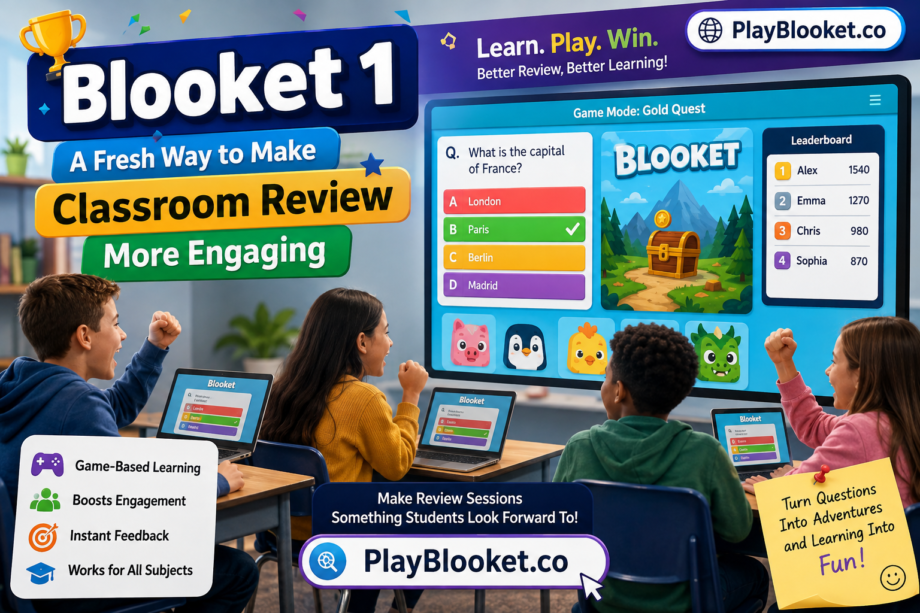
Keeping students interested during a review session is not always easy. A teacher can prepare excellent questions, explain the answers clearly, and still notice a few students staring at the clock. This is where Blooket takes a different approach.
Instead of making review feel like another test, Blooket turns questions into an interactive game. Students answer questions while taking part in different challenges, collecting rewards, competing with classmates, and trying to improve their results.
The idea is simple: learning remains at the center, but the experience feels more like play.
What Is Blooket?
Blooket is an online educational game platform designed to make classroom review more engaging. Teachers can use existing question sets or create their own, then choose a game mode that changes how students interact with those questions.
The official platform describes its basic process in three steps: choose a question set, select a game mode, and then play, learn, and review the results.
This flexibility is one of the reasons the platform can work across different subjects and grade levels. A vocabulary quiz, math practice session, science review, or history recap can all be turned into a game without changing the underlying questions.
Why Does Blooket Feel Different?
Traditional review often follows a familiar pattern: question, answer, correction, and move on.
Blooket adds another layer to that process.
A correct answer can affect what happens inside the game. Depending on the selected mode, students may race, collect resources, defend a tower, earn rewards, or compete against others. The questions remain educational, but the surrounding experience gives students another reason to stay involved.
Blooket currently offers a wide variety of game modes, with different modes emphasizing skills such as speed, accuracy, strategy, memory, or competition.
That variety can also help prevent review sessions from becoming repetitive.
How a Booket-Style Review Session Works
The process is relatively straightforward.
First, the teacher chooses a question set. Teachers can use a set created by another user or prepare their own questions. Blooket says its question sets are the foundation of its games and that users can browse a large library of existing sets.
Next comes the important choice: the game mode.
A teacher might choose a fast-paced option when the goal is quick recall, or select a more strategic mode when students need a longer activity. There are also solo options for independent practice.
Finally, students join and play.
For live games, students can enter a game code, scan a QR code, or use a shared join link. Student accounts are not required simply to join a live game.
Game Modes Give Teachers More Options
One of Blooket’s strongest features is that the same question set can feel completely different depending on the game mode.
For example, Classic keeps the experience relatively straightforward and focuses on answering questions and earning points. Racing adds a competitive race, while Tower Defense combines correct answers with building and defensive strategy. Blooket also provides a Study mode for students who want a simpler question-focused review experience.
This matters because not every classroom needs the same type of activity.
A five-minute warm-up might benefit from a quick game. A longer revision lesson could use a strategy-based mode. Students working independently may prefer a solo format without the pressure of competing with classmates.
Blooket Can Turn Review Into Participation
The biggest advantage isn’t simply that the platform looks like a game. It is that students have something happening around each question.
Instead of waiting for a worksheet to be completed, students are making decisions and watching their progress change.
That can create a different classroom atmosphere.
A student who might normally hesitate to answer a question aloud may be more willing to participate when the answer is part of a game. At the same time, the teacher can observe performance and identify areas where students may need additional explanation.
Blooket also promotes feedback after gameplay, allowing educators to use results to understand student performance and identify knowledge gaps.
It Is Not Only About Competition
It is easy to assume that Blooket is useful only when students compete against each other. That is not really the case.
The platform also supports solo and homework experiences. Its Study mode, for example, presents questions one at a time and immediately tells students whether their answers are correct.
Homework can also be accessed through a shared link or QR code, and students can choose from available solo game modes when completing an assignment.
This makes the platform more flexible than a simple classroom competition.
How Teachers Can Get More From Blooket
The best results usually come from matching the game to the lesson rather than choosing a mode simply because it looks exciting.
A few practical ideas can help:
Use short question sets for warm-ups.
A quick activity at the beginning of class can refresh knowledge from the previous lesson.
Use review games before an assessment.
Blooket can provide an engaging way to revisit important concepts before a test or quiz.
Create questions that test understanding.
A colorful game cannot replace good questions. The quality of the question set still matters.
Change the game mode.
Using the same mode every time can make even an entertaining platform feel predictable. Trying different formats can keep the experience fresh.
Use solo activities when appropriate.
Not every student learns best through competition. Independent modes can give learners a quieter way to practice.
Is Blooket Suitable for Every Classroom?
No single educational tool is perfect for every situation.
Some students enjoy competition and fast gameplay, while others may find highly competitive activities distracting or stressful. Teachers therefore need to consider their students, lesson objectives, available technology, and the amount of time they have.
The platform works best when the game supports the lesson rather than becoming the entire lesson.
A teacher might spend ten minutes using Blooket to review multiplication facts, for example, and then move into a deeper discussion of the mistakes students made. In that situation, the game is not replacing teaching; it is helping prepare students for it.
The Bigger Idea Behind Blooket
What makes Blooket interesting is not simply its collection of colorful characters or game mechanics.
The bigger idea is that education does not always have to look like traditional studying.
A review question can become part of a race. A correct answer can help build a defense. A practice session can become a challenge. When these elements are combined thoughtfully, students may become more willing to participate and spend more time interacting with the material.
That is the real potential of a platform like Blooket.
Whether someone searches for booket, Blooket, or an educational classroom review game, the important idea remains the same: students often learn differently when they are actively involved.
Final Thoughts
Blooket brings a playful layer to classroom review without removing the educational purpose behind the questions. Teachers can choose from different game styles, students can participate through live or independent activities, and the results can provide useful feedback for future lessons.
Used thoughtfully, it can turn an ordinary review session into something students actually look forward to.
The game is only the surface. The real value comes from using that game to encourage students to answer, think, remember, and learn.
