
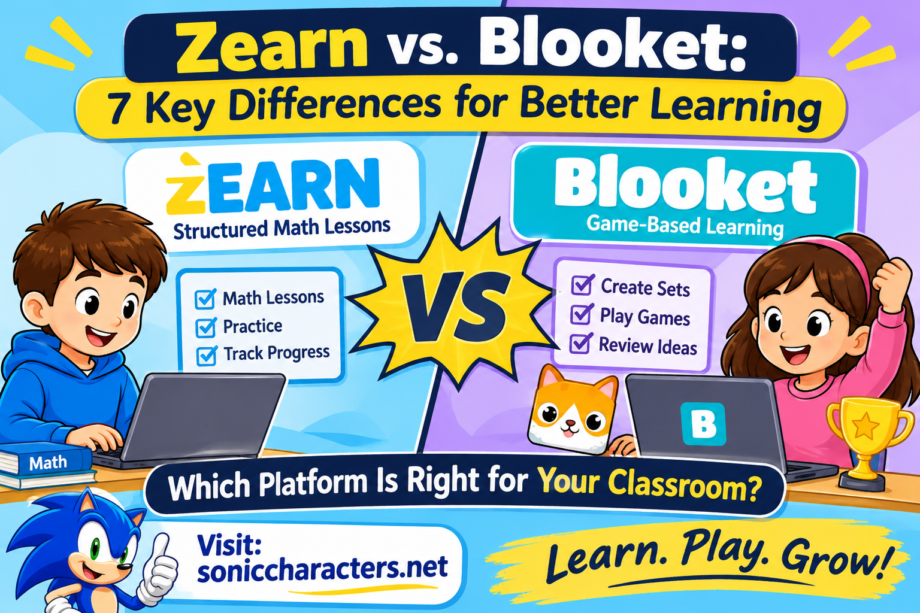
Digital learning platforms have changed the way teachers introduce lessons, review important concepts, and keep students involved in classroom activities. Instead of relying entirely on textbooks and traditional worksheets, educators can now use interactive tools to create more flexible learning experiences. Two platforms that represent different approaches to education are Zearn and Blooket.
Although both platforms support student learning, they are designed for different classroom purposes. Zearn focuses on structured mathematics instruction, guided practice, and building a strong understanding of mathematical concepts. Blooket, on the other hand, allows teachers to create or select question sets and turn them into interactive games that encourage participation.
Understanding the difference between Zearn and Blooket can help educators choose the right resource for their teaching goals. One platform provides a more organized learning pathway, while the other makes reviewing information feel like a classroom competition. Both can be useful when teachers understand how to incorporate them into everyday instruction.
1. What Is Zearn and How Does It Work?
Zearn is a digital mathematics learning platform designed to help students develop mathematical understanding through structured lessons and interactive activities. Rather than simply presenting a collection of questions, it provides an organized learning experience that guides students through different concepts.
The platform is especially useful for teachers who want students to follow a consistent mathematics learning pathway. Lessons can include visual explanations, guided activities, independent practice, and opportunities to work through mathematical problems.
One important feature of Zearn is its emphasis on understanding how mathematical ideas work. Students are encouraged to explore concepts instead of only memorizing answers. This approach can help them recognize patterns, understand relationships between numbers, and develop confidence when solving unfamiliar problems.
For example, when students are learning multiplication, they may encounter visual models and activities that demonstrate how multiplication works. This makes the learning process more meaningful because students can connect mathematical symbols with practical representations.
Teachers can also use the platform to support classroom instruction. They may assign lessons, monitor student progress, and identify areas where additional explanation or practice is needed.
The main advantage of Zearn is that it provides a structured environment for mathematics education. Instead of depending entirely on separate classroom activities, teachers can incorporate digital lessons into a broader instructional plan.
2. What Makes Blooket Different From Zearn?
Blooket takes a different approach to digital learning. It focuses on interactive games that teachers can create using question sets. Students join these activities and answer questions while participating in different game modes.
Unlike Zearn, Blooket is not primarily designed to deliver a complete mathematics curriculum. Its main purpose is to make question-based learning more engaging through competition, rewards, and interactive gameplay.
Teachers can create their own question sets or explore existing collections that match their classroom topics. Once a set is ready, they can select a game mode and invite students to participate.
For example, a teacher covering multiplication tables might prepare a set containing questions about numbers, calculations, and mathematical patterns. Students answer the questions while playing a selected game.
This approach can make classroom revision more enjoyable. Students who normally feel less interested in traditional question sheets may become more motivated when the same questions are included in an interactive activity.
Another difference is flexibility. Blooket can be used across different subjects, including mathematics, science, vocabulary, history, and general knowledge.
While Zearn provides a more focused mathematical learning experience, Blooket offers a flexible question-based environment that teachers can adapt to different classroom situations.
3. Zearn vs. Blooket: Understanding Their Main Learning Approaches
The most important difference between these platforms is how they organize learning.
Zearn provides structured lessons that students follow to develop their understanding of specific mathematical concepts. Its activities are designed to support learning over time, rather than focusing only on answering individual questions.
Blooket works differently because teachers build or select question sets and use them in interactive games. The platform does not require teachers to follow one fixed instructional sequence.
Consider a classroom where students are learning fractions.
With Zearn, a teacher might use structured lessons that introduce fraction concepts, explain mathematical relationships, and provide guided opportunities for practice.
With Blooket, the same teacher could create a fraction question set and use it in a game to review equivalent fractions, comparisons, or basic calculations.
Both experiences can contribute to learning, but they serve different purposes.
Zearn is better suited to introducing and developing mathematical understanding through an organized learning process. Blooket is particularly useful when teachers want students to revisit information, practice answering questions, and participate in a more entertaining classroom activity.
These differences make it important to select a platform according to the lesson objective rather than simply choosing the one with the most exciting interface.
4. Classroom Engagement: Structured Practice or Game-Based Learning?
Student engagement is an important part of successful teaching. Even a well-prepared lesson may become less effective if students struggle to maintain their attention.
Both platforms offer different ways to encourage participation.
Zearn supports engagement through interactive mathematics activities and lessons that give students opportunities to work with mathematical ideas. Students can progress through learning activities while developing their understanding of the subject.
This type of engagement is useful for classrooms where teachers want students to concentrate on a particular concept and complete activities connected to their learning objectives.
Blooket encourages participation through game mechanics. Students answer questions, collect rewards, and compete in different game environments. These elements can make review sessions more exciting.
For instance, a teacher might organize a short Blooket activity at the end of a lesson about division. Students answer questions while participating in a selected game mode, allowing the teacher to review the material in a more interactive way.
However, teachers should remember that competition does not automatically mean deeper understanding. Some students may focus more on earning rewards or answering quickly than considering why an answer is correct.
Similarly, structured digital lessons are most effective when students receive appropriate classroom guidance.
A balanced teaching strategy can use both approaches. Zearn can support the main instructional process, while Blooket can provide an enjoyable opportunity to revisit important concepts.
5. Lesson Structure and Teacher Control
Teachers need educational resources that fit their classroom schedules, student abilities, and curriculum requirements.
Zearn is built around organized mathematics lessons. This makes it useful for educators who want students to work through concepts in a planned sequence.
The structured nature of Zearn can help teachers maintain consistency across different lessons. It also provides a way to include digital mathematics practice alongside teacher-led explanations and classroom discussions.
Blooket gives teachers a different type of control. Instead of following a predefined lesson pathway, educators can prepare question sets based on what students are currently studying.
For example, a teacher can create questions about addition, subtraction, multiplication, or geometry and use those questions in a game.
This flexibility makes Blooket suitable for short activities, classroom reviews, and informal knowledge checks.
The two platforms can also fit into different parts of the same teaching schedule.
A teacher might begin a mathematics lesson with an explanation, introduce structured practice through Zearn, and finish with a short Blooket activity.
This arrangement gives students opportunities to learn, practice, and review information without making every classroom activity feel identical.
6. Personalized Learning and Student Progress
Students do not always learn at the same speed. Some understand a new concept immediately, while others need additional examples and practice.
A useful digital learning platform should help teachers recognize these differences and provide suitable support.
Zearn is designed to support students as they progress through mathematics lessons. Its structured activities allow educators to incorporate digital practice into instruction and identify where students may need additional assistance.
This can be especially helpful when teaching topics that build on earlier knowledge. A student who has difficulty understanding multiplication, for example, may also experience challenges when learning division.
Teachers can use classroom observations and available progress information to decide when students need another explanation or more practice.
Blooket supports a different type of learning assessment. Teachers can use question-based activities to see how students respond to particular topics.
A game session can reveal which questions students answer correctly and which concepts may require further review. This information can help teachers decide what to explain during the next lesson.
However, Blooket games should not be treated as a complete measurement of mathematical ability. A student’s performance in a competitive activity may be influenced by speed, familiarity with the game, and confidence.
For deeper mathematics instruction, Zearn and teacher-led assessment can provide a more organized approach, while Blooket can help identify topics that deserve additional attention.
7. Subject Coverage and Learning Flexibility
Another important difference involves the subjects each platform supports.
Zearn has a strong focus on mathematics education. Its lessons are intended to help students understand mathematical concepts through organized instruction and practice.
This focused approach is useful for schools and teachers looking for a digital resource specifically connected to mathematics learning.
Blooket is more flexible in terms of subject matter. Teachers can create question sets for a wide range of classroom topics.
For example, educators can use Blooket for:
- Mathematics calculations and number practice.
- Science vocabulary and basic concepts.
- History dates and important events.
- English vocabulary and reading comprehension.
- Geography questions and general knowledge.
- Classroom revision before quizzes and assessments.
This flexibility makes it suitable for teachers who want one game-based platform for different subjects.
However, having more subject options does not necessarily make a platform better for every learning objective.
A mathematics teacher who needs structured lessons may prefer Zearn, while an educator who wants to review vocabulary or science facts may find Blooket more adaptable.
The best choice depends on what students need to accomplish during a particular lesson.
8. How Teachers Can Use Zearn and Blooket Together
Teachers do not necessarily need to choose only one platform. In many classrooms, combining different educational resources can create a more balanced learning experience.
Zearn and Blooket can complement each other because their primary purposes are different.
Here is an example of how a teacher might use both platforms during a mathematics lesson.
Step 1: Introduce the mathematical concept
The teacher begins by explaining the topic using classroom examples, visual materials, and questions that encourage students to think.
Step 2: Use Zearn for structured instruction
Students work through relevant mathematics lessons and activities. This provides an opportunity to develop understanding and practice the concept in an organized environment.
Step 3: Identify areas that need revision
The teacher observes student performance and identifies topics that may require further explanation.
Step 4: Prepare a Blooket question set
The teacher creates a question set based on the lesson. Questions can cover important definitions, calculations, and common mistakes.
Step 5: Organize an interactive review activity
Students participate in a selected Blooket game mode and answer questions related to the mathematics lesson.
Step 6: Discuss the results
After the activity, the teacher reviews difficult questions and explains why certain answers are correct.
This method creates a connection between structured learning and interactive revision.
Instead of using games as a replacement for teaching, educators can use them as an additional opportunity for students to practice what they have already learned.
9. Which Platform Is Better for Different Types of Students?
Different students respond to different teaching methods. Some prefer working independently, while others enjoy collaborative activities and classroom competitions.
Zearn may be particularly useful for students who benefit from organized mathematics instruction. Its structured learning approach gives them an opportunity to work through concepts and practice mathematical skills.
Students who need more time to understand a topic can benefit from activities that encourage careful thinking rather than focusing entirely on speed.
Blooket may appeal to students who enjoy interactive challenges and game-based activities. Its different game modes can create an energetic classroom atmosphere and encourage participation.
It can also help teachers make revision sessions less repetitive.
However, educators should consider student preferences carefully. Not every student enjoys competition, and not every student finds independent digital lessons equally comfortable.
Some students may feel more confident when working through structured activities, while others may become more involved when learning includes games and rewards.
The goal should be to provide different opportunities for participation rather than expecting every student to learn in exactly the same way.
10. Common Mistakes Teachers Should Avoid
Digital learning platforms can be valuable classroom resources, but their effectiveness depends on how they are used.
One common mistake is treating Zearn and Blooket as interchangeable tools. Although both support learning, their purposes are not identical.
Zearn is designed around structured mathematics instruction, while Blooket focuses on teacher-created or selected question sets used in games.
Another mistake is using game-based activities without connecting them to lesson objectives. A Blooket game should contain questions that support what students are learning rather than simply providing entertainment.
Teachers should also avoid relying entirely on digital activities. Classroom discussion, teacher explanations, written practice, and real-world examples remain important parts of education.
A further mistake is focusing only on completion or game scores. Students may complete an activity without fully understanding the concept behind it.
For better results, teachers should discuss difficult questions, explain incorrect answers, and provide opportunities for additional practice.
Finally, educators should consider the practical requirements of each platform, including internet access, device availability, student accounts where required, and school policies.
A successful digital learning strategy is not about using the largest number of educational tools. It is about choosing suitable resources and using them with a clear purpose.
11. Final Comparison: Zearn or Blooket?
Choosing between these platforms becomes easier when teachers consider what they want students to achieve.
Zearn is a suitable choice when the main objective is structured mathematics instruction. It supports organized lessons, guided activities, and opportunities to develop mathematical understanding.
Blooket is a suitable option when teachers want to create interactive question-based activities. Its game modes can make revision more enjoyable and provide an alternative way to check students’ knowledge.
The following comparison summarizes their main differences:
| Feature | Zearn | Blooket |
|---|---|---|
| Main purpose | Mathematics instruction | Game-based learning |
| Learning approach | Structured lessons | Interactive question sets |
| Subject focus | Mathematics | Multiple subjects |
| Teacher preparation | Lesson planning and assignments | Creating or selecting question sets |
| Student activities | Guided math practice | Games and quizzes |
| Classroom use | Learning and practice | Revision and engagement |
| Flexibility | Mathematics-focused | Broad subject flexibility |
| Best suited for | Developing math understanding | Reviewing knowledge |
Neither platform is automatically the better option for every classroom.
Teachers who want a structured mathematics learning experience may find Zearn more appropriate. Educators who want to turn classroom questions into interactive games may prefer Blooket.
For many classrooms, using both can be a practical solution.
Conclusion
Digital education works best when technology supports the teacher’s instructional goals rather than replacing the entire learning process. Zearn and Blooket demonstrate two different ways of making classroom activities more effective.
Zearn provides structured mathematics lessons that can become part of regular classroom instruction. Blooket offers a flexible game-based environment where teachers build question sets and encourage students to review information through interactive activities.
Understanding the difference between Zearn and Blooket helps educators make better decisions about their digital teaching resources. Rather than expecting one platform to perform every educational task, teachers can select the right tool for each stage of learning.
When structured mathematics practice is combined with meaningful classroom discussion and enjoyable review activities, students receive more opportunities to understand concepts, improve their skills, and participate actively in their education.
