
Mathematics is one of the most important subjects children study during their school years. However, many young learners find mathematical word problems confusing because they require more than simply adding, subtracting, multiplying, or dividing numbers. Students must understand the situation, identify useful information, and decide which mathematical operation will produce the correct answer.
A math solver approach can make this process easier by breaking complicated questions into smaller, manageable steps. When students understand how numbers connect with everyday situations, they become more confident and develop stronger problem-solving abilities.
Interactive educational platforms such as Blooket have introduced exciting ways to practise mathematics through classroom games and quizzes. Instead of answering questions only on paper, students can participate in activities that combine learning with friendly competition.
For Grades 4–6, mathematical word problems are especially valuable because children are developing essential skills involving fractions, decimals, percentages, measurements, and basic geometry.
In this guide, we will explore ten engaging mathematics questions suitable for elementary and middle school learners. Each example includes an explanation, a solution, and practical suggestions for using the question in an interactive classroom environment.
Why Mathematical Word Problems Matter for Grades 4–6
Word problems encourage children to think beyond memorized formulas. They introduce realistic situations where mathematical reasoning becomes useful.
For example, imagine a student buying school supplies, sharing pizza with friends, or calculating the distance between two locations. Each situation requires a different mathematical strategy.
A math solver method helps learners recognize which information matters and which calculation should be performed.
Teachers often introduce word problems to develop several important abilities:
- Reading comprehension and mathematical vocabulary
- Logical reasoning and critical thinking
- Understanding relationships between quantities
- Selecting appropriate mathematical operations
- Checking whether an answer makes sense
- Applying classroom knowledge to real situations
These abilities become increasingly important as students move into higher grades.
Interactive games can also make mathematical practice more enjoyable. When learners receive immediate feedback, they can recognize mistakes and improve their understanding before moving to the next challenge.
1. Shopping at the School Bookstore
Question: Emma visits a bookstore to purchase three notebooks. Each notebook costs $4. She also buys two pencils costing $2 each. How much money does Emma spend altogether?
Step-by-Step Solution
First, calculate the total cost of the notebooks.
3 × $4 = $12
Next, calculate the cost of the pencils.
2 × $2 = $4
Finally, add both amounts.
$12 + $4 = $16
Correct Answer: $16
This problem introduces multiplication followed by addition.
A math solver strategy involves separating the purchases into individual categories before calculating the final amount.
Classroom Activity: Teachers can create a Blooket multiple-choice question with four possible answers: $12, $14, $16, and $18.
Students select the correct answer and discuss why the other options are incorrect.
This activity teaches learners how to organize information when solving shopping-related mathematical questions.
2. Sharing Pizza With Friends
Question: A pizza is divided into eight equal slices. Daniel eats three slices, and his sister eats two slices. What fraction of the pizza remains?
Step-by-Step Solution
The pizza originally contains eight slices.
Daniel eats 3 slices.
His sister eats 2 slices.
Total slices eaten:
3 + 2 = 5
Remaining slices:
8 − 5 = 3
The fraction remaining is:
3/8
Correct Answer: 3/8
This question introduces fractions using an everyday example.
Students can apply a math solver technique by identifying the whole quantity before determining how much remains.
Classroom Activity: Display a picture of a pizza divided into eight sections. Ask students to identify the fraction remaining after five slices have been removed.
Visual examples help children understand fractions more effectively than memorizing numerical rules alone.
3. Calculating Distance During a Bicycle Ride
Question: Oliver rides his bicycle 6 kilometers every day. How many kilometers will he travel in seven days if he rides the same distance daily?
Step-by-Step Solution
Daily distance = 6 kilometers
Number of days = 7
Multiply the daily distance by the number of days.
6 × 7 = 42
Correct Answer: 42 kilometers
This problem demonstrates repeated addition and multiplication.
A math solver approach encourages students to recognize that repeated equal quantities can be calculated using multiplication.
Classroom Activity: Teachers can challenge students to solve the problem within 30 seconds during a Blooket game.
After the activity, ask learners to explain how multiplication makes the calculation faster than adding six seven times.
4. Finding the Perimeter of a Garden
Question: A rectangular garden is 12 meters long and 7 meters wide. What is its perimeter?
Step-by-Step Solution
The perimeter of a rectangle is calculated using:
Perimeter = 2 × (Length + Width)
Substitute the given measurements.
Perimeter = 2 × (12 + 7)
Perimeter = 2 × 19
Perimeter = 38 meters
Correct Answer: 38 meters
This question introduces geometry and measurement.
A math solver process helps students remember that perimeter represents the total distance around a shape rather than the space inside it.
Classroom Activity: Draw a rectangle on the board and label its sides.
Students can calculate the perimeter individually before comparing their answers with classmates.
Teachers may also introduce a follow-up question asking how much fencing would be required to surround the garden.
5. Understanding Discounts at a Clothing Store
Question: A jacket costs $60. During a special sale, the store offers a 25% discount. What is the final price of the jacket?
Step-by-Step Solution
Original price = $60
Discount = 25%
Calculate the discount amount.
25/100 × 60 = $15
Subtract the discount from the original price.
$60 − $15 = $45
Correct Answer: $45
This problem introduces percentages and financial literacy.
Students using a math solver method should first calculate the discount amount before subtracting it from the original price.
Classroom Activity: Create a shopping-themed quiz containing different products and discounts.
Students can compare prices and determine which products offer the greatest savings.
For younger learners, teachers can explain that 25% means one-quarter of the original amount.
6. Measuring Ingredients for a Cake
Question: A cake recipe requires 3/4 cup of sugar. Mia wants to prepare two cakes using the same recipe. How much sugar will she need altogether?
Step-by-Step Solution
Sugar required for one cake = 3/4 cup
Number of cakes = 2
Multiply the fraction by two.
3/4 × 2 = 6/4
Simplify the fraction.
6/4 = 3/2 = 1 1/2
Correct Answer: 1½ cups
This question demonstrates multiplication involving fractions.
A math solver approach helps students understand that doubling a recipe means doubling every ingredient.
Classroom Activity: Ask students to imagine preparing cakes for a school celebration.
Teachers can expand the question by asking how much sugar would be needed for four cakes.
This activity connects mathematics with cooking and everyday measurements.
7. Calculating the Average Test Score
Question: Sophia receives the following scores on four mathematics tests: 80, 90, 70, and 100. What is her average score?
Step-by-Step Solution
First, add the four scores.
80 + 90 + 70 + 100 = 340
Next, divide the total by the number of tests.
340 ÷ 4 = 85
Correct Answer: 85
This question introduces the arithmetic mean, commonly called the average.
Students following a math solver method should remember that calculating an average requires adding all values and dividing by the number of values.
Classroom Activity: Teachers can present different groups of test scores and ask students to calculate the average for each group.
Students can also compare how a particularly high or low score affects the final average.
8. Finding the Area of a Playground
Question: A rectangular playground measures 15 meters in length and 10 meters in width. What is its total area?
Step-by-Step Solution
The formula for the area of a rectangle is:
Area = Length × Width
Substitute the measurements.
Area = 15 × 10
Area = 150 square meters
Correct Answer: 150 square meters
This problem introduces area measurement.
A math solver strategy encourages students to distinguish between area and perimeter.
Perimeter measures the distance around a shape, while area measures the space inside it.
Classroom Activity: Ask learners to draw rectangles with different dimensions and calculate their areas.
Students can compare which rectangles cover the largest amount of space.
Teachers can also introduce square grids to demonstrate why area is expressed in square units.
9. Calculating Time for a School Trip
Question: A school bus leaves at 9:15 AM and reaches the museum at 11:00 AM. How long does the journey take?
Step-by-Step Solution
Start time = 9:15 AM
Arrival time = 11:00 AM
First, calculate the time from 9:15 AM to 10:15 AM.
That equals 1 hour.
Next, calculate the time from 10:15 AM to 11:00 AM.
That equals 45 minutes.
Total travel time:
1 hour + 45 minutes = 1 hour 45 minutes
Correct Answer: 1 hour 45 minutes
This problem develops time calculation skills.
A math solver method helps learners divide the time interval into smaller sections instead of attempting the entire calculation mentally.
Classroom Activity: Present different bus departure and arrival times.
Ask students to determine travel durations and explain their calculations.
Teachers can also introduce questions involving arrival times after midday.
10. Dividing School Supplies Equally
Question: A teacher has 96 colored pencils and wants to distribute them equally among eight students. How many pencils will each student receive?
Step-by-Step Solution
Total pencils = 96
Number of students = 8
Divide the total number of pencils by the number of students.
96 ÷ 8 = 12
Correct Answer: 12 pencils
This question introduces equal distribution through division.
A math solver technique encourages students to identify the total quantity and the number of equal groups.
Classroom Activity: Teachers can use counters, blocks, or pencils to demonstrate equal sharing.
Students can physically divide objects into groups before performing the calculation.
This practical approach is especially helpful for children who are still developing confidence with division.
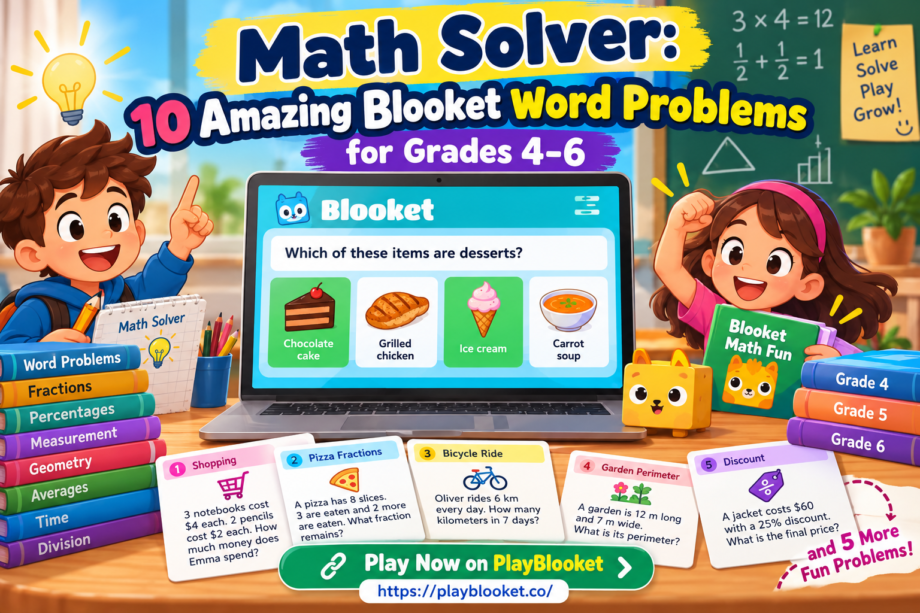
Bonus Quiz: Which of These Items Are Desserts?
Not every classroom quiz needs to involve numerical calculations. Some interactive activities can develop classification, reading comprehension, and logical thinking.
For example, a question inspired by the type of quizzes available on Wayground might ask:
Question: Which of these items are desserts?
A. Chocolate cake
B. Grilled chicken
C. Ice cream
D. Carrot soup
Correct Answers: A and C — Chocolate cake and ice cream
This is a multiple-answer classification question rather than a mathematics problem.
Teachers can use similar questions as warm-up activities before introducing numerical challenges.
A math solver lesson can incorporate these short reasoning exercises to encourage students to read instructions carefully.
For instance, teachers might replace the food question with one asking students to identify all the even numbers from a group of choices.
This combines classification skills with mathematical understanding.
How Blooket Makes Mathematics More Interactive
Blooket is an educational platform that allows teachers to create and host learning games using question sets.
Instead of completing traditional worksheets throughout an entire lesson, students can answer mathematical questions through interactive game modes.
Teachers can create their own questions or explore suitable existing sets.
The platform can be useful for reviewing previously taught concepts and identifying areas where students need additional practice.
Creating a Mathematics Question Set
Teachers can begin by signing into Blooket and opening their dashboard.
From there, they can create a new question set and give it a descriptive title such as “Grade 5 Mathematics Word Problems.”
Each question should include clear instructions, appropriate answer choices, and the correct answer.
A math solver question set works best when problems gradually increase in difficulty.
For example, teachers might begin with multiplication questions before introducing fractions, percentages, and geometry.
This progression helps students build confidence while developing new skills.
Choosing Suitable Questions
Questions should match the age and learning level of the students.
Grade 4 learners may benefit from multiplication, division, basic fractions, and simple measurements.
Grade 5 students can explore decimal calculations, multi-step word problems, and more advanced fraction operations.
Grade 6 learners may be ready for percentages, ratios, averages, and introductory algebra.
Teachers should avoid introducing too many unfamiliar concepts in a single activity.
Encouraging Mathematical Explanations
Selecting the correct answer is important, but understanding the reasoning behind the answer is equally valuable.
After each game, teachers can review difficult questions with the class.
Students should explain which operations they selected and why those operations were appropriate.
This process transforms a simple quiz into a meaningful learning opportunity.
How to Use a Math Solver Strategy Without Relying on Guesswork
Students sometimes become frustrated when they encounter long mathematical questions.
However, a structured approach can make these problems easier to understand.
The following five-step process can help learners solve questions independently.
Step 1: Read the Entire Question
Students should read the problem carefully before attempting any calculation.
They must understand what the question is asking.
Rushing often leads to mistakes because important details are overlooked.
Step 2: Identify Important Information
The next step is to highlight useful numbers and quantities.
For example, a shopping question might contain prices, quantities, and discounts.
A math solver approach helps learners separate essential information from unnecessary details.
Step 3: Choose the Correct Operation
Students must decide whether the problem requires addition, subtraction, multiplication, division, or a combination of operations.
Words such as “altogether,” “remaining,” and “equally shared” may provide clues.
However, learners should understand the complete situation rather than depend only on keywords.
Step 4: Solve the Problem Carefully
After choosing an operation, students should perform the calculation one step at a time.
Writing down intermediate results helps prevent confusion.
A math solver routine should encourage organized working rather than random guessing.
Step 5: Check the Final Answer
Students should review their calculations and decide whether the answer makes sense.
For example, if a discounted product costs more than its original price, the calculation probably contains an error.
Checking answers develops accuracy and independent thinking.
Benefits of Practising Mathematics Through Educational Games
Interactive learning can provide several advantages when used alongside traditional teaching.
Greater Student Participation
Educational games can encourage participation from students who are usually hesitant to answer questions aloud.
A playful environment may help learners feel more comfortable attempting challenging problems.
Immediate Feedback
When students receive quick feedback, they can identify incorrect answers and review their reasoning.
However, teachers should still explain mistakes so students understand the underlying concepts.
Better Problem-Solving Habits
Regular practice encourages children to approach unfamiliar questions with greater confidence.
Using a math solver process repeatedly can help students develop consistent problem-solving habits.
Opportunities for Collaborative Learning
Teachers can organize small-group activities where students discuss possible solutions.
Working together allows children to compare strategies and learn from one another.
Increased Motivation
Games can make repetitive practice feel more engaging.
However, teachers should balance competition with thoughtful explanations so that speed does not become more important than accuracy.
Blooket and Wayground: Different Ways to Practise Mathematics
Blooket and Wayground, formerly known as Quizizz, both support interactive educational activities.
Blooket emphasizes game-based learning through question sets and different gameplay experiences.
Wayground provides quiz-based learning activities, instructional resources, and assessment tools.
Both can support mathematics practice, although their features and available activities differ.
A math solver classroom activity can be adapted for either platform by using clear word problems and carefully selected answer choices.
For example, teachers could create a ten-question quiz involving shopping, fractions, geometry, and measurement.
Students could complete the activity individually or participate in a teacher-led classroom session.
Some learning resources are available for free, while particular features may depend on the platform’s current subscription options.
Teachers should review the available settings before planning their lessons.
Common Mistakes Students Make When Solving Word Problems
Even students who understand basic calculations sometimes struggle with word problems.
One common mistake is choosing the wrong mathematical operation.
For example, a student may multiply two numbers when the problem actually requires division.
Another mistake involves ignoring measurement units.
If a question asks for distance in kilometers, the final answer should include kilometers.
Fractions and percentages can also create confusion, especially when students forget to simplify answers or misunderstand the meaning of a percentage.
A math solver checklist can reduce these mistakes by reminding learners to read carefully, organize information, perform calculations, and verify results.
Teachers should encourage students to treat incorrect answers as opportunities to improve their reasoning.
Rather than simply providing the correct answer, they can ask students to identify where their calculations went wrong.
Practical Tips for Parents Supporting Mathematics at Home
Parents can play an important role in developing children’s mathematical confidence.
Daily activities provide many opportunities to practise mathematics naturally.
For example, children can calculate the cost of groceries, measure ingredients while cooking, or determine how much time remains before an appointment.
Parents can also create short quizzes involving multiplication, division, and fractions.
A math solver activity at home does not require expensive equipment or complicated technology.
Paper, pencils, measuring cups, coins, and everyday objects can become useful learning materials.
Parents should focus on understanding rather than speed.
When children explain their reasoning, adults can identify misunderstandings and provide appropriate guidance.
Short, regular practice sessions are often more manageable than long sessions that leave children feeling overwhelmed.
Frequently Asked Questions
What is a math solver in elementary mathematics?
A math solver is a method or tool used to work through mathematical questions. For elementary students, it is most useful when it encourages step-by-step reasoning and helps children understand how an answer is calculated.
Are Blooket mathematics games suitable for Grades 4–6?
Yes. Teachers can create age-appropriate question sets involving multiplication, division, fractions, percentages, geometry, and word problems. The difficulty should match the students’ learning levels.
Can students practise mathematics on Wayground for free?
Wayground offers free educational resources and activities, although some features may require a paid plan. Teachers and students should check the current availability of specific resources.
What makes mathematical word problems difficult?
Word problems require students to understand written instructions, identify relevant quantities, select operations, and calculate accurately. Difficulty may arise from reading comprehension as well as mathematical understanding.
How can teachers improve students’ problem-solving skills?
Teachers can use real-world examples, visual aids, guided explanations, classroom discussions, and interactive quizzes. Students should also be encouraged to explain their reasoning rather than memorize answers.
Should children use online tools for every mathematics question?
No. Online tools can support learning, but students should also practise solving questions independently. Understanding mathematical concepts is more valuable than simply receiving correct answers.
Conclusion
Mathematical word problems help children understand how classroom knowledge connects with everyday life. From calculating shopping expenses to measuring playgrounds and sharing school supplies, practical questions make mathematics more meaningful.
The ten examples in this guide cover essential topics for Grades 4–6, including arithmetic, fractions, percentages, geometry, averages, and time calculations.
Interactive platforms such as Blooket and Wayground can make these lessons more engaging by allowing students to practise through quizzes and classroom activities.
Most importantly, a reliable math solver approach teaches children to read carefully, organize information, select suitable operations, and check their answers.
With regular practice, supportive teaching, and enjoyable learning activities, students can develop the confidence and reasoning skills needed to tackle increasingly challenging mathematics problems.
