
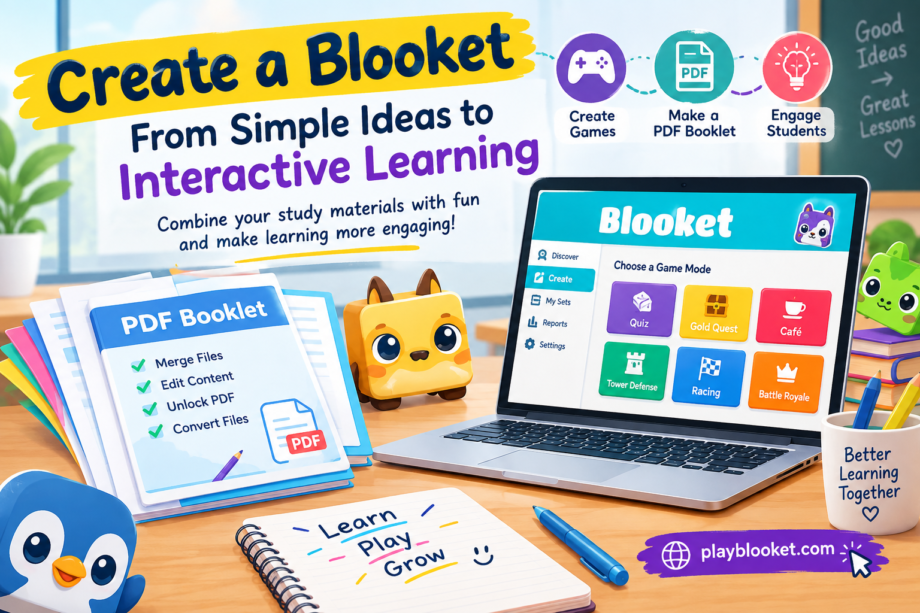
Learning becomes much more interesting when students are given a chance to participate rather than simply read information from a page. Digital learning platforms have made it easier for teachers, students, and content creators to turn ordinary lessons into interactive activities. One popular approach is to create a blooket, where questions, answers, and game elements can work together to make review sessions more engaging.
At the same time, traditional documents still have an important role in education. Teachers often prepare worksheets, study guides, handouts, and small booklets to support a lesson. A digital booklet can be especially convenient because several files can be combined, edited, converted, or organized before sharing them with students.
Why Create a Blooket for Learning?
A classroom review session does not always have to follow the same routine. Instead of asking students to answer questions from a worksheet one by one, a teacher can introduce a game-based activity that encourages everyone to participate.
When you create a blooket, you can build questions around a particular subject or lesson. Students can then use those questions as a way to review information while taking part in a more entertaining activity.
The biggest advantage is that the questions can be adapted to the lesson. A history teacher might prepare questions about important events, while a science teacher could focus on vocabulary, concepts, or processes. The same basic idea can be used across many different subjects.
Start With a Clear Topic
Before creating any activity, decide what students should learn or review. A focused topic usually produces better questions than trying to cover an entire subject at once.
For example, a teacher working on fractions could prepare questions involving equivalent fractions, comparisons, and basic calculations. Another teacher might create an activity around vocabulary words from a recent reading assignment.
Writing down the learning goals first can make the process much easier. Once the goals are clear, the questions can be designed around them rather than added randomly.
Prepare Your Questions Carefully
Good questions are at the heart of any educational game. They should test knowledge without creating unnecessary confusion.
Try to include a mixture of straightforward questions and slightly more challenging ones. Easy questions can help students build confidence, while more difficult questions encourage them to think carefully about the material.
It is also useful to check every answer before using the activity. A small mistake in a question or answer can distract students and make the review session less effective.
Connect Digital Games With Useful Resources
Although interactive games are useful, they do not need to replace every other learning resource. Teachers can combine game-based activities with worksheets, notes, presentations, and digital booklets.
A booklet can contain information that students need before or after a game. For example, a teacher could provide a short study guide containing definitions, examples, diagrams, or practice exercises. Students could review that material and then participate in an interactive quiz.
This combination gives learners more than one way to approach the same subject.
Easily Create a PDF Booklet
PDF files are convenient when educational material needs to be shared across different devices. A teacher may have several documents containing lesson notes, exercises, or reference material and want to bring them together into one organized booklet.
You can easily create a PDF booklet by selecting the files you want to work with and combining them into a single document. Depending on the tool being used, files may also be edited, unlocked, converted, or rearranged before the final PDF is prepared.
This can save time when preparing resources for students. Instead of sending several separate files, a teacher can organize important material into one document that is easier to open, save, and reference.
Keep the Booklet Simple
A useful booklet does not have to contain dozens of pages. In many cases, a short and well-organized document is easier for students to use.
Start with a clear title and arrange the information in a logical order. Headings can separate different sections, while short paragraphs and lists can make the content easier to scan.
If images or diagrams are included, they should support the subject rather than simply fill empty space. The goal is to make the material useful and easy to understand.
Use a Booklet Before the Game
One practical approach is to use the PDF booklet as preparation for an interactive session. Students can receive the document before class and review the important information.
Afterward, the teacher can create a blooket based on the same material. This creates a simple connection between reading and participation.
For instance, a booklet about the solar system might introduce the planets, their characteristics, and interesting facts. The following game could then ask students to identify planets, match characteristics, or answer questions about their positions and features.
Students are therefore reviewing information they have already encountered rather than seeing completely unfamiliar questions.
Make Review Sessions More Engaging
Repetition is an important part of learning, but repeating the same exercise can become boring. Changing the format can help students stay interested.
A digital game can provide a different experience from reading a PDF or completing a worksheet. Students can review familiar information while interacting with classmates and responding to questions.
The key is balance. The game should support the lesson instead of becoming a distraction from it. Questions should remain connected to the subject, and the activity should have a clear purpose.
Organize Your Materials for Future Lessons
Once a teacher has created a useful collection of questions and PDF resources, those materials can become valuable references for future classes.
A well-organized folder might contain lesson notes, PDF booklets, question sets, answer keys, and other supporting documents. Keeping these materials organized makes it easier to update them when a lesson changes.
A booklet can also be revised when information needs to be corrected or expanded. Likewise, an interactive question set can be adjusted based on the areas where students struggled.
A Practical Combination for Modern Learning
Digital learning does not have to mean choosing one tool and ignoring everything else. Different resources can serve different purposes.
A PDF booklet can provide structured information. A worksheet can offer practice. An interactive game can provide review and participation. When these resources are connected, they can create a more complete learning experience.
The process can begin with a simple idea: decide what students need to understand, prepare supporting material, and then create a blooket that gives them an enjoyable way to review the lesson.
Final Thoughts
Creating engaging educational content is often less complicated than it seems. A focused set of questions, a clear learning objective, and useful supporting material can go a long way.
Teachers can combine interactive activities with practical resources such as PDF booklets to give students different ways to learn and review information. By organizing files, preparing thoughtful questions, and choosing an appropriate activity, a simple lesson can become much more engaging.
Whether the goal is to create a blooket for classroom review or create a PDF booklet containing helpful study material, the most important thing is keeping the learner at the center of the experience. Good educational resources should be clear, purposeful, and easy to use.
