
Introduction
Keeping students interested during a lesson is not always easy. Teachers regularly look for ways to make classroom activities more enjoyable without losing the educational purpose behind them. Traditional worksheets, written quizzes, and question-and-answer sessions can sometimes feel repetitive, especially when students have to review the same information several times. This is where interactive learning platforms can make a difference.
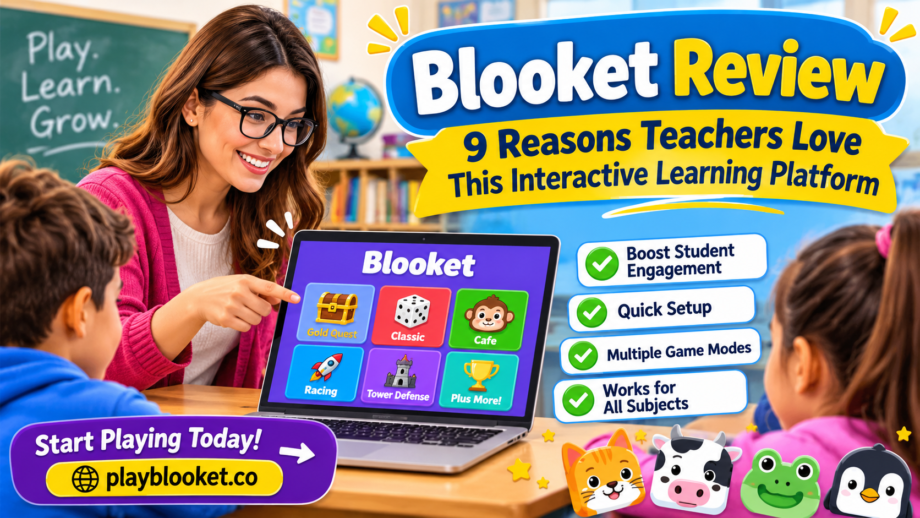
Blooket has become a popular option for educators who want to introduce a little competition and entertainment into their classrooms. It combines educational questions with game-based activities, allowing students to participate while practicing subjects they are already studying. Instead of simply answering questions on a worksheet, learners can take part in an activity that gives them an additional reason to stay focused.
This Blooket review explores the platform from a teacher’s perspective, including its classroom engagement, setup process, game experience, educational benefits, limitations, and overall value. One of its biggest attractions is how quickly an educator can organize a game, even when an unexpected opportunity for revision appears during a busy school day.
Whether you are a teacher searching for a fresh classroom activity or a parent interested in educational technology, understanding how Blooket works can help you decide whether it deserves a place in your learning routine.
1. What Makes Blooket Different From Traditional Classroom Quizzes?
Blooket takes the familiar idea of answering educational questions and introduces a game-based experience around it. Students respond to questions while participating in different game activities. Their answers become part of a larger experience rather than an isolated assessment.
In a traditional quiz, students usually receive questions, write their answers, and wait for their work to be checked. Although this approach remains useful, it does not always encourage enthusiastic participation from everyone. Some learners enjoy answering questions, while others may feel uncomfortable or lose interest.
Blooket offers another approach. Teachers can select a question set, choose a suitable game mode, and invite students to participate. The questions remain connected to learning objectives, but the surrounding activity introduces excitement.
An important point in this Blooket review is that the platform does not replace good teaching. Instead, it provides another way to practice information that students have already encountered. A well-planned game can reinforce vocabulary, mathematical concepts, historical facts, science topics, and many other subjects.
The experience is particularly useful when teachers want to change the pace of a lesson without spending an entire class period preparing a new activity.
2. Quick Game Setup Is a Major Advantage
Teachers often work under tight schedules. Between preparing lessons, checking assignments, managing classroom activities, and answering student questions, there may be very little time available for creating additional learning resources.
One reason Blooket receives positive feedback from educators is its relatively straightforward game setup.
A teacher can start by choosing an existing question set or preparing a new one. After selecting an appropriate game mode, the teacher can host the activity and provide students with the joining information. Students can then participate using compatible devices and the instructions provided by their teacher.
This process can be particularly helpful during a last-minute revision session.
Imagine that a teacher finishes a mathematics lesson earlier than expected. Instead of immediately assigning another worksheet, the teacher can organize a short review game based on the topic covered that day. Students get an opportunity to practice, and the teacher gets another chance to observe how well the class understands the material.
The convenience of preparation is one of the strongest points highlighted in this Blooket review. A classroom activity does not always need elaborate planning to become useful. Sometimes, selecting the right questions and choosing an appropriate game mode is enough to create a productive learning opportunity.
However, teachers should still check their questions before starting. Incorrect answers, unclear wording, or questions that are too difficult can interrupt the activity and create confusion.
3. Student Engagement Makes Learning More Enjoyable
Student engagement is one of the most frequently discussed advantages of game-based learning. When learners feel involved in an activity, they may become more willing to participate and pay attention.
Blooket introduces several elements that can support classroom involvement. These include competition, progress, rewards within game activities, and opportunities to answer questions in an interactive environment.
For students who enjoy games, these elements can make revision feel less like a routine academic task. They have a reason to concentrate on each question because their responses contribute to the activity.
Another benefit is that students who normally remain quiet during traditional classroom discussions may become more interested in participating. A game creates a different atmosphere, which can encourage learners to try answering questions without feeling that every response is part of a formal examination.
Still, engagement should not be confused with learning. A student may enjoy a game without fully understanding the subject. Teachers need to connect the activity to the lesson and discuss difficult questions afterward.
A balanced Blooket review should recognize both sides. The platform can make educational practice more appealing, but the teacher remains responsible for ensuring that entertainment supports the intended learning outcome.
4. Different Game Modes Keep Classroom Activities Fresh
Repeating exactly the same activity every day can make students lose interest. Even a useful learning resource can become less exciting when there is no variation.
Blooket addresses this challenge by offering different game modes that change how students interact with questions. Depending on the available modes and their current features, the experience may involve collecting rewards, competing with classmates, building progress, or completing other game-based challenges.
This variety gives teachers more flexibility when planning classroom activities.
For example, a teacher might select a competitive format for a short revision session when students are already familiar with the topic. For another lesson, a different mode may be more appropriate because it creates a new experience.
The important thing is to select a mode that matches the classroom objective rather than choosing one simply because it looks entertaining.
Some students prefer fast-paced activities, while others may perform better when they have more time to consider each answer. Teachers should consider the age, ability, and preferences of their learners before deciding which experience to use.
In this Blooket review, variety stands out as a practical advantage because it gives educators more opportunities to experiment. They can adjust classroom activities without changing the educational questions every time.
5. Teachers Can Use Existing Question Sets
Creating educational questions from scratch takes time. Teachers who prepare multiple lessons every week may not always have the opportunity to develop a complete quiz for every topic.
Existing question sets can make this process easier.
Blooket allows educators to explore available learning content and use suitable question sets for their activities. This can be particularly helpful when preparing a quick classroom review or looking for inspiration before introducing a new topic.
For instance, a science teacher might look for questions about the human body, while an English teacher may want vocabulary or grammar practice. A mathematics educator could use questions involving calculations, shapes, or number recognition.
Before using any existing set, teachers should review its content carefully. Not every question set will match the exact curriculum, grade level, or terminology used in a particular classroom.
Some questions may need editing, while others may be unsuitable for the intended students. Checking the answers is equally important because educational accuracy should always come before convenience.
A useful Blooket review should emphasize that existing content saves preparation time, but it does not remove the need for teacher judgment.
6. How Blooket Supports Different Learning Subjects
One attractive feature of a question-based learning platform is its flexibility across different academic subjects.
Teachers do not have to limit their activities to one particular area of education. With appropriate question sets, Blooket can support revision across several subjects.
Mathematics
Mathematics teachers can use question sets for addition, subtraction, multiplication, division, fractions, percentages, and other concepts. Short questions can help students practice calculations and improve familiarity with important formulas.
English Language
English educators can create activities involving spelling, vocabulary, grammar, sentence structure, and reading comprehension. These activities can help students review concepts that require regular practice.
Science
Science question sets can cover subjects such as biology, chemistry, physics, environmental studies, and general scientific knowledge. Teachers can use questions to reinforce important definitions and concepts.
History and Geography
Students can practice historical events, important dates, geographical locations, capitals, landmarks, and other information. These topics often involve remembering facts, making interactive revision useful.
General Knowledge
General knowledge activities can introduce students to information beyond their regular textbooks. Teachers may use them for classroom warm-ups, informal competitions, or occasional revision sessions.
The flexibility of subject selection is another reason educators may consider this platform. As this Blooket review demonstrates, the usefulness of the experience depends largely on the quality and relevance of the questions selected.
7. Is Blooket Easy for Students to Use?
An educational platform should not create unnecessary technical difficulties. If students spend more time understanding how to join an activity than answering questions, the experience can become frustrating.
Blooket aims to keep student participation relatively straightforward. In a typical hosted game, the teacher shares the joining instructions, and students follow them to enter the activity.
The exact experience depends on the game, classroom devices, internet connection, and any school restrictions.
Students who regularly use online learning tools may find the process familiar. Those who are using the platform for the first time may need a short explanation from their teacher.
It is helpful to demonstrate the joining process before starting an important classroom activity. Teachers can also explain the rules, show students how to respond to questions, and clarify what they should do if a technical problem occurs.
An important observation in this Blooket review is that ease of use does not mean every classroom will have an identical experience. Schools with reliable internet access and suitable devices may find implementation easier than classrooms with limited technology.
Teachers should have an alternative activity ready in case the connection fails or a student cannot access the game.
8. Benefits for Teachers Beyond Entertainment
Although student engagement receives considerable attention, Blooket can also offer practical advantages for educators.
One benefit is the opportunity to observe student responses during an activity. Depending on the game and available reporting features, teachers may be able to review performance information and identify areas that need additional attention.
This can help educators decide whether a topic requires further explanation.
For example, suppose a class completes a vocabulary activity and several students struggle with the same group of words. The teacher can use that information to plan another lesson, provide additional examples, or prepare a short revision exercise.
Another benefit is flexibility. A teacher can use game-based activities as a lesson introduction, a practice session, a revision exercise, or a short classroom reward after completing an important task.
The platform may also help create a more active classroom environment. Rather than relying entirely on teacher-led questioning, students have opportunities to respond individually and take part in a shared activity.
However, educators should not rely on game scores as the only measure of academic understanding. Speed, familiarity with the game, and competition can influence performance. A student who understands the subject may still struggle in a fast-paced activity.
For that reason, this Blooket review recommends using game results alongside class discussions, written assignments, and other assessment methods.
9. Potential Limitations Teachers Should Consider
No educational platform is perfect for every classroom. While Blooket offers several useful features, teachers should understand its limitations before making it a regular part of their teaching routine.
Internet and Device Requirements
Online classroom games require suitable internet access and compatible devices. Students who experience connection problems may have difficulty participating.
This can create an uneven experience when some students have reliable devices while others do not.
Distractions From Competition
Competition can motivate some students, but it can also distract others. A learner may become more interested in winning than understanding the educational questions.
Teachers should establish clear expectations and remind students that learning is more important than achieving the highest score.
Question Quality
The usefulness of any educational quiz depends on its content. Poorly written questions, incorrect answers, or irrelevant material can reduce the educational value of the activity.
Teachers should always inspect question sets before using them.
Not Suitable for Every Lesson
Some subjects require detailed explanations, extended discussions, practical demonstrations, or individual written work. A game cannot replace these important teaching methods.
Screen Time
Adding another online activity may not be appropriate when students already spend considerable time using screens. Educators should balance digital learning with offline activities.
Considering these limitations makes this Blooket review more balanced. The platform can be useful, but teachers should select activities based on their students’ needs rather than assuming that every lesson becomes better when turned into a game.
10. Blooket Compared With Traditional Revision Methods
Traditional revision methods still have an important place in education. Textbooks, worksheets, classroom discussions, and written quizzes allow students to develop different academic skills.
Blooket offers a different type of experience.
A worksheet gives students time to work independently and explain their answers. A classroom discussion encourages learners to communicate their ideas. A digital game introduces interaction and can make repeated question practice more appealing.
These methods do not necessarily compete with each other. In fact, combining them can create a stronger learning routine.
A teacher might begin with a short explanation, introduce a Blooket activity, and finish with a written exercise based on the questions students found difficult.
This approach provides variety while ensuring that students still practice important academic skills.
The biggest takeaway from this Blooket review is that interactive learning works best when it supports a broader teaching strategy. It should be treated as one resource among several rather than a complete replacement for traditional classroom methods.
11. Practical Ways to Get Better Results From Blooket
Teachers can improve the classroom experience by making a few simple decisions before hosting a game.
Choose a clear learning objective. Decide whether the activity is intended for revision, vocabulary practice, knowledge checking, or introducing a subject.
Keep questions relevant. Use content that matches the current lesson and the students’ educational level.
Check answers in advance. Reviewing the question set can prevent mistakes and unnecessary interruptions.
Select an appropriate game mode. Consider whether the class would benefit more from a relaxed activity or a competitive experience.
Explain the rules first. Students should understand how to participate and what behavior is expected.
Avoid making every activity a competition. Some students may feel uncomfortable when constantly compared with classmates. Different formats can provide a more inclusive experience.
Discuss difficult questions afterward. A short explanation following the game can turn incorrect responses into valuable learning opportunities.
Use results thoughtfully. Performance information can help identify topics that deserve further attention, but it should not become the only measure of student ability.
These suggestions can help teachers get more value from the platform without making classroom preparation unnecessarily complicated.
12. Is Blooket Worth Trying for Modern Classrooms?
Whether Blooket is worth trying depends on what a teacher wants to achieve.
Educators searching for a simple way to introduce interactive question practice may find it useful. Its game-based approach offers a change from traditional quizzes, while different activities provide opportunities to keep revision sessions varied.
Teachers who need to organize an activity quickly may particularly appreciate the ability to select existing question sets and host a game without developing an entirely new lesson.
On the other hand, educators looking for a platform that can replace detailed teaching, written assessment, or practical classroom activities may have unrealistic expectations.
Technology should make teaching more effective, not create additional work or distract students from the subject.
Another consideration is the classroom environment. A school with reliable devices and internet access may be able to use Blooket more regularly. A classroom with limited technology may need to use it occasionally or choose an alternative revision method.
Ultimately, the best way to evaluate the platform is to try a short activity with a familiar topic and observe how students respond.
Final Verdict
Blooket offers an interesting approach to classroom revision by combining educational questions with interactive game experiences. Its biggest strengths include student engagement, different activity formats, access to existing question sets, and a relatively convenient hosting process.
For teachers who frequently need a quick review activity, these advantages can make a meaningful difference. A short game can provide another opportunity for students to practice information, participate with classmates, and revisit topics covered during a lesson.
However, the platform also has limitations. Internet access, device availability, question quality, screen time, and classroom distractions all deserve consideration. Teachers should also remember that enjoying an activity does not automatically mean mastering the subject.
Overall, this Blooket review finds the platform worth considering as a supplementary classroom resource. It is most effective when educators use it with a clear learning objective, carefully selected questions, and follow-up explanations.
The real value of Blooket is not simply that it makes quizzes more entertaining. Its value comes from giving teachers another practical way to encourage participation and make everyday revision feel a little more engaging.
