
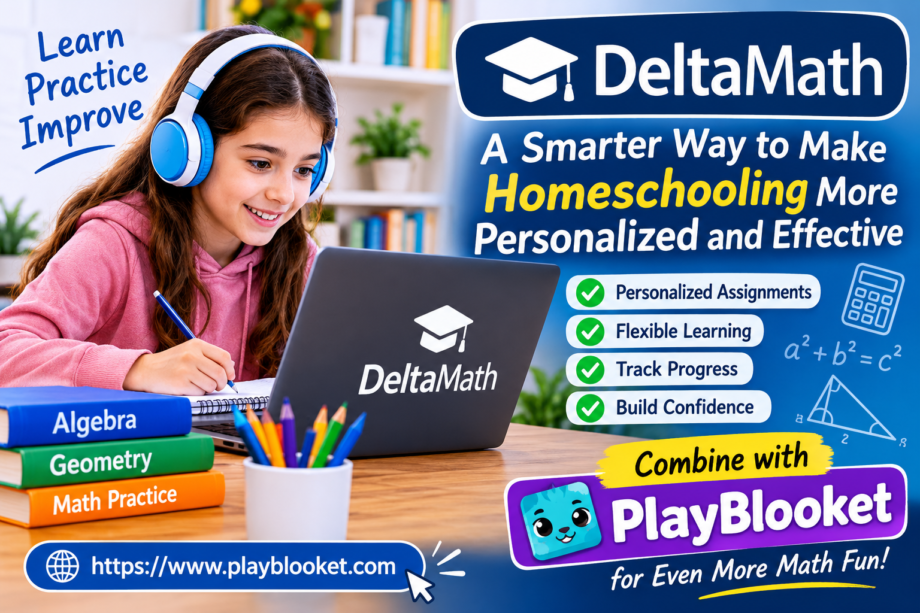
Learning at home offers families something traditional classrooms cannot always provide: the freedom to build an educational experience around a student’s individual needs. Some learners understand mathematical concepts quickly, while others need additional explanations, repeated practice, and time to gain confidence. Finding the right educational tools can make this process easier for both students and parents.
This is where DeltaMath becomes an interesting option for families exploring digital mathematics education. Designed around interactive assignments and personalized practice, the platform gives educators ways to organize problem sets, adjust difficulty, and monitor student progress. Its classroom-focused features can also support structured learning routines outside school.
For homeschooling families, the biggest advantage of digital learning is flexibility. Students can work through mathematical exercises at a manageable pace instead of feeling pressured to follow the same schedule as everyone else. With thoughtful planning, DeltaMath can become part of a home learning environment that encourages consistency, independence, and stronger problem-solving skills.
Understanding the Purpose of DeltaMath
Mathematics is a subject that becomes easier when students combine clear explanations with regular practice. Reading a formula is one thing, but applying it to different problems requires a deeper understanding. Educational technology can help bridge this gap by giving learners opportunities to practice concepts in an organized environment.
DeltaMath is an online mathematics platform primarily designed for teachers and students. Educators can create assignments from different mathematical topics, select problem types, and establish expectations for completing the work. Students then access their assigned activities and practice the skills covered in their lessons.
Rather than relying entirely on printed worksheets, learners can interact with digital questions and receive feedback as they work. This makes it easier to identify areas that require further attention.
For families who homeschool, it is important to understand that the platform is not necessarily a complete standalone curriculum. It works best when combined with teaching materials, explanations, discussions, and other learning resources.
Why Personalized Learning Matters at Home
Every student has a different learning style. One child might enjoy solving algebra problems, while another may struggle with fractions despite understanding basic multiplication. A single teaching method cannot always address these differences effectively.
Personalized education allows parents and educators to adjust learning activities according to a student’s current abilities.
There are several reasons this approach can make home education more productive.
Students Can Learn at Their Own Pace
Some mathematical topics require more attention than others. A student might understand percentages after one lesson but need several practice sessions to become comfortable with equations.
A flexible learning schedule allows students to spend additional time where necessary. Instead of rushing toward the next chapter, they can strengthen their understanding before moving forward.
Practice Becomes More Organized
Without a clear structure, homeschooling can sometimes become difficult to manage. Students may complete exercises inconsistently or forget which topics need revision.
Digital assignments help organize learning activities into manageable tasks. Parents can establish weekly goals and encourage students to complete a reasonable amount of work each day.
Confidence Grows Through Repetition
Making mistakes is a normal part of learning mathematics. However, students sometimes lose confidence when they repeatedly encounter unfamiliar questions.
Regular practice gives them opportunities to recognize patterns, correct mistakes, and improve their approach. Over time, challenging exercises can become less intimidating.
How Teachers Can Customize Mathematical Assignments
One useful feature of DeltaMath is the ability for teachers to create and organize assignments according to their instructional goals.
Instead of giving every student exactly the same collection of questions, educators can select different problem sets and adjust the level of challenge.
This flexibility can also provide useful ideas for homeschooling parents who want to create more structured learning experiences.
Mixing Different Problem Sets
Students benefit from practicing different versions of a mathematical concept. For example, a lesson about fractions can include identifying equivalent fractions, comparing values, and solving addition problems.
Mixing question types prevents students from memorizing one repeated procedure without understanding the underlying concept.
Parents can apply a similar strategy by combining textbook exercises, online activities, and practical examples.
Adjusting the Level of Difficulty
Not every student needs the same level of challenge. Beginners may benefit from straightforward calculations, while more advanced learners may be ready for multi-step problems.
Educators can use assignment settings to select appropriate problem types and levels of rigor.
This approach helps students develop skills gradually rather than introducing unnecessarily difficult material too early.
Managing Due Dates
A learning schedule is useful because it creates clear expectations. However, homeschooling families often need more flexibility than traditional classroom environments.
Teachers can organize assignment deadlines according to their lesson plans. At home, parents can establish similar weekly targets without making every learning activity feel like a stressful deadline.
Building a Successful Mathematics Routine at Home
Technology alone does not guarantee better learning outcomes. Students still need regular instruction, encouragement, and opportunities to apply what they have learned.
Families can create an effective routine by following a few simple practices.
1. Begin With a Learning Goal
Before opening an educational platform, decide what the student should understand by the end of the session.
For example, the goal might be learning how to solve one-step equations or understanding how to calculate percentages.
A specific objective makes the lesson easier to organize and evaluate.
2. Review the Previous Lesson
Spend a few minutes discussing the previous topic. Ask the student to explain important formulas or demonstrate how they solved an earlier problem.
This short review helps identify forgotten concepts before introducing something new.
3. Introduce the Main Concept
Provide a clear explanation before assigning independent exercises. Use examples, diagrams, or everyday situations to make abstract mathematical ideas easier to understand.
For instance, percentages can be introduced through shopping discounts, while fractions can be explained using food portions.
4. Include Interactive Practice
After explaining the topic, students can complete relevant digital exercises. DeltaMath may be useful for reinforcing concepts when an appropriate teacher-created assignment is available.
Encourage learners to read every question carefully instead of rushing to submit answers.
5. Discuss Mistakes
When students answer incorrectly, ask them to explain their reasoning. Sometimes the problem is not a lack of mathematical knowledge but a misunderstanding of the question.
Discussing mistakes helps learners develop stronger problem-solving habits.
6. Finish With a Short Review
At the end of each session, ask students what they found easy and which questions were difficult.
This information can help parents decide what to teach next.
Making Mathematics More Interesting Through Real-Life Examples
One common problem with mathematics education is that students do not always understand how classroom concepts relate to everyday life.
A digital platform can provide practice, but parents can make lessons more meaningful by connecting mathematical ideas to familiar activities.
Consider these examples:
Shopping and budgeting: Ask students to calculate discounts, compare prices, or determine how much money remains after purchasing several items.
Cooking and measurements: Recipes provide practical opportunities to understand fractions, ratios, and measurement conversions.
Travel and distance: Planning a journey can introduce speed, time, distance, and basic calculations.
Sports statistics: Students can calculate averages, percentages, scores, and differences between player performances.
Household projects: Measuring furniture, calculating room areas, and estimating material quantities can make geometry more practical.
Combining these activities with DeltaMath assignments gives students different ways to understand mathematical ideas.
Supporting Different Learning Abilities
Homeschooling families often work with students who have different strengths and weaknesses. Some children are comfortable with numbers but struggle with written explanations. Others understand concepts visually but need additional practice with calculations.
A flexible educational strategy should recognize these differences.
Visual Learners
Visual learners may benefit from graphs, diagrams, number lines, and color-coded examples.
When teaching geometry or algebra, parents can use drawings to demonstrate relationships between different mathematical elements.
Independent Learners
Some students enjoy working through problems without constant supervision. Structured digital assignments can encourage them to take responsibility for completing their work.
Parents should still remain available to answer questions and review progress.
Students Who Need Extra Support
Learners who struggle with a topic may need smaller assignments and additional explanations.
Breaking a difficult chapter into several manageable sections can reduce frustration and make progress easier to recognize.
Using DeltaMath as a practice resource, alongside direct teaching, can help families create a more balanced learning experience.
Helping Parents Monitor Learning Progress
One of the responsibilities of homeschooling parents is understanding whether their teaching approach is working.
Simply completing assignments does not always mean that a student has mastered a topic. Parents should look for evidence of understanding, including the ability to explain methods and solve unfamiliar questions.
A few useful progress-monitoring habits include:
- Reviewing completed assignments regularly.
- Keeping a record of topics that require revision.
- Comparing performance across different practice sessions.
- Asking students to explain how they reached an answer.
- Providing additional exercises when a concept remains difficult.
When teachers use DeltaMath, its assignment and progress features can help them review student performance within the platform.
For homeschooling families, access and available features may depend on the teacher or account arrangement. Parents should check the current platform requirements before making it a central part of their educational routine.
Common Challenges When Using Digital Mathematics Tools
Although online learning offers many advantages, families should also understand its limitations.
Too Much Screen Time
Students who spend several hours using computers may experience tiredness or reduced concentration.
A balanced routine should include breaks, printed exercises, reading, and practical activities away from screens.
Depending Only on Automated Feedback
Instant feedback can be useful, but it does not always replace a teacher’s explanation.
Students should understand why an answer is incorrect instead of simply attempting the same question repeatedly.
Internet and Device Requirements
Digital educational tools generally require a suitable device and reliable internet access.
Families should check technical requirements before scheduling lessons around an online platform.
Lack of Consistency
Without a regular routine, students may postpone assignments or lose track of their learning goals.
Creating a realistic timetable and celebrating small achievements can help maintain motivation.
DeltaMath Compared With Traditional Worksheets
Both digital exercises and printed worksheets have a place in mathematics education. The most effective approach often combines the advantages of each.
Traditional worksheets provide a simple way to practice calculations without requiring internet access. Students can write detailed working steps and keep physical records of completed exercises.
Digital platforms offer a different experience through interactive questions, assignment organization, and online progress monitoring.
DeltaMath can be particularly useful when educators want to organize multiple types of mathematical practice in one environment.
However, worksheets remain valuable for showing detailed working steps and encouraging students to solve problems independently.
The choice should depend on the student’s needs, available resources, and learning objectives rather than assuming one method is always better.
Tips for Getting More Value From Online Math Practice
Families can make digital learning more productive by establishing a few basic habits.
Set realistic daily targets. Completing a small number of carefully selected problems is often more beneficial than rushing through a large assignment.
Encourage independent thinking. Allow students to attempt questions before providing hints or explanations.
Review difficult concepts. Keep a list of topics that cause repeated problems and include them in future lessons.
Use multiple resources. Combine textbooks, educational videos, worksheets, and interactive exercises.
Recognize improvement. Celebrate progress in understanding, not just high scores or completed assignments.
Keep communication open. Students should feel comfortable explaining when a lesson is confusing or an assignment is too challenging.
These habits make DeltaMath and similar educational tools more useful as part of a wider learning strategy.
The Importance of Balancing Technology and Teaching
Modern educational platforms have changed how students practice mathematics. Digital assignments can make learning more organized, but the most important part of education remains the student’s understanding.
A strong homeschooling environment combines technology with personal instruction.
Parents can introduce concepts through conversation, demonstrate solutions on paper, and encourage children to ask questions. Afterward, digital exercises provide another opportunity to apply those ideas.
Teachers can also use DeltaMath to support classroom instruction while giving students additional opportunities to practice outside school.
This combination creates a more complete experience than depending entirely on one educational resource.
Frequently Asked Questions
What is DeltaMath used for?
DeltaMath is an online mathematics platform that allows teachers to create assignments and provide students with opportunities to practice different mathematical concepts.
Can homeschooling students use DeltaMath?
Homeschooling students may be able to use the platform through an appropriate teacher or account arrangement. Families should check current registration requirements and available access options.
Does DeltaMath support personalized learning?
Its assignment customization features allow teachers to select different problem sets and adjust learning expectations. These options can support differentiated instruction.
Is DeltaMath a replacement for a mathematics curriculum?
No. It is best viewed as a practice and assignment resource rather than a complete replacement for structured lessons, textbooks, and teacher guidance.
How can parents help students improve their math skills?
Parents can create consistent study routines, explain difficult concepts, review mistakes, and provide practical examples from everyday life.
Final Thoughts
Successful homeschooling is not about completing the largest number of assignments. It is about helping students develop confidence, understand important concepts, and become independent learners.
Digital educational resources can support this process by making mathematical practice more accessible and organized. With customizable assignments, different problem types, and opportunities for progress monitoring, DeltaMath offers useful features for educators looking to strengthen mathematics instruction.
For families, the best results come from combining interactive exercises with personal teaching, real-world examples, and regular revision. When students receive the right balance of guidance and independence, mathematics can become a more manageable and rewarding subject.
A thoughtful learning routine, supported by suitable educational tools, can make a meaningful difference in a student’s journey toward academic success.
