Introduction
Chemistry becomes much easier to understand when elements are arranged according to their properties and atomic structures. The periodic table provides this organization, helping students, researchers, and science enthusiasts discover connections between different elements. Although some elements are familiar from everyday products, others play important roles behind the scenes in electronics, medicine, manufacturing, and modern technology.
Boron, Silicon, Germanium, Arsenic, Antimony, and Tellurium are particularly interesting because they share several chemical characteristics while behaving differently in important ways. Most of these elements are classified as metalloids, a group known for properties that fall between those of metals and nonmetals. Their positions on the periodic table help explain why they can be useful in applications ranging from computer chips to heat-resistant glass.
Learning about these six elements offers more than a collection of chemical facts. It demonstrates how atomic structure influences physical behavior, how neighboring elements can have different uses, and why the arrangement of elements remains valuable in scientific research.
Understanding the Periodic Table and Its Organization
The periodic table arranges chemical elements by increasing atomic number, which represents the number of protons in an atom’s nucleus. Elements are placed in horizontal rows called periods and vertical columns called groups. Their positions reflect recurring patterns in electron configurations and chemical behavior.
Scientists use these patterns to predict how elements interact, whether they tend to form particular types of bonds, and what kinds of compounds they may produce. Elements in the same group often share chemical similarities, although their properties can change considerably as atomic number increases.
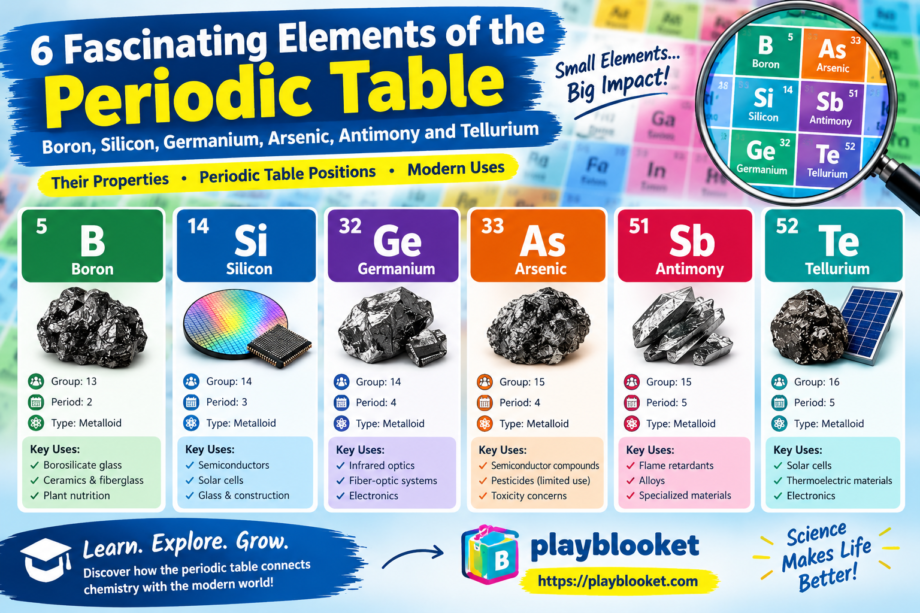
Boron, Silicon, Germanium, Arsenic, Antimony, and Tellurium occupy neighboring regions in the central-right portion of the periodic table. Boron belongs to Group 13, silicon and germanium belong to Group 14, arsenic and antimony belong to Group 15, and tellurium belongs to Group 16.
These elements are often discussed together because several exhibit metalloid characteristics. However, the classification of an element as a metalloid is not completely standardized. Different educational references may classify certain borderline elements differently.
The periodic table is therefore more than a list of chemical symbols. It is a framework that connects atomic structure with observable properties and helps explain why these six elements are important in modern materials science.
1. Boron: A Small Element with Remarkable Strength
Boron is a chemical element with the symbol B and atomic number 5. It is relatively light, but its compounds can be exceptionally hard, heat-resistant, and chemically useful. On the periodic table, boron occupies Group 13 and Period 2.
Pure boron is a dark, brittle solid that does not behave like a typical metal. Its chemistry is strongly influenced by its three valence electrons, which allow it to form a wide variety of compounds. Boron chemistry is especially interesting because many boron compounds feature unusual bonding arrangements.
Important Uses of Boron
One of the best-known applications of boron is the production of borosilicate glass. This material resists thermal shock better than ordinary glass, making it useful in laboratory equipment, cookware, and specialized industrial containers.
Boron compounds also appear in detergents, ceramic materials, fiberglass, and certain agricultural products. Boron is an essential micronutrient for plants because it contributes to cell wall development and normal growth. However, the difference between a beneficial amount and a harmful excess can be relatively small.
Some boron-containing materials are extremely hard. Boron carbide, for example, is used in selected protective and abrasive applications because of its hardness and low density.
The periodic table helps explain boron’s position between metals and nonmetals, but its unusual chemistry becomes clearer when scientists examine its bonding and compounds. Boron demonstrates how a lightweight element can contribute to materials designed for demanding conditions.
2. Silicon: The Foundation of Modern Electronics
Silicon, represented by Si, has atomic number 14 and belongs to Group 14. It is one of the most significant elements in modern technology. Although silicon is abundant in Earth’s crust, it is rarely found naturally as a pure element because it readily combines with oxygen and other elements.
On the periodic table, silicon sits directly below carbon. Both elements have four valence electrons, allowing them to form stable covalent bonds. However, their physical and chemical characteristics differ because silicon atoms are larger and form different structures and compounds.
Why Silicon Matters
Silicon is the primary material used in most conventional semiconductor devices. When carefully purified and processed, it can be used to manufacture integrated circuits, computer processors, memory chips, and many electronic components.
Its electrical conductivity can be controlled by introducing small quantities of selected impurities, a process known as doping. This makes it possible to create the p-type and n-type regions needed for semiconductor devices.
Silicon is also essential to solar technology. Photovoltaic cells commonly use silicon to convert sunlight into electrical energy. Its abundance, established manufacturing methods, and suitable electronic properties have helped make silicon solar panels widely available.
Another important silicon compound is silicon dioxide, which occurs naturally in quartz and is a major component of sand. Silicon-containing materials are also used in glass, cement, ceramics, and construction products.
Studying silicon on the periodic table reveals why its four valence electrons are so important. Its position helps connect its chemical bonding to the electronic properties that make modern computing possible.
3. Germanium: A Semiconductor with Specialized Applications
Germanium, with the chemical symbol Ge and atomic number 32, belongs to Group 14. It appears below silicon on the periodic table, and both elements share important chemical similarities because they occupy the same group.
Germanium is a grayish-white, brittle metalloid. It was identified in the nineteenth century, and its discovery helped demonstrate the predictive power of the periodic arrangement of elements. Dmitri Mendeleev had predicted the existence and approximate properties of an element that would later be identified as germanium.
The Role of Germanium in Technology
Germanium is a semiconductor, meaning its electrical conductivity lies between that of a good conductor and a typical insulator under relevant conditions. Its behavior changes with temperature, impurities, and the structure of the material.
Early semiconductor electronics relied heavily on germanium. Silicon later became more widely used for many mainstream applications because it offers advantages in manufacturing and device performance, particularly at higher operating temperatures.
Germanium remains valuable in specialized technologies. Certain germanium compounds and materials are used in fiber-optic systems, infrared optics, and high-performance electronic components. Germanium-containing optical materials can transmit infrared radiation in ways that ordinary glass cannot.
Germanium is also used in some solar applications, including specialized multijunction solar cells designed for demanding environments such as spacecraft.
Its location beneath silicon on the periodic table helps explain their related chemistry, while differences in atomic size and electronic structure account for their different technological roles.
Germanium illustrates an important principle: an element does not need to dominate an entire industry to remain scientifically and commercially valuable. Sometimes its greatest contribution comes from specialized applications where its properties offer a distinct advantage.
4. Arsenic: A Useful but Highly Toxic Element
Arsenic has the chemical symbol As and atomic number 33. It belongs to Group 15 and is commonly described as a metalloid. Its position on the periodic table places it near phosphorus and antimony, elements with related chemical characteristics.
Arsenic has a complicated reputation because certain arsenic compounds have useful industrial applications, while many forms of inorganic arsenic are highly toxic. Understanding the difference between chemical forms is essential when discussing its behavior and environmental effects.
Applications and Environmental Concerns
Historically, arsenic compounds have been used in pesticides, wood preservatives, pigments, and various industrial processes. Many of these applications have been restricted or replaced because of health and environmental risks.
Arsenic also has a role in semiconductor technology. Gallium arsenide, a compound made from gallium and arsenic, is used in selected high-frequency electronic devices, light-emitting technologies, and specialized solar cells. Its electronic properties make it useful in applications where conventional silicon devices may not offer the same performance.
However, arsenic exposure must be taken seriously. Contaminated groundwater is a major source of exposure in some regions. Long-term ingestion of inorganic arsenic can cause serious health problems, including an increased risk of certain cancers.
Arsenic’s location on the periodic table helps explain some of its chemical similarities to neighboring elements, but its toxicity depends on the compound, oxidation state, exposure route, and amount involved.
This element demonstrates why chemistry must consider both potential benefits and risks. A substance can be valuable in carefully controlled industrial applications while requiring strict safety measures to protect people and the environment.
5. Antimony: A Metalloid Used in Alloys and Materials
Antimony, symbol Sb, has atomic number 51 and belongs to Group 15. Its symbol comes from the Latin name stibium. On the periodic table, antimony appears below arsenic and above bismuth.
Antimony is a brittle, silvery-gray element that can display a metallic appearance. Despite its appearance, it does not behave like many common structural metals. Its most important applications often involve compounds or mixtures with other materials.
Where Antimony Is Used
One major use of antimony compounds is in flame-retardant systems. Antimony trioxide has traditionally been used with certain halogen-containing materials to help improve fire resistance. These applications are subject to safety and environmental requirements, and alternatives are used in some products.
Antimony is also used in selected alloys. Adding it to lead can improve hardness and mechanical performance, which has made antimony-containing lead alloys useful in particular industrial applications, including some battery components.
Other antimony compounds are used in specialized glass, ceramics, and electronic materials. Its properties can be valuable when manufacturers need specific performance characteristics rather than the behavior of a pure metal.
The periodic table places antimony in the same group as arsenic and nitrogen, but its larger atomic structure contributes to differences in bonding and physical behavior. These changes across a group are important for understanding why related elements are not interchangeable.
Antimony also requires responsible handling. Some antimony compounds can pose health risks, and the hazards depend on their chemical form and exposure conditions. Industrial use therefore requires appropriate controls and waste management.
6. Tellurium: A Rare Element with Modern Potential
Tellurium, represented by Te, has atomic number 52 and belongs to Group 16. It is generally classified as a metalloid and is located near selenium and polonium on the periodic table.
Tellurium is relatively rare in Earth’s crust and is often obtained as a byproduct of processing copper and other metal ores. It has a silvery appearance and can form compounds with a range of useful electronic and chemical properties.
Tellurium in Energy and Electronics
One of tellurium’s important applications is in cadmium telluride, a semiconductor material used in thin-film solar panels. These photovoltaic technologies provide an alternative to conventional crystalline silicon panels and are manufactured for utility-scale and other solar installations.
Tellurium is also used in certain thermoelectric materials. Thermoelectric devices can convert a temperature difference into electrical energy or use electrical current to create heating and cooling. Tellurium-containing compounds are valuable in some of these specialized systems.
Other applications include selected metal alloys, electronic materials, and chemical manufacturing. Adding small amounts of tellurium to certain metals can improve machinability or influence other material properties.
The periodic table helps place tellurium in context because its relationship to selenium and other Group 16 elements reveals recurring patterns in chemical behavior. However, tellurium’s relatively large atoms and distinctive solid-state properties give it its own industrial identity.
As demand for renewable energy and advanced electronics grows, tellurium remains an important material to study. Its supply is connected to the production of other metals, which means availability, recycling, and resource efficiency can influence its long-term use.
Comparing the Six Elements
The six elements share some characteristics, but each has a distinct chemical identity. Their positions on the periodic table provide a convenient starting point for comparing them.
- Boron (B): Atomic number 5; Group 13. Important in borosilicate glass, boron carbide, and plant nutrition.
- Silicon (Si): Atomic number 14; Group 14. Widely used in semiconductors, solar cells, glass, and construction materials.
- Germanium (Ge): Atomic number 32; Group 14. Useful in infrared optics, fiber-optic systems, and specialized electronics.
- Arsenic (As): Atomic number 33; Group 15. Used in selected semiconductor compounds, but many inorganic forms are highly toxic.
- Antimony (Sb): Atomic number 51; Group 15. Used in certain flame-retardant systems, alloys, and specialized materials.
- Tellurium (Te): Atomic number 52; Group 16. Important in cadmium telluride solar cells and selected thermoelectric materials.
These differences show how an element’s atomic number and group relate to its properties. They also demonstrate that neighboring elements can serve very different purposes in technology and industry.
Why These Elements Matter in Everyday Life
People may rarely encounter pure boron, germanium, arsenic, antimony, or tellurium directly, but their compounds can be present in products and technologies that influence daily life.
Silicon supports the semiconductor industry, allowing smartphones, computers, and countless electronic devices to function. Boron-containing glass helps laboratories and kitchens use materials that withstand changing temperatures. Germanium compounds support specialized optical systems, while tellurium contributes to some solar-energy technologies.
Antimony compounds have roles in selected manufacturing processes, including some fire-protection applications. Arsenic compounds are important in specific semiconductor technologies, although their use requires careful control because of their toxicity.
The periodic table makes it easier to understand how these materials connect chemistry with engineering. Rather than memorizing isolated facts, learners can examine the elements’ positions, electron configurations, and recurring chemical patterns to understand why each material is suited to particular applications.
This perspective is especially useful for students studying materials science, environmental chemistry, electronics, or renewable energy. It connects classroom concepts with technologies and challenges in the real world.
How to Study These Elements More Effectively
A practical way to learn these six elements is to combine their positions on the periodic table with their properties and real-world uses.
First, memorize each symbol and atomic number. Boron is B, silicon is Si, germanium is Ge, arsenic is As, antimony is Sb, and tellurium is Te. Remembering these basic details makes it easier to locate each element and compare it with its neighbors.
Second, learn the group numbers. Silicon and germanium share Group 14, while arsenic and antimony belong to Group 15. Their shared group positions help explain recurring patterns in valence electrons and chemical behavior.
Third, connect each element to one major application. For example, associate boron with heat-resistant glass, silicon with computer chips, germanium with infrared optics, arsenic with specialized semiconductors and toxicity concerns, antimony with selected flame-retardant systems, and tellurium with thin-film solar technology.
Finally, use a blank periodic table to test your knowledge. Locate each element, identify its group and period, and explain one similarity or difference between it and a neighboring element. This active approach encourages understanding instead of simple memorization.
Conclusion
Boron, silicon, germanium, arsenic, antimony, and tellurium demonstrate the variety of properties found among elements in neighboring regions of the periodic table. Some are essential to mainstream electronics, others support specialized optical or energy technologies, and several contribute to important industrial materials.
Their similarities arise partly from their positions and electron configurations, while differences in atomic structure, bonding, and chemical form determine their individual behavior. Understanding these relationships helps explain why scientists use particular elements for particular purposes.
The periodic table remains one of chemistry’s most useful tools because it organizes complex information into a structure that reveals patterns. By studying these six elements together, learners can develop a clearer understanding of chemistry, modern technology, material selection, and the importance of using chemical substances safely and responsibly.
