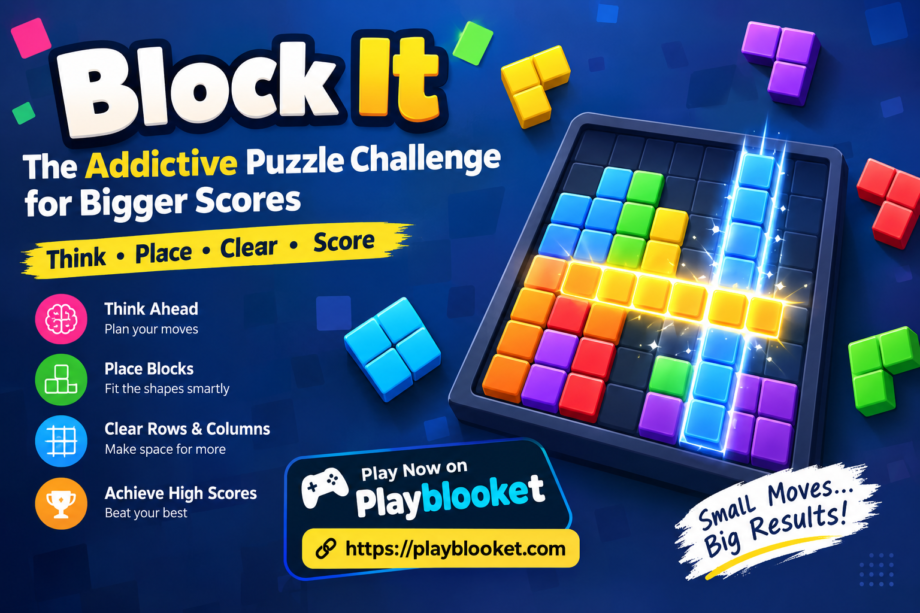
Some games need complicated controls, detailed stories, and hours of tutorials before they become interesting. Others can explain almost everything through a simple board and a handful of shapes. That simplicity is one of the biggest reasons block puzzle games continue to attract players of all ages. Block It belongs to that enjoyable category, offering an easy-to-understand experience while leaving plenty of room for thoughtful strategy.
The concept is straightforward. Players receive different shapes and must position them carefully on a board. Whenever a complete row or column is created, the filled line disappears, opening valuable space for new pieces. The objective is to continue making smart placements, clear as many lines as possible, and build a score that beats previous attempts.
At first, the game can feel incredibly simple. After a few rounds, however, the real challenge starts to appear. Empty spaces become important, awkward shapes become difficult to manage, and one careless placement can change the entire board. Block It becomes especially interesting when players stop thinking about individual moves and begin considering how each placement will affect the next several turns.
That combination of simple mechanics and strategic decision-making gives the game its lasting appeal.
Why Block It Is So Addictive
The appeal of Block It comes from a familiar gaming formula: easy rules combined with difficult mastery. You can understand the basic objective almost immediately, but achieving consistently high scores requires practice.
Every new piece creates a decision. A shape might fit into several locations, but only one of those positions may leave enough useful space for future pieces. Choosing the wrong location can create small gaps, block an important section, or make a larger shape almost impossible to place later.
This creates a constant cycle of decision and reward.
You place a piece, complete a line, watch the board open up, and then receive another shape. That new shape changes your options again. The process continues until there are no practical placements left.
The experience can become surprisingly absorbing because each round feels like a small challenge against your previous performance.
Understanding the Basic Gameplay
The central mechanics of Block It are simple enough for almost anyone to understand.
You receive block shapes that can be placed on an open board. The shapes may vary in size and arrangement. Your job is to find suitable positions for them without creating an unmanageable board.
When you complete an entire horizontal row or vertical column, that line is cleared. The empty spaces created by the clearance allow you to continue playing.
The important point is that clearing lines serves two purposes.
First, it contributes toward your score. Second, and often more importantly, it creates additional room.
That second benefit becomes increasingly important during longer rounds. A board with plenty of open space gives you more choices, while a crowded board limits your options.
This means that successful gameplay is not simply about placing every available shape. It is about placing each shape in a way that keeps the board useful.
The Value of Empty Space
One of the biggest lessons players discover while playing Block It is that empty space has value.
New players sometimes see a large open area and immediately try to fill it. While filling spaces is necessary eventually, using an area too quickly can create problems later.
Imagine receiving a large shape several turns from now. If you have already filled the only suitable area with smaller pieces, the large shape may have nowhere to go.
For that reason, experienced players often protect certain sections of the board.
A large open area can accommodate many different shapes. A narrow opening might only accept one particular arrangement. Therefore, two boards with the same number of empty squares can have completely different levels of flexibility.
The better board is usually the one that gives you more future options.
Think Before You Place a Block
The fastest move is not always the smartest move.
Before placing a piece, take a quick look across the entire board. Consider where the shape could fit and what each possible placement would create.
Ask yourself:
- Can this placement complete a row?
- Can it help finish a column?
- Will it block a useful area?
- Does it create an awkward gap?
- Where could a larger future piece go?
- Will the board still have several flexible spaces afterward?
These questions do not need to become complicated. With practice, they can become part of your normal playing rhythm.
A few seconds of thought can prevent a mistake that would otherwise end the round several turns later.
Building Rows and Columns Efficiently
The main objective in Block It is to complete rows and columns, but not every line clearance has the same strategic value.
A single completed row may provide some points and a little additional space. However, preparing multiple lines can produce a much more valuable result.
For example, suppose two rows are both missing only a few squares. A carefully selected shape might complete one while also helping prepare the second.
This creates a chain of useful decisions.
Rather than clearing lines whenever possible, try to identify opportunities where one placement can improve several parts of the board.
At the same time, avoid becoming so focused on combinations that you ignore the overall condition of the board. A complicated setup is not useful if it leaves you with no room for the next shape.
Balance is essential.
Keep Large Areas Available
Large pieces can become difficult when the board is crowded.
One effective strategy is to maintain at least one reasonably open section that can accommodate different shapes. This does not mean leaving half the board empty throughout the entire game. Instead, it means avoiding unnecessary fragmentation.
A board filled with isolated holes can be harder to manage than a board with fewer but larger open spaces.
When placing smaller shapes, consider whether they are dividing an open area into several unusable sections.
This becomes especially important as the game progresses.
During the early part of a round, you can usually afford to make imperfect decisions. Later, every available space matters much more.
Avoid Creating Awkward Gaps
Small gaps are one of the biggest problems in block puzzle games.
A single empty square may not seem important, but several isolated gaps can quickly reduce your available options. If the incoming shapes do not match those spaces, they may remain unused for a long time.
Players should therefore think about the shape of the empty area, not just its size.
A connected empty region generally offers more possibilities than the same number of squares scattered around the board.
When possible, place blocks in ways that preserve useful open sections.
This simple habit can significantly improve consistency.
Block It Strategy: Look Beyond the Current Move
A strong Block It strategy involves thinking at least one or two moves beyond the piece currently available.
You cannot always predict what shape will appear next, but you can prepare the board so that different possibilities remain available.
Suppose you have a large empty region in one corner and several smaller openings elsewhere. It may be tempting to use the large region immediately. However, keeping it open could be safer if you have recently received several small pieces.
The goal is not to predict the future perfectly.
Instead, the goal is to avoid making a move that leaves you dependent on one specific future shape.
Flexibility is more reliable than prediction.
Why Rushing Can Hurt Your Score
Some players naturally speed up when they become comfortable with the controls. While quick decisions can feel satisfying, rushing can cause unnecessary mistakes.
A piece may appear to fit perfectly in one location, only for you to realize afterward that another placement would have created a line clearance.
Taking a moment to examine alternatives can make a major difference.
This is particularly true when the board contains several nearly completed rows or columns. A single placement might trigger a useful clearance, while another placement might destroy the opportunity.
A calm approach often produces better results than simply trying to play as quickly as possible.
Learning From Bad Moves
Every unsuccessful round can teach you something.
When Block It ends earlier than expected, think about what caused the problem. Was the board filled with isolated gaps? Did you use an important open area too early? Did you focus on immediate points instead of maintaining flexibility?
Reviewing mistakes helps turn experience into improvement.
For example, if you repeatedly struggle when large shapes appear, you may need to protect larger open areas earlier in your games.
If you often have several nearly completed lines but cannot finish them, you may need to reconsider how you distribute pieces across the board.
Improvement comes from recognizing these patterns.
Common Mistakes Beginners Should Avoid
Filling Every Available Space
An empty area is not automatically a problem. Sometimes leaving it open is the smartest choice.
Ignoring Future Shapes
Although you cannot know every upcoming piece, you can still preserve spaces capable of accepting different shapes.
Creating Narrow Corridors
Very narrow openings may become useful for only one type of piece. Too many of them can reduce your options.
Chasing Points Too Aggressively
Immediate points can be attractive, but maintaining a healthy board is usually more important during longer rounds.
Forgetting About Columns
Some players naturally focus on horizontal rows and overlook vertical opportunities. Always examine both directions.
Blocking the Center
The center of the board can be strategically valuable because many shapes can interact with it. Filling it without a plan may restrict future placements.
A Beginner-Friendly Approach
If you are new to Block It, do not worry about achieving an enormous score immediately.
Start by learning how different shapes interact with the board.
During your first few rounds, focus on keeping large areas open and completing straightforward rows or columns. Avoid complicated combinations until you feel comfortable judging available space.
As you gain experience, begin looking for opportunities where one placement can contribute to multiple potential clears.
Eventually, you will start recognizing useful patterns without consciously calculating every possibility.
That is when the game becomes much more enjoyable.
How to Improve Your High Score
Improving your score requires more than simply playing repeatedly.
Try changing one part of your strategy at a time.
For one session, concentrate on keeping the center open. During another, focus on creating larger connected areas. In another round, pay close attention to potential double clears.
This approach helps you understand which habits improve your performance.
It also prevents practice from becoming repetitive.
A high score usually develops from several small improvements working together rather than one secret trick.
Better placement, stronger awareness, smarter line clearing, and patience all contribute.
The Psychology Behind the “One More Game” Feeling
Why can such a simple game keep players coming back?
Part of the answer is the immediate feedback. Completing a row gives you a visible result. Clearing several lines can feel particularly satisfying. Seeing the score rise creates a natural reason to continue.
Another factor is personal improvement.
You may finish a round knowing that one different decision could have produced a much higher score. That creates curiosity about what might happen during the next attempt.
This is one reason Block It can turn a short break into a longer gaming session.
The rules remain simple, but every new board presents a different puzzle.
Using Practice to Recognize Patterns
Pattern recognition is one of the most useful skills in block puzzles.
After playing enough rounds, you begin to recognize dangerous arrangements almost immediately.
You notice when a board is becoming too fragmented. You learn which gaps are difficult to use. You become better at spotting nearly completed lines.
This experience reduces the amount of conscious calculation required.
Instead of asking whether a particular arrangement is safe every time, you begin recognizing its strengths and weaknesses automatically.
That is one of the clearest signs that your skills are improving.
Managing Difficult Shapes
Not every piece will arrive at the perfect moment.
Sometimes a large or unusual shape appears when the board is already crowded. These moments test your earlier decisions.
If you have maintained flexible areas, you may still have several possibilities. If the board is filled with narrow gaps, the same shape can become extremely difficult to place.
This is why good strategy is often about preparation.
You cannot control every shape you receive, but you can control the condition of your board when that shape arrives.
That distinction is extremely important.
Creating Multiple Opportunities
A useful Block It technique is to avoid relying on one possible move.
Suppose you have three open regions where a new piece might fit. Even if one looks slightly better, keeping the other areas available gives you additional options for future shapes.
The strongest positions often provide several possible placements.
If a board forces you to place every new shape in exactly one location, your flexibility is already low.
Try to maintain alternative options whenever possible.
This does not mean avoiding line clears. It means clearing lines while preserving useful space.
When to Take a Risk
Sometimes a high score requires a calculated risk.
You may have an opportunity to create a large clearance, but doing so could leave the board in an awkward configuration if the next pieces are unfavorable.
Whether the risk is worthwhile depends on the current state of the board.
If you have plenty of open space, experimenting may be reasonable. If the board is already crowded, a safer move may be better.
Good players learn to distinguish between a calculated risk and an unnecessary gamble.
Playing for Consistency
Not every round needs to produce a record-breaking score.
Consistent gameplay can be more valuable than occasional lucky runs.
If you repeatedly reach a reasonable score before the board becomes difficult, that suggests your basic strategy is working. From there, you can focus on improving specific weaknesses.
For example, perhaps you manage the early game well but struggle during crowded situations. Your practice should then focus on late-game positioning rather than starting over with basic mechanics.
This targeted approach can accelerate improvement.
Why Simple Games Can Have Deep Strategy
The simplicity of Block It should not be confused with a lack of depth.
The rules are limited, but the number of possible board arrangements can create countless decisions.
Every placement changes the available space. Every cleared line changes the shape of the board. Every new piece introduces another set of possibilities.
That is enough to create a continuously changing puzzle.
The game does not need dozens of features to remain interesting because the challenge is generated naturally by the board itself.
Making Each Round More Interesting
Players can create personal challenges to keep their sessions fresh.
Try setting a target score and attempting to beat it without rushing. Another option is to focus on clearing multiple lines efficiently.
You could also challenge yourself to keep certain areas open for as long as possible.
These personal goals turn ordinary rounds into skill-building exercises.
They also provide a sense of progress even when you are not setting a new overall record.
A Strong Mindset for Better Results
The best approach is to treat every move as part of a larger plan.
Instead of thinking, “Where can I put this shape?” think, “Which placement gives me the best future options?”
Instead of thinking, “Can I clear this row?” ask, “What happens to the rest of the board after I clear it?”
These small changes in perspective can make your gameplay more strategic.
You do not need to become an expert immediately. The important thing is to develop better habits one round at a time.
Final Thoughts
Block It demonstrates why block puzzle games remain so popular. The rules are easy enough for a new player to understand, but the board creates enough strategic possibilities to keep experienced players interested.
The key is not simply placing blocks wherever they fit. Strong gameplay involves managing space, protecting flexible areas, recognizing rows and columns that can be completed, and thinking about future possibilities.
Keep large areas available when possible. Avoid unnecessary gaps. Do not rush difficult decisions. Most importantly, remember that a move should be judged by what it creates as well as what it accomplishes.
With practice, the board starts to look different. Instead of seeing individual empty squares, you begin seeing patterns, potential clears, and future opportunities.
That change in perspective is what makes Block It more than a basic time-killing puzzle. It becomes a small strategic challenge where every move matters.
Whether you play for a few minutes during a break or spend a longer session chasing a personal record, the appeal remains the same: place the blocks carefully, clear the lines, protect your space, and see how far your next smart decision can take you.
The next time you start a round, take your time, study the board, and think one move ahead. Your highest score may be waiting behind a placement that you would have overlooked before.
