
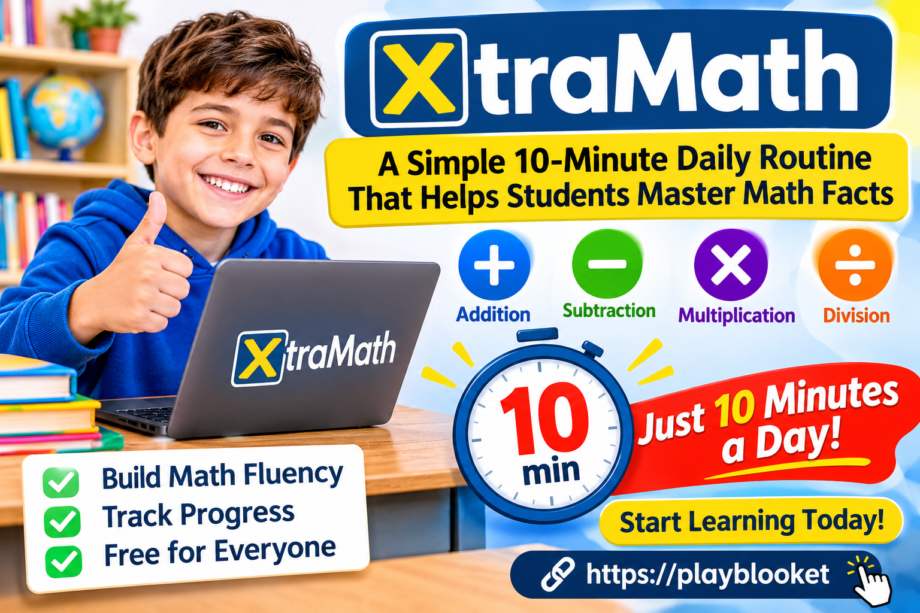
Learning mathematics is not always about solving complicated equations or understanding advanced formulas. Sometimes, the biggest challenge for students is remembering basic math facts quickly and accurately. Addition, subtraction, multiplication, and division are essential skills that support almost every area of mathematics. When students struggle with these basic operations, even simple classroom activities can become frustrating.
This is where XtraMath can make a meaningful difference. It is a free educational program designed to help students develop stronger arithmetic fluency through short, focused practice sessions. Instead of asking children to spend hours repeating worksheets, the program encourages a manageable daily routine that takes approximately ten minutes.
The idea behind this approach is straightforward: regular practice helps students become more comfortable with numbers. As they improve their ability to recall basic facts, they can spend less time thinking about individual calculations and more time understanding how mathematics works.
For parents and teachers looking for a practical way to support elementary math learning, this type of structured practice can be a useful addition to regular classroom instruction.
What Is XtraMath and How Does It Help Students?
XtraMath is a free online math practice program that focuses on building fluency in four fundamental arithmetic operations: addition, subtraction, multiplication, and division. Its primary purpose is to help students remember basic math facts accurately without needing to count on their fingers or repeatedly work through lengthy calculations.
The platform uses short exercises to introduce questions, track responses, and measure progress over time. Students answer individual problems while the program records how accurately and quickly they respond.
Unlike traditional worksheets, which often contain a large collection of problems on a single page, the program provides an interactive experience. Students can work through questions on a computer or another supported device.
The learning process is designed around repetition and gradual improvement. Students begin with the skills they need to practice and continue working until their responses become more consistent.
The main goal is not simply to finish a certain number of questions. It is to develop a stronger understanding of basic arithmetic so students can approach more advanced mathematics with confidence.
Why Ten Minutes of Daily Math Practice Matters
Children do not always need long study sessions to improve a particular skill. In many situations, shorter learning activities can be easier to manage and repeat consistently.
A ten-minute daily routine gives students an opportunity to practice without making mathematics feel like an overwhelming responsibility.
There are several reasons why this approach can be effective.
1. Regular Practice Builds Familiarity
When students encounter similar types of questions regularly, they become more familiar with number combinations and arithmetic patterns.
For example, a child who frequently practices addition may eventually recognize that 7 + 8 equals 15 without having to count each number individually.
This familiarity develops through repeated exposure and active participation.
2. Short Sessions Are Easier to Maintain
A long worksheet can sometimes discourage younger learners, particularly after a full school day.
A short session feels more manageable. Parents can include it in an existing homework routine, while teachers can use it as part of a classroom activity.
Because the daily commitment is relatively small, students may find it easier to develop a consistent habit.
3. Students Can Recognize Their Improvement
Progress becomes more encouraging when learners can see that their performance is changing.
A structured practice program can help students recognize improvements in their accuracy, response time, and overall familiarity with arithmetic.
These small achievements can encourage children to continue learning.
4. Better Fluency Supports Advanced Mathematics
Basic arithmetic is used in fractions, measurements, percentages, word problems, and many other mathematical topics.
Students who remember fundamental calculations more easily may have more attention available for understanding the larger problem.
For this reason, XtraMath focuses on skills that remain important throughout a student’s mathematical education.
How Does XtraMath Work?
The program follows a structured learning process that adjusts practice according to each student’s performance. Rather than presenting every question in the same order, it uses spaced repetition to bring back facts that need additional attention.
Here is how the learning process generally works.
Step 1: Students Receive an Appropriate Starting Level
When students begin, their existing knowledge is considered so that practice can start at a suitable level. Teachers and parents can use the available program settings to support different learning needs.
Younger children may begin with basic addition, while students with stronger arithmetic skills can work toward more advanced operations.
Step 2: Students Answer Math Questions
During each session, learners see individual arithmetic questions and enter their answers. The program records whether the response was correct and how long the student needed to answer.
For example, students might see questions such as:
-
6 + 9 = 15
-
14 − 8 = 6
-
7 × 8 = 56
-
36 ÷ 6 = 6
These examples represent the kinds of basic calculations students practice as they develop stronger recall.
Step 3: The Program Identifies Areas That Need Practice
One useful feature of XtraMath is its ability to recognize which facts students already remember and which ones require more attention.
If a learner struggles with certain multiplication facts, those questions can appear again during future practice sessions.
This approach prevents students from spending all their time answering questions they already know. Instead, practice remains focused on developing weaker areas.
Step 4: Students Gradually Build Fluency
Progress is based on mastery rather than simply completing a fixed number of questions.
As students demonstrate consistent accuracy and meet the program’s fluency requirements, they can progress through their assigned operations.
The goal is to make basic calculations increasingly automatic through repeated practice.
home.xtramath.org+1
Four Essential Math Skills Students Can Practice
Basic arithmetic includes four operations, and each one plays an important role in everyday mathematics.
XtraMath provides practice opportunities for all four, helping students strengthen the calculations they will use in school and beyond.
Addition: Developing Number Confidence
Addition is usually one of the first mathematical skills children learn. It helps students understand how numbers combine to create larger amounts.
For example, adding 12 and 8 gives 20. While this calculation may seem simple, students who are still learning number combinations can benefit from repeated practice.
Developing addition fluency makes it easier to work with larger numbers, measurements, and everyday calculations.
Subtraction: Understanding the Difference Between Numbers
Subtraction teaches students how to find the difference between two quantities.
Questions such as 15 − 7 or 20 − 9 help children recognize relationships between numbers.
This operation is particularly useful when working with money, measuring objects, comparing quantities, and solving word problems.
Regular practice helps learners become more comfortable with subtraction without relying on counting backward every time.
Multiplication: Recognizing Number Patterns
Multiplication introduces students to repeated addition and number patterns.
Learning multiplication tables can initially feel challenging, especially when children encounter facts involving larger numbers.
For example, remembering that 8 × 7 equals 56 becomes easier with consistent practice.
As students improve their multiplication recall, they can approach division, fractions, and other mathematical topics with greater confidence.
Division: Building a Foundation for More Complex Problems
Division involves separating quantities into equal groups. It is closely connected to multiplication, which makes understanding multiplication facts helpful when learning division.
For example, knowing that 6 × 4 equals 24 can help a student understand that 24 ÷ 6 equals 4.
Practicing these relationships gives students a stronger foundation for handling more complicated calculations.
How Parents Can Introduce XtraMath at Home
Parents play an important role in developing positive learning habits. Even when children receive regular mathematics instruction at school, additional practice at home can help reinforce what they have learned.
The key is to make practice feel like a normal part of the day rather than another stressful homework assignment.
Here are some practical ways to introduce the program into a family routine.
Choose a Consistent Practice Time
Select a time when your child is generally comfortable and focused. Some families prefer practicing after school, while others find that a short session after breakfast works better.
Consistency matters more than choosing a perfect time.
A regular ten-minute session can become a familiar daily habit when parents keep the schedule simple.
Create a Comfortable Learning Space
Children should have a quiet place where they can concentrate without unnecessary distractions.
A computer or supported device, a stable internet connection, and a comfortable seating arrangement are usually enough to get started.
Parents do not need to create a complicated classroom environment at home.
Encourage Effort Instead of Speed Alone
One important point is that faster answers should not become the only measure of success.
Some children need additional time to become comfortable with basic calculations. Encouraging accuracy and understanding can help them develop confidence without feeling pressured.
When a child makes mistakes, parents can use those moments to review the underlying number relationship.
Celebrate Small Improvements
A child who previously struggled with addition may begin answering familiar questions correctly.
That progress deserves recognition, even if the student has not completed an entire operation.
Positive feedback can make learning more enjoyable and encourage children to maintain their practice routine.
Why Teachers May Find XtraMath Useful in the Classroom
Teachers work with students who have different learning abilities, confidence levels, and mathematical backgrounds. Some children remember basic calculations quickly, while others need additional opportunities to practice.
A structured digital program can provide another way to support these differences.
XtraMath allows educators to incorporate short arithmetic practice sessions into their existing classroom schedules.
Supporting Individual Learning Progress
Students do not necessarily develop mathematical fluency at the same speed.
Some may already understand addition but need more practice with subtraction. Others might be ready to strengthen multiplication and division skills.
The program’s adaptive practice approach helps students work on facts according to their demonstrated progress.
Monitoring Student Performance
Progress information can help teachers understand how students are performing during their practice sessions.
Rather than relying only on completed worksheets, educators can review available reports to identify patterns in accuracy and response times.
This information may help teachers decide which skills need additional classroom attention.
Saving Classroom Time
A short digital activity can fit into different parts of the school day.
For example, teachers might schedule practice during morning activities, independent learning periods, or mathematics rotations.
This makes it possible to reinforce arithmetic skills without replacing the main mathematics lesson.
Supporting Different Grade Levels
The program is designed primarily for elementary learners, but older students who need additional arithmetic practice may also benefit.
A student who has difficulty recalling multiplication facts, for example, may need to strengthen those basics before moving confidently into more advanced calculations.
The program is a supplementary practice resource, not a replacement for teacher-led instruction.
home.xtramath.org+1
Getting Started With XtraMath
For families and educators who want to explore the platform, getting started is relatively straightforward.
The following steps provide a simple overview.
-
Visit the official website: Open XtraMath’s official website.
-
Create an account: Follow the available registration instructions for your role as a parent or teacher.
-
Add student information: Set up the learner’s profile using the requested details.
-
Choose an appropriate program: Begin with the recommended practice level and available arithmetic operations.
-
Start daily sessions: Encourage the student to complete short practice activities regularly.
-
Review progress: Use the available reports to understand which skills are improving and which need more attention.
Students who already have school accounts should follow their teacher’s login instructions. Using the correct account can help ensure that practice information remains connected to the appropriate classroom.
XtraMath+1
Is XtraMath Enough to Teach All of Mathematics?
Although XtraMath can help students improve arithmetic fluency, it is important to understand what the program is designed to accomplish.
It focuses on recalling basic math facts. It is not a complete mathematics curriculum and does not independently teach every mathematical concept.
For example, a student might memorize multiplication facts but still need instruction to understand fractions, decimals, geometry, or algebra.
That is why digital practice should be combined with other learning activities.
Parents can use everyday situations to introduce mathematical thinking. Shopping trips, cooking measurements, counting objects, and simple money calculations provide opportunities to apply classroom knowledge.
Teachers can also combine digital practice with explanations, group activities, worksheets, and hands-on exercises.
When students understand both how to solve a problem and how to recall the necessary facts, they develop a more complete mathematical foundation.
Practical Tips for Making Daily Math Practice Successful
Even a useful educational resource works best when students approach it with a positive attitude.
A few simple habits can make regular practice more productive.
-
Keep sessions consistent: Encourage a regular schedule instead of practicing only before tests.
-
Avoid unnecessary pressure: Children should feel supported rather than rushed.
-
Review difficult questions: Discuss mistakes and explain number relationships when needed.
-
Use additional activities: Combine digital practice with puzzles, flashcards, and everyday calculations.
-
Watch for frustration: If a child becomes tired or discouraged, take a break and return later.
-
Recognize progress: Celebrate improvements in accuracy, confidence, and consistency.
Parents should also remember that every child learns differently. Some students become comfortable with multiplication quickly, while others need more time.
The purpose of daily practice is to develop stronger skills gradually, not to make every student progress at exactly the same speed.
Common Challenges Students May Experience
Not every student immediately enjoys timed arithmetic exercises. Some children feel nervous when they see a countdown, while others become frustrated when they receive an unfamiliar question.
Parents and teachers can make the experience easier by explaining that mistakes are part of learning.
It is also helpful to remember that speed develops over time. Students should first understand the calculations before focusing heavily on answering them quickly.
If a learner repeatedly struggles with a particular operation, additional explanation and hands-on practice may be necessary.
XtraMath works best when students already understand the basic mathematical concepts behind the questions. Its role is to strengthen recall, not replace the instruction needed to understand how calculations work.
home.xtramath.org+1
Frequently Asked Questions
1. Is XtraMath free for students?
Yes. The standard program offers free access for families and teachers. Optional paid plans provide additional features and customization, but students can use the standard practice program without purchasing a subscription.
XtraMath Pro & Fluency Intelligence+1
2. How much time should students spend practicing?
Approximately ten minutes per day is the recommended routine. Short, consistent sessions help students practice regularly without making arithmetic feel like an exhausting activity.
3. Which mathematical operations are included?
Students can practice addition, subtraction, multiplication, and division. The assigned program determines which operations they work on and how their practice progresses.
4. Can parents monitor their child’s progress?
Yes. Parents and educators can use the available progress information to understand a student’s performance, identify areas that need improvement, and recognize learning milestones.
Final Thoughts
Developing strong mathematical skills begins with understanding the basics. Students who can recall addition, subtraction, multiplication, and division facts more confidently have a valuable advantage when approaching more complicated mathematical challenges.
XtraMath offers a straightforward way to strengthen these essential skills through short, structured daily sessions. Its focus on repetition, individual progress, and gradual mastery makes it a practical supplementary resource for families and classrooms.
The most important part of the experience is consistency. Just ten minutes of focused practice each day can give students regular opportunities to improve their arithmetic fluency and become more comfortable working with numbers.
With encouragement from parents and teachers, students can turn a small daily activity into a positive learning habit that supports their mathematical development for years to come.
