
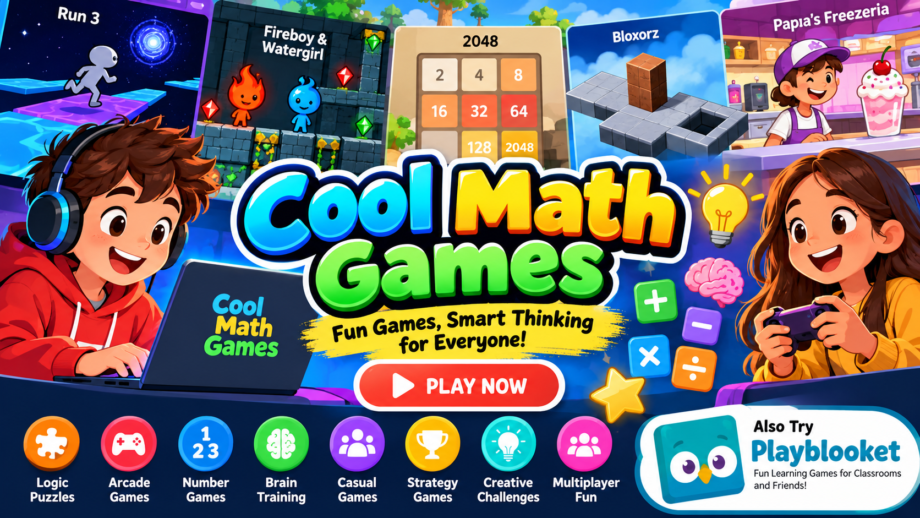
Online gaming is no longer just about fast action, intense competition, or complicated controls. Sometimes, the most enjoyable experiences come from simple challenges that encourage players to think, experiment, and discover new solutions. That is exactly why cool math games have become a popular choice for people who enjoy entertainment with a little mental exercise.
From clever logic puzzles to colorful arcade adventures, Coolmath Games offers a collection of casual games that can keep players entertained during short breaks or longer gaming sessions. Whether you are a student looking for an enjoyable challenge, a parent exploring family-friendly entertainment, or an adult who loves solving puzzles, there is plenty to discover.
The beauty of these games is their accessibility. You do not need advanced mathematical knowledge, expensive equipment, or years of gaming experience to get started. Many challenges focus on observation, timing, planning, and creative thinking rather than traditional classroom calculations.
In this detailed guide, we will explore the different categories, popular titles, possible cognitive benefits, and practical strategies that make this gaming platform worth exploring.
What Are Cool Math Games?
Cool math games refer to a collection of browser-based activities that combine entertainment with problem-solving, logic, strategy, and casual gameplay. The well-known Coolmath Games website provides access to many titles, ranging from simple number challenges to complex puzzle adventures.
Despite the name, not every game involves mathematical equations. Some focus on movement, others require careful planning, and many challenge players to identify patterns or make quick decisions.
The platform is especially appealing because its games generally have straightforward controls and easy-to-understand objectives. Players can often begin within seconds without downloading large software packages.
The main attraction is the combination of entertainment and mental engagement. Instead of simply watching something happen, players must interact with the game, test ideas, and adjust their strategies.
Why Cool Math Games Are Popular Among Different Age Groups
The popularity of cool math games comes from their ability to offer different experiences for different players.
Younger players may enjoy colorful characters, simple controls, and short levels. Teenagers often appreciate challenging puzzles, competitive scores, and games that require strategic thinking. Adults may prefer relaxing logic games or classic arcade experiences that bring back memories of earlier gaming.
Another important advantage is convenience. Many browser games can be played without installing additional applications, although individual titles may have different technical requirements.
The games also offer a sense of progress. Completing a difficult level, discovering a shortcut, or improving a previous score can make even a short session rewarding.
Unlike games built entirely around long stories, many casual puzzles allow players to stop and return later without losing track of complicated narratives.
15 Amazing Ways Cool Math Games Can Make Your Free Time More Enjoyable
There are many reasons players continue returning to puzzle and casual gaming websites. The following fifteen features and activities explain their lasting appeal.
1. Explore Exciting Logic Puzzles
Logic puzzles are among the most recognizable attractions of cool math games.
These challenges encourage players to evaluate situations carefully before taking action. Some require moving objects into specific positions, while others involve opening pathways, activating switches, or identifying the correct sequence of steps.
A successful solution often depends on understanding how different elements interact.
Rather than randomly clicking, players benefit from observing the entire puzzle and predicting what might happen after each move.
2. Enjoy Classic Arcade Adventures
Arcade-style games remain popular because they are easy to learn but can become surprisingly challenging.
Players may need to avoid obstacles, collect objects, reach checkpoints, or navigate increasingly difficult environments.
Games such as Run 3 demonstrate how simple movement mechanics can create engaging challenges.
As the difficulty increases, players learn to anticipate obstacles and adjust their timing.
These experiences are especially suitable for short gaming breaks because individual attempts often take only a few minutes.
3. Challenge Yourself With Number Puzzles
Number-based activities are a natural part of cool math games.
These puzzles may involve arithmetic, numerical patterns, sequencing, or combining values to reach a target.
For example, a player might need to arrange numbered tiles in a particular order or determine which mathematical operation produces the desired result.
The goal is not necessarily to solve difficult equations. Many games introduce simple concepts through interactive challenges.
Number puzzles can make familiar mathematical ideas feel more approachable, especially when they provide immediate feedback.
4. Practice Strategic Decision-Making
Strategy games encourage players to think beyond their next move.
Instead of reacting immediately, successful players consider available resources, possible consequences, and alternative approaches.
A game might require deciding which upgrade to purchase, which path to follow, or how to protect an important objective.
These decisions introduce basic concepts of planning and prioritization.
Even when a strategy fails, the experience provides information that can improve the next attempt.
5. Discover Creative Physics Challenges
Physics-based puzzles add another dimension to cool math games.
These activities use concepts such as gravity, momentum, movement, and object interaction.
Players might launch an object toward a target, construct a path, or determine how different materials affect movement.
The rules are usually simplified for entertainment, but the challenges encourage experimentation.
A player may discover that changing an angle slightly produces a completely different result.
This trial-and-error process is part of what makes physics puzzles enjoyable.
6. Improve Your Timing With Skill Games
Some games are less about solving complicated puzzles and more about mastering precise actions.
Timing challenges may require jumping at the right moment, stopping a moving object, or navigating a narrow passage.
The controls can be simple, yet success depends on practice.
Players gradually become more familiar with movement patterns and develop better control within the game.
Skill-based challenges are particularly satisfying when a difficult level finally becomes manageable after several attempts.
7. Enjoy Relaxing Casual Games
Not everyone wants an intense gaming experience.
One reason cool math games appeal to a broad audience is the availability of casual activities that emphasize enjoyment over competition.
Relaxing games may feature straightforward objectives, colorful environments, and manageable difficulty.
Some allow players to progress at their own pace without constant time pressure.
These activities can provide a pleasant change of pace after studying, working, or completing daily responsibilities.
Choosing a calmer game is especially useful when the goal is simply to unwind.
8. Test Your Memory and Observation
Memory games challenge players to remember locations, sequences, symbols, or patterns.
Observation challenges may ask players to identify differences, recognize visual clues, or notice small changes in an environment.
These activities reward attention to detail.
A player who rushes may overlook an important clue, while someone who studies the screen carefully may discover a simpler solution.
Although gaming alone does not guarantee broad improvements in memory, these activities provide enjoyable opportunities to practice specific recall and observation tasks.
9. Experience Cooperative Puzzle Adventures
Some of the most entertaining cool math games involve coordinating multiple characters or working with another player.
Fireboy and Watergirl is a well-known example of a puzzle-platforming series built around cooperation and character-specific abilities.
Players must consider how one character’s actions affect the other.
A switch activated by one character might open a path for the second, while certain hazards require careful movement.
These challenges reward communication, patience, and coordination when played together.
They also demonstrate how teamwork can turn a complicated problem into a manageable task.
10. Learn Through Trial and Error
One of the most valuable features of puzzle gaming is the freedom to experiment.
Players can try an approach, observe the outcome, and make changes when necessary.
A failed attempt is not always wasted effort. It may reveal how a particular obstacle works or why a certain strategy is ineffective.
This encourages an iterative approach to problem-solving.
For example, if a character repeatedly falls while attempting a difficult jump, the player can adjust the timing, distance, or movement pattern.
Over time, the process becomes more deliberate.
11. Discover Different Game Categories
The variety available through cool math games helps prevent the experience from becoming repetitive.
A player who enjoys logic puzzles today might prefer racing challenges tomorrow.
Common categories include:
- Logic and thinking puzzles
- Arcade and platform adventures
- Number and arithmetic activities
- Strategy and planning games
- Memory and observation challenges
- Physics-based puzzles
- Casual skill games
- Multiplayer and cooperative activities
Each category provides a different style of entertainment.
Exploring several genres can also help players discover interests they did not previously recognize.
12. Play Games With Simple Controls
Complicated controls can discourage beginners, particularly those unfamiliar with online gaming.
Many browser games avoid this problem by using only a few keys or mouse actions.
Movement might involve the arrow keys, while other games rely on clicking, dragging, or tapping.
Simple controls allow players to focus on the challenge rather than memorizing complicated instructions.
However, easy controls do not necessarily mean easy gameplay.
A game with only one or two actions can still require considerable patience and precision.
13. Enjoy Short Gaming Sessions
Another advantage of cool math games is their suitability for short periods of free time.
Some players have only five or ten minutes available between responsibilities.
A quick puzzle or arcade level can fit into that schedule without requiring a major commitment.
This flexibility makes casual gaming convenient for people with busy routines.
Players should still manage their screen time and avoid allowing entertainment to interfere with schoolwork, sleep, exercise, or other priorities.
A short, intentional session is often more enjoyable than playing without a clear stopping point.
14. Explore Challenges That Encourage Creativity
Creative thinking becomes important when a puzzle has an unusual solution.
Sometimes the obvious approach does not work, and players must reconsider their assumptions.
They may need to use an object differently, combine several actions, or approach a problem from another direction.
These moments make puzzle games particularly rewarding.
Instead of following a fixed set of instructions, players discover possibilities through experimentation.
Creative challenges can also encourage discussion when friends or family members compare different solutions.
15. Build Confidence Through Gradual Progress
The final reason cool math games remain appealing is the satisfaction of overcoming challenges.
Many games introduce simple mechanics before presenting more difficult situations.
This progression allows players to become familiar with the rules and develop their skills.
Completing a challenging level can create a genuine sense of achievement.
Progress does not always mean reaching the final stage. Sometimes improving a score, understanding a mechanic, or solving one difficult puzzle is enough to make the experience worthwhile.
Popular Games Worth Exploring
The Coolmath Games platform includes many recognizable titles. The following examples highlight several different gameplay styles.
Run 3: Navigate a Challenging Space Environment
Run 3 is a platforming game in which players guide a character through a series of tunnels and pathways in space.
The challenge involves avoiding gaps, navigating changing surfaces, and adapting to increasingly complex environments.
Players must combine quick reactions with an understanding of movement.
The game is appealing because its basic mechanics are accessible while later stages demand more careful control.
Fireboy and Watergirl: Solve Puzzles Together
Fireboy and Watergirl challenges players to guide two characters through environments filled with obstacles and interactive mechanisms.
Each character has different strengths and limitations.
Success requires understanding those differences and using them to solve puzzles.
The series is especially enjoyable for players who appreciate cooperation and thoughtful planning.
Papa’s Freezeria: Manage a Busy Dessert Shop
Papa’s Freezeria introduces a different kind of challenge.
Players prepare frozen desserts according to customer orders while managing several stages of the process.
Attention to detail, sequencing, and time management are central to the experience.
The game demonstrates that casual entertainment does not always require jumping, racing, or mathematical calculations.
Bloxorz: Think Before Every Move
Bloxorz is a logic puzzle in which players move a rectangular block across a platform toward a designated opening.
Each movement changes the block’s position and orientation.
A poorly planned move can send the block off the platform.
The challenge encourages players to visualize movement and consider several steps ahead.
For puzzle enthusiasts, this type of gameplay can be particularly satisfying.
2048: Combine Numbers Strategically
2048 is a number-merging puzzle that challenges players to combine matching tiles.
As tiles merge, their values increase.
The objective is to reach a tile with the value 2048, although players may continue beyond that point in some versions.
Success requires more than random movement.
Players benefit from keeping the board organized, preserving useful spaces, and planning future combinations.
Can Cool Math Games Help Develop Thinking Skills?
Many people are interested in cool math games because they combine entertainment with activities that involve mental effort.
Certain puzzles require attention, working memory, spatial reasoning, or planning. Others involve recognizing patterns or making decisions under time pressure.
These tasks can provide practice in the specific skills used during gameplay.
However, it is important to distinguish between practicing a skill inside a game and demonstrating improvements in unrelated real-world activities.
Playing a logic puzzle does not automatically make someone better at every type of problem-solving.
The benefits depend on the game, the player, the amount of practice, and whether the learned strategies transfer to other situations.
For students, games can be a useful supplement to learning when they reinforce relevant concepts.
They should not replace structured lessons, reading, physical activity, or meaningful social interaction.
How to Get Started With Cool Math Games
Getting started with cool math games is generally straightforward.
First, open a modern web browser and visit the official website at https://www.playblooket.co/
Browse the available categories or use the website’s search feature to find a particular title.
After selecting a game, read its instructions and identify the controls.
Some titles use keyboard commands, while others rely on mouse or touchscreen input.
Begin with a simple level to understand the mechanics before attempting more difficult challenges.
If a game does not load correctly, check your browser compatibility, connection, and device requirements.
Not every title works identically across desktop computers, tablets, and smartphones.
It is also wise to use the official website rather than unfamiliar imitation sites that may contain misleading downloads or advertisements.
Tips to Become Better at Puzzle and Logic Games
Enjoying cool math games becomes easier when players develop a thoughtful approach.
Understand the Objective First
Before making a move, identify what the game requires.
Is the goal to reach a destination, collect an object, solve an equation, or survive a difficult section?
Understanding the objective helps prevent unnecessary mistakes.
Observe Before Acting
Take a moment to study obstacles, patterns, and available tools.
Some puzzles provide important clues through colors, movement, or object placement.
Break Difficult Problems Into Smaller Steps
A complicated level may become manageable when divided into individual tasks.
Focus on completing one section before worrying about the entire challenge.
Experiment With Different Strategies
If one approach repeatedly fails, try something different.
Changing the order of actions or using another route may reveal a better solution.
Take Breaks When Frustrated
Repeated failure can make it harder to concentrate.
Stepping away briefly may help players return with a fresh perspective.
Focus on Enjoyment Rather Than Perfect Scores
Improvement is rewarding, but gaming should remain enjoyable.
Not every level needs to be completed immediately, and not every score needs to be beaten.
Cool Math Games for Students, Parents, and Teachers
The educational appeal of cool math games depends largely on how they are selected and used.
Students may enjoy interactive challenges that reinforce arithmetic, sequencing, or logical thinking.
Parents can explore age-appropriate activities with their children and discuss how particular puzzles are solved.
Teachers may use selected games as supplementary classroom activities when they align with specific learning objectives and school policies.
For example, a number puzzle might support practice with numerical relationships, while a cooperative challenge could encourage students to explain their reasoning.
Adults should review individual games before recommending them to younger players.
The presence of the word “math” in a website’s name does not mean every title is directly educational or suitable for every age.
Thoughtful selection makes the experience more meaningful.
Are Cool Math Games Free to Play?
Many cool math games are available to play for free through the platform’s website.
This accessibility is one reason browser-based gaming attracts a wide audience.
However, the platform may offer advertisements, optional paid features, or subscription services, and these details can change over time.
Players should check the official website for current information about premium access and individual game availability.
It is also important to remember that free entertainment can still involve data collection, advertising, and website policies.
Parents should review relevant privacy information and supervise younger users where appropriate.
Common Mistakes Players Should Avoid
Even simple games can become frustrating when players develop unhelpful habits.
One common mistake is rushing through instructions. Skipping the explanation of a game’s mechanics can create unnecessary confusion.
Another mistake is repeating the same unsuccessful strategy without considering alternatives.
Players should also avoid focusing entirely on speed when a puzzle requires careful observation.
Ignoring breaks is another issue. Long gaming sessions may contribute to fatigue and reduce enjoyment.
Finally, players should be cautious about unofficial websites promising unlimited rewards, modified games, or special cheats.
Such sites may expose users to unwanted downloads or security risks.
The Future of Browser-Based Puzzle Gaming
The continued interest in cool math games reflects a broader demand for accessible, lightweight entertainment.
Modern web technologies have made it possible to create interactive experiences that run directly in compatible browsers.
As devices and browsers improve, developers can experiment with new visual styles, game mechanics, and accessibility features.
Future puzzle games may offer more adaptive challenges, improved mobile controls, and additional ways for players to collaborate.
However, the core appeal is unlikely to disappear.
Simple games built around clever ideas can remain entertaining without requiring enormous worlds or complicated systems.
A memorable puzzle often succeeds because of its design rather than its technical complexity.
Frequently Asked Questions
1. What is the main purpose of Coolmath Games?
The platform provides casual entertainment through puzzles, arcade adventures, strategy activities, and other interactive games. Some titles involve mathematical thinking, while others focus on different gameplay skills.
2. Are these games suitable for children?
Many titles may be appropriate for younger players, but suitability varies. Parents and teachers should review individual games, advertisements, and website policies before recommending them.
3. Do all games require mathematical knowledge?
No. Many titles involve timing, movement, observation, logic, or strategy rather than traditional mathematics.
4. Can I play on a mobile phone?
Some games support mobile browsers or touchscreen controls. Compatibility depends on the individual title and device.
5. What are some popular puzzle games to try?
Run 3, Bloxorz, Fireboy and Watergirl, and 2048 are recognizable examples that offer different types of challenges.
6. Can playing puzzle games improve concentration?
Puzzle activities require attention during gameplay and may help players practice specific concentration-related tasks. Broader improvements outside the game are not guaranteed.
7. Is an account required to play?
Many browser games can be accessed without creating an account, although certain features or services may have additional requirements.
Final Thoughts
Cool math games offer an enjoyable combination of casual entertainment, creative puzzles, strategy challenges, and interactive problem-solving.
Their biggest strength is variety. Players can explore number puzzles, test their reactions in arcade adventures, experiment with physics challenges, or enjoy cooperative activities with friends.
For students, these games can supplement selected learning experiences. For adults, they can provide a convenient form of entertainment during free time. For families, certain titles create opportunities to play and solve problems together.
The key is choosing appropriate games, maintaining balanced screen habits, and approaching challenges with curiosity rather than frustration.
Whether you enjoy solving difficult puzzles or simply want a fun activity for a short break, the world of browser-based gaming offers plenty of possibilities.
Start with a game that interests you, learn its mechanics, and enjoy discovering new challenges one level at a time.
